


Current global poverty landscape
Kharas and Dooley in this commentary highlight the recent trends in global poverty:
- In December 2020, China declared it had eliminated extreme poverty completely;
- In India strong economic growth drove poverty rates down to 77 million, or 6% of the population, in 2019. It is expected that by 2030, India is likely to essentially eliminate extreme poverty, with less than 5 million people living below the $1.90 line;
- In Latin America, poverty fell rapidly at the beginning of this century but has been rising since 2015, with no substantial reductions forecast by the end of this decade;
- In Africa, poverty has been rising steadily, thanks to rapid population growth and stagnant economic growth. The pandemic has induced a rise of 11% in poverty while prospects for African poverty to decline by 2030 are slim;
- By 2030 the top 10 countries by poverty headcount will be found in sub-Saharan Africa in fragile and conflict-affected states such as Nigeria, Democratic Republic of the Congo, Mozambique and Somalia.
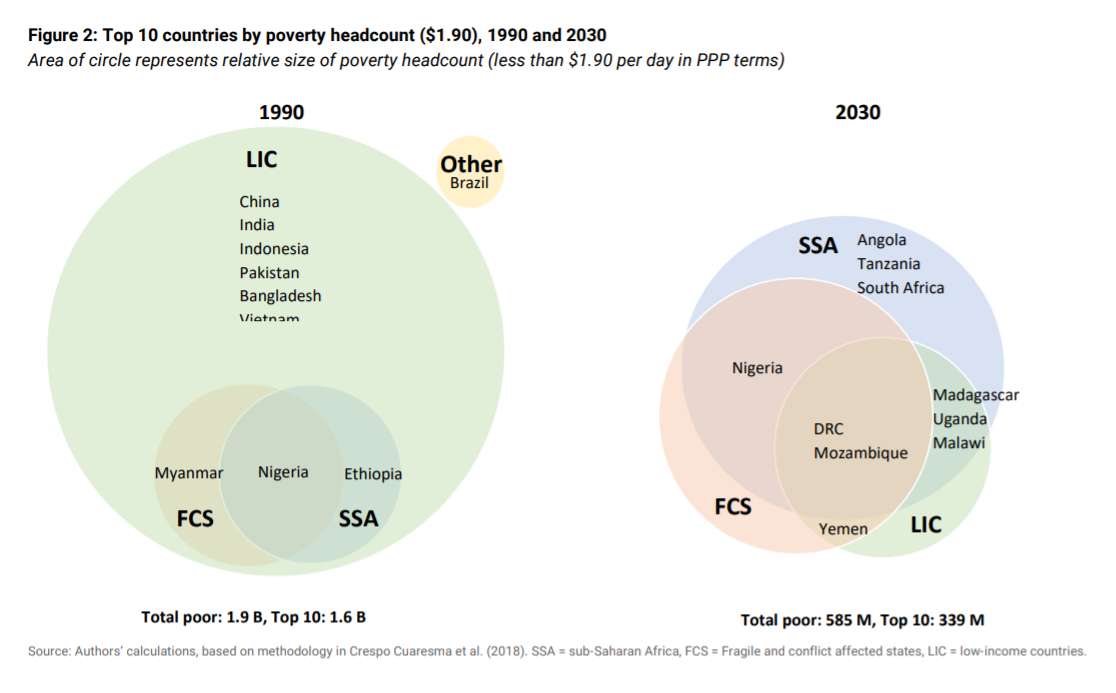
The evolution of global poverty, 1990-2030
By: Homi Kharas, Meagan Dooley – Brookings
New tools to measure global poverty
Michail Moatsos in this paper explains that there are now two new sources of price data that have become available and provide the possibility to measure global poverty in terms of specific consumption baskets, which can include not only food and other consumables, but also utilities and services.
- The first source is the availability of price data from the periodical World Bank’s ICP rounds that estimate the Purchasing Power Parities for almost all the economies around the globe, in recent years. This source has been used in estimating the cost and the affordability of health diets based
on the EAT–Lancet framework. - The second source is the retail prices for food stuff, energy and utilities from the October Inquiry of the International Labour Organization (ILO).
Using these two data sets he finds that:
[G]lobal poverty in terms of a consumption basket that includes a healthy diet, and frugal additional expenses per Allen (2017)1, for example 3 square meters per person, has –at least since 1820– been higher in comparison to the dollar-a-day findings. The divergence between the two approaches has an increasing trend since 1990. The number of individuals living in conditions of poverty according to the the EAT–Lancet based poverty lines has increased by more than threefold since 1820, to reach almost 2.7 billion in 2018.
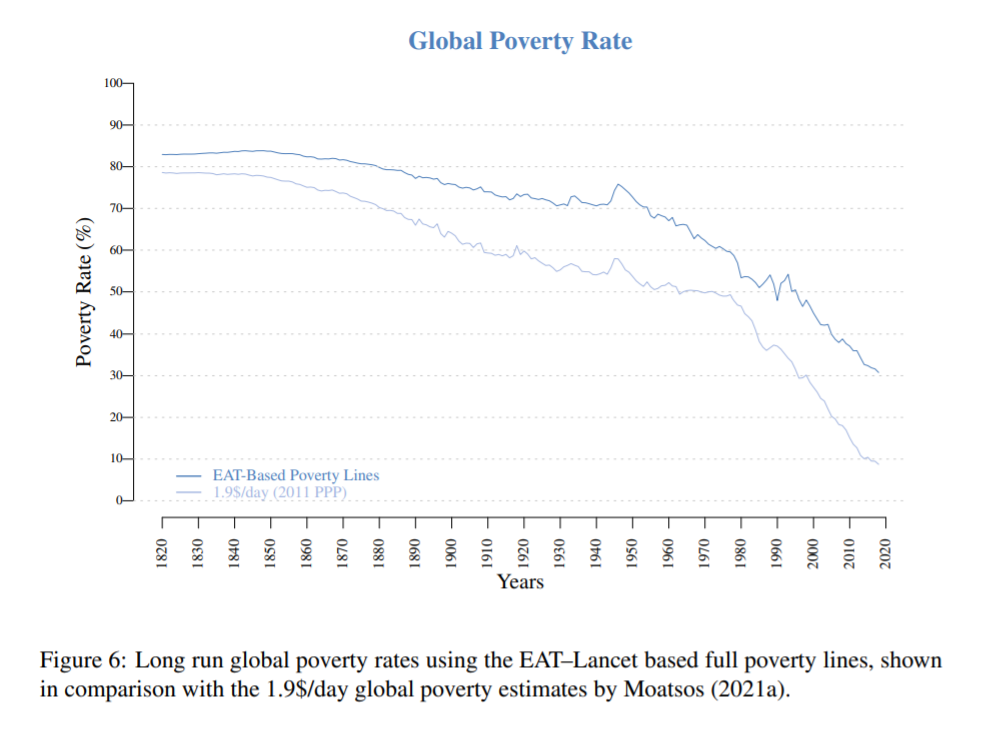
Confidence Intervals and Long-Run Trends in Food Prices, the Cost of Basic Needs, and Global Poverty
Author: Michail Moatsos
From: Utrecht University
1 Allen, R. C. (2017). Absolute poverty: When necessity displaces desire. American Economic Review, 107(12):3690–3721.
