


Employer concentration and wage inequality in cities
Hugo Lhuillier uses French matched employer-employee data to analyze wage inequality both between and within cities. The author estimates job wage premia (the extra pay associated with specific jobs, controlling for worker characteristics) using a two-way fixed effects model. The study documents where high- and low-paying jobs are located and how workers’ wages evolve as they switch jobs. A spatial model is developed where productive employers choose to locate in large cities to grow bigger, facing local labor market frictions and competition for workers. The model is quantitatively estimated to separate the effects of employer sorting, search frictions, and local productivity differences (TFP).
Key findings
- Empirical facts:
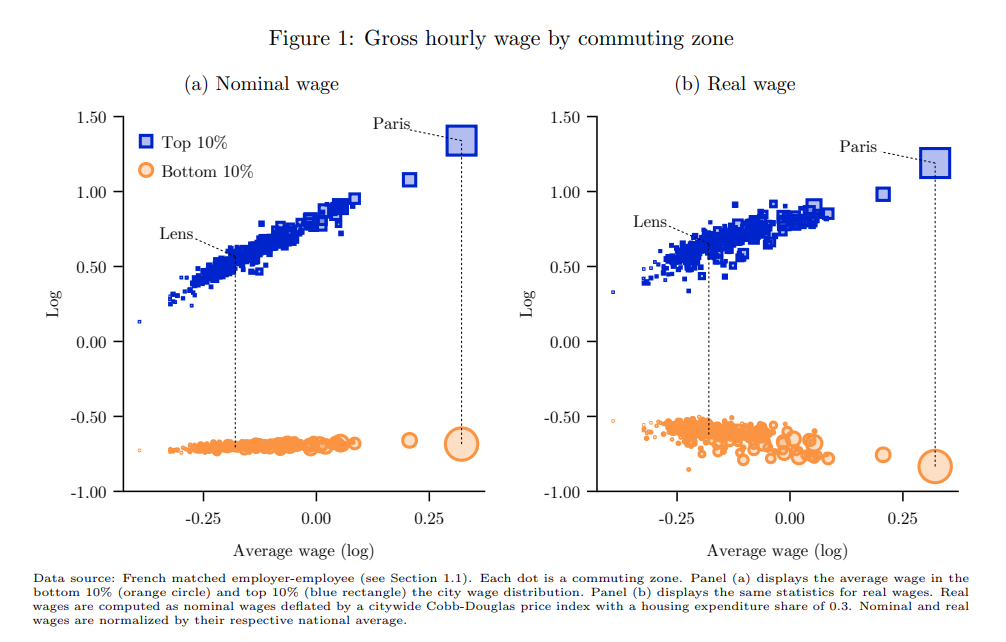
– Fact 1: High-paying jobs are disproportionately concentrated in large cities, while low-paying jobs are spread throughout all cities. For example, 17.9% of jobs in Paris are in the top 10% of the national job wage premia distribution, compared to only 6.9% in a median city like Lens. Low-paying jobs are equally present everywhere.
– Fact 2: Wage gains from large cities accrue over time, not at entry. Starting wages for similar workers are nearly identical across cities, but the “job ladder” in large cities is steeper—job switchers in big cities experience higher wage growth than those in smaller cities. This dynamic accounts for most of the between-city wage variance. - Role of employers:
The spatial sorting of productive employers into large cities, driven by their desire to sidestep search frictions and grow larger, is the primary source of higher average wages and greater wage inequality in those cities. This sorting explains both the higher average wage premia and the greater within-city wage dispersion observed in large urban areas. - Model validation and quantification:
The estimated model shows that local TFP differences explain only a small fraction (about 3%) of the between-city wage premia variance. Instead, employer sorting and local labor market competition account for the bulk of observed wage disparities. The model replicates the empirical findings: high-paying jobs are clustered in large cities, low-paying jobs are ubiquitous, and the wage ladder is steeper in bigger cities. - Policy-relevant implications:
The model predicts that all workers—including those with initially low real wages—enjoy higher lifetime real earnings in large cities due to faster wage growth. However, if job mobility slows (e.g., due to higher search frictions), the comparative advantage of large cities diminishes for both workers and employers, reducing spatial wage disparities and city size.
The Local Root of Wage Inequality
Author: Hugo Lhuillier
From: University of Chicago
