



The AI infrastructure buildout: productive investment, financial leverage, and systemic risk
Stijn Van Nieuwerburgh treats AI not primarily as a software revolution but as an unprecedented physical-capital and financing cycle involving data centers, specialized chips, electricity generation, cooling, and grid infrastructure. Rather than estimating a single causal model, the paper combines several approaches:
- A bottom-up engineering estimate of the cost of a representative AI campus, covering data-center construction, power infrastructure, GPUs, networking, storage, and systems integration.
- Project-level data on operating, under-construction, and planned US data centers to construct scenarios for capacity completed by 2032; the author adjusts for cancellations, delays, missing capacities, and cost inflation.
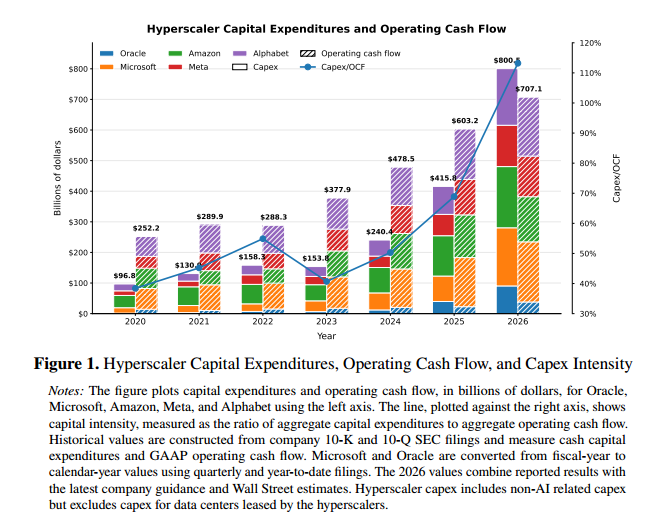
- Company filings, guidance, and market estimates to compare hyperscalers’ capital expenditures with their operating cash flows and trace the growing use of external finance.
- A detailed case study of Meta’s Hyperion project to illustrate joint ventures, special-purpose vehicles, leases, guarantees, and high project-level leverage.
- Scenario calculations of the revenues required to make the investment viable, comparisons with previous US infrastructure booms, and an analysis of changing stock-market betas for publicly traded data-center REITs.
Findings
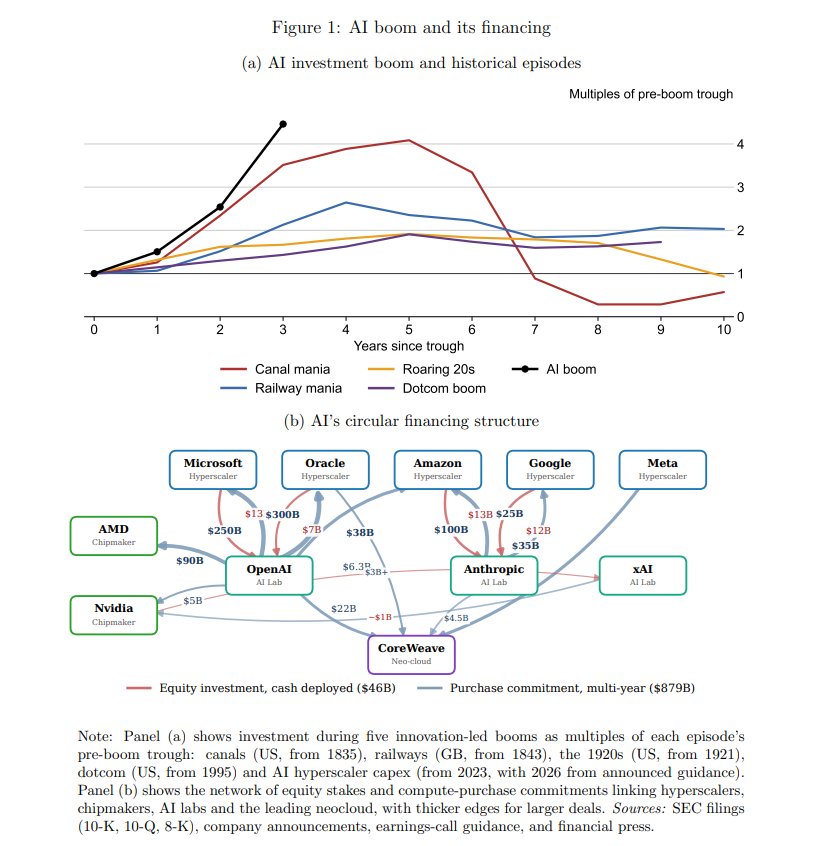
- A representative 1 GW AI campus is estimated to cost approximately $41 billion. Under the paper’s central scenario, 188 GW of new US capacity becomes operational during 2025–2032, requiring nearly $9 trillion of investment, averaging about 3.2% of GDP annually. This is larger relative to GDP than earlier US railroad, electrification, highway, and telecommunications booms.
- As hyperscaler capital expenditure exceeds internally generated cash flow, financing is moving toward leases, joint ventures, project debt, private credit, securitization, and special-purpose vehicles. These structures expand investment capacity but can relocate leverage outside technology companies’ reported balance sheets, make contingent obligations harder to observe, and concentrate risk among investors dependent on the same tenants and asset values.
- The economic viability of the buildout depends on exceptionally strong demand. Under the central assumptions, the capacity completed by 2032 would need approximately $3.55 trillion in mature annual revenue to earn a 10% unlevered return at a 50% operating cash-flow margin. The investment could therefore generate transformative productive capacity, but weaker utilization, falling compute prices, technological obsolescence, construction delays, or shorter hardware lives would substantially increase downside risk.
- Stijn Van Nieuwerburgh does not conclude that a systemic crisis is imminent. The warning is that uncertain AI demand is increasingly being financed with long-duration debt, high project-level leverage, opaque commitments, and correlated exposures, creating conditions under which a reassessment of AI profitability could propagate across firms and financial institutions.
Financing the AI Buildout
Author: Stijn Van Nieuwerburgh
From: Columbia University
The AI investment race: market dominance, overinvestment, and financial fragility
Phurichai Rungcharoenkitkul develops a formal explanation for why the AI infrastructure boom could involve socially excessive investment and endogenous financial fragility. His central argument is that winner-take-most competition induces firms to build too much capacity, too early, and with financing structures that amplify losses if expected AI revenues disappoint.
Rungcharoenkitkul develops a dynamic contest model in which hyperscaler–AI laboratory partnerships compete for a small number of dominant market positions. Firms choose the scale, timing, and financing of computing investment under uncertain future AI productivity, using internal funds, debt, and circular financing. The model is calibrated using firms’ balance sheets, SEC filings, announced capital expenditure, and publicly disclosed financing agreements, then extended to a network of hyperscalers, AI laboratories, chipmakers, and neocloud providers to evaluate financial contagion.
Findings
- Winner-take-most competition produces substantial overinvestment. In the baseline calibration, dollar investment is approximately 1.5 times the socially efficient level in the frictionless benchmark and about 1.4 times in the full model. With less elastic demand for AI services, the estimated distortion can approach three times the efficient level.
- As Stijn Van Nieuwerburgh finds above, the distortion affects not only the amount of investment but also its timing and financing. Firms commit capital prematurely to secure an early-mover advantage and rely excessively on debt and circular financing. A larger buildout consequently requires a stronger realization of AI productivity to remain viable, making the boom more vulnerable to revenue disappointment.
- If productivity or revenues fall short, firms stop further investment and simultaneously liquidate specialized assets. Because natural buyers are also under stress, asset recoveries decline as sector-wide leverage rises, deepening fire-sale losses. Under the paper’s assumptions, once the buildout reaches around $3 trillion, expected net economic surplus turns negative; projected investment of $3–4 trillion therefore falls within a region of significant downside risk.
- The network analysis finds an additional systemic channel. Circular equity stakes and compute-purchase commitments create links through which the failure of one AI laboratory can weaken a common financial backer, force it to withdraw funding from another laboratory, and trigger further failures. Contagion becomes more likely as the buildout expands and financing becomes concentrated among shared counterparties.
- The paper does not argue that AI investment is intrinsically unproductive or that a bust is inevitable. Its conclusion is conditional: strong AI productivity could validate a large infrastructure expansion, but competitive overinvestment, leverage, and interconnected financing raise the probability and severity of a correction if revenues do not meet expectations.
The AI investment race
Author: Phurichai Rungcharoenkitkul
From: BIS
