


Today’s dollar-denominated world
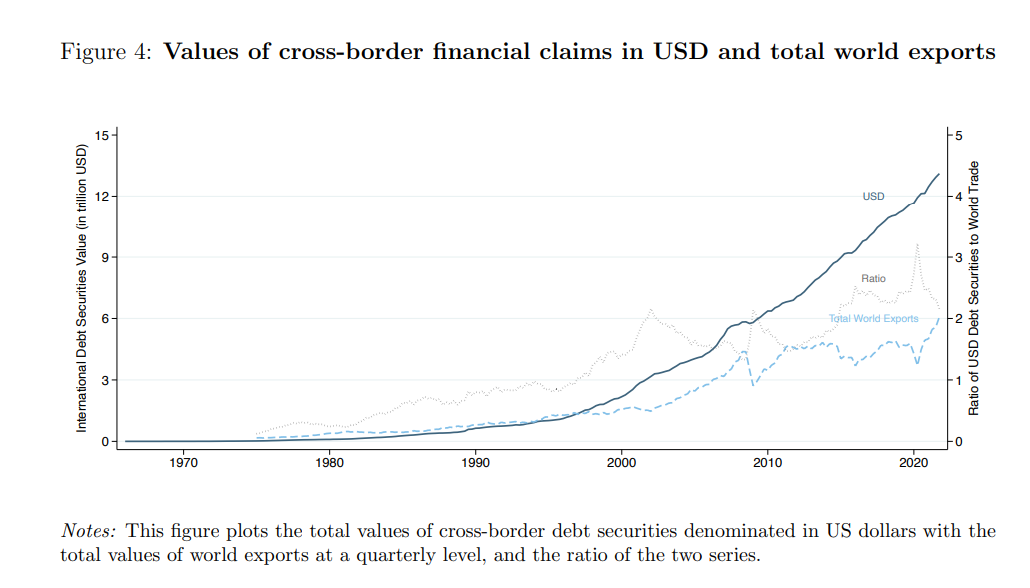
Coppola et al. in this paper offer a theory of currency dominance in the denomination of global financial contracts: they explain why among many alternatives for debt denomination, in equilibrium, one currency emerges endogenously as dominant. Their model shows that non-U.S. entities issue debt denominated in dollars because the large and liquid nature of the dollar money market facilitates dollar settlement. This then creates a vicious cycle:
[T]he ease of settling obligations in dollars begets new issuance in dollars. As more dollar debt is issued, some of this issuance adds to the stock of dollar-denominated money market instruments and expands the supply of available assets that can be used by other issuers to extinguish their debt. Dollar debt begets dollar debt, bootstrapping itself, leading to currency dominance.
Might the Euro or the Reminbi displace the US dollar as the world’s dominant?
- In the early 2000s the Euro was challenging the dollar as a reserve currency, but this pattern reversed after the sovereign debt crises in Europe as some of the sovereign issuers in the Euro area were deemed unsafe.
- China’s safe debt markets are currently not sufficiently liquid, safe, or investable in size to challenge the dollar as a reserve currency.
Liquidity, Debt Denomination, and Currency Dominance
Authors: Antonio Coppola, Arvind Krishnamurthy, Chenzi Xu
From: Stanford University
A granular look at the currency composition of international borrowers
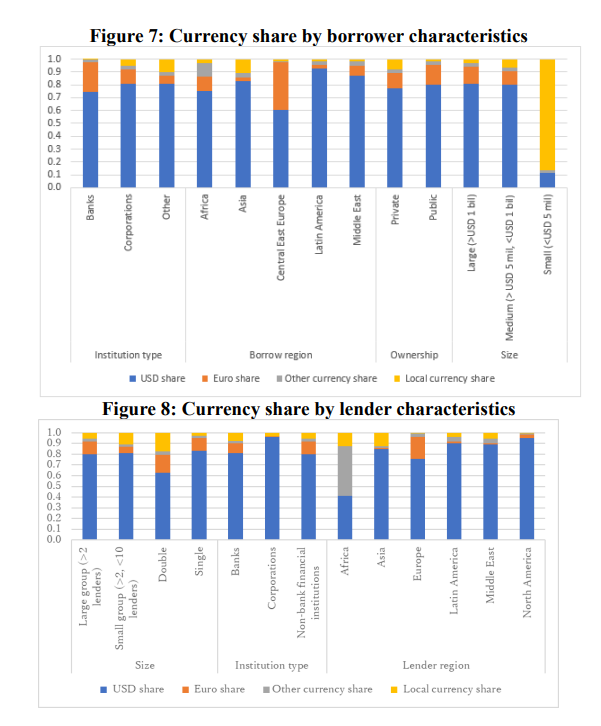
In this paper, Ito and Xu look at the currency shares from the international borrowers’ and lenders’ perspective. They use a dataset comprising 35,260 international syndicated loans borrowed by 17,571 firms in 25 EMEs over the period of January 1995 through December 2019. The lenders participating in the syndicated loans are located in 59 advanced and emerging market economies. They find:
- The USD share is high and similar across three different types of borrowers: banks, corporations, and non-bank financial institutions, ranging from 75-80%. However, the EUR share is higher for banks, 25%, compared to corporations and non-bank financial institutions (11% and 8%, respectively). The share of local currency loans is about 5-10% for corporations and non-bank financial institutions, but it is non-existent for banks.
- Latin America and Middle-East borrowers are the most reliant on USD loans with a share of about 90%. Considering both regions are exporters of commodities and natural resources, it makes sense for the borrowers in these regions to borrow mostly in USD.
- Asian borrowers also tend to borrow in USD with a share of more than 80%. Unsurprisingly, the USD share is noticeably smaller for Central or Eastern Europe (CEE), 50%, and euro-denominated loans account for nearly 40% of total cross-border loans.
- African lenders stand out from the others by having a low USD share, only 40% in their loans. Finally, Asian and African leaders mobilize a higher proportion of loans in local currencies compared to the lenders of the other regions.
Dollar dominance in Cross-border Bank Loans and Its Response to Uncertainties
Authors: Hiro ITO, Ying Xu
From: Portland State University, Australian National University
