


China’s policy-driven centrality in critical-mineral networks
In this paper, Josh Kirk, Evgenia Passari, and Hélène Rey analyze how China acquired geopolitical and pricing power in critical minerals by becoming central to their processing and trade networks, even without possessing large natural reserves. The authors combine three approaches:
- A theoretical model. They develop a stylized dominant-firm model in which a country invests in processing capacity and supply-chain relationships. Centrality increases pricing power when downstream demand and alternative supply are inelastic.
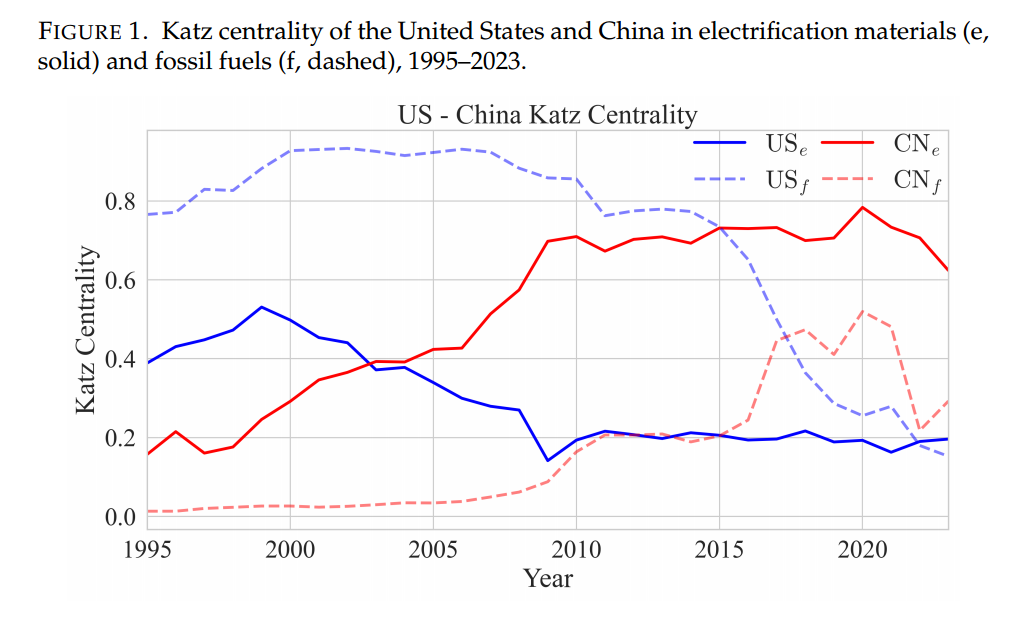
- Trade-network analysis. Using bilateral CEPII-BACI trade data for thirteen electrification metals from 1995 to 2023, the authors construct weighted trade networks. They measure China’s Katz centrality, market dominance, trade strength, and local clustering, comparing critical minerals with fossil fuels.
- Macroeconomic shock analysis. The authors use more than eight million news articles to construct commodity-specific supply and demand shocks. They then estimate local projections for the United States and European Union, measuring the cumulative effects of supply contractions on consumer and producer prices.
Findings
- China became the central hub of electrification-metal trade. China’s centrality rose sharply after approximately 2005 and overtook that of the United States, while fossil-fuel trade remained comparatively decentralized.
- China’s position reflects processing capacity rather than resource endowment. The paper argues that China holds relatively few of the relevant reserves but built influence through refining, processing investment, industrial policy, and development finance.
- The mineral trade network became hub-and-spoke. Local clustering declined toward zero, indicating that suppliers increasingly traded through China rather than directly with one another.
- Market power is concentrated in particular minerals. The Democratic Republic of the Congo in cobalt and Indonesia in nickel appear especially dominant because these markets have limited short-run supply alternatives and relatively low substitutability.
- Mineral supply shocks have substantial inflationary effects. A one-standard-deviation contraction in electrification-metal supply raises the cumulative CPI level in the United States and European Union by approximately one percentage point over two years i.e. roughly twice the effect of a comparable fossil-fuel supply shock.
- The effects are more persistent for metals. Producer-price responses are considerably larger than consumer-price responses, suggesting substantial transmission through industrial input costs.
- China’s power is contestable. Diversified processing capacity, recycling, strategic reserves, technological substitution, and investment by other countries could increase the elasticity of alternative supply and reduce China’s pricing power.
Exorbitant Privilege of the Periodic Table? Geoeconomics, Endogenous Centrality and Strategic Minerals for the Green Transition
Authors: Josh Kirk, Evgenia Passari, Hélène Rey
From: Imperial College London, Evgenia Passari, Université Paris Dauphine-PSL
Cross-country macroeconomic vulnerability to rare earth supply shocks
In this paper, Christian Bogmans, Maximiliano Jerez-Osses, Jorge Alberto Miranda Pinto, and Jean-Marc Natal analyze the macroeconomic impact of a major disruption in rare-earth supplies to different countries and sectors. The authors combine descriptive input-output analysis with a structural macroeconomic model:
- Sectoral exposure measurement. The authors identify industries using rare earths and permanent magnets, drawing on U.S. Geological Survey data, detailed U.S. Bureau of Economic Analysis input-output tables, OECD input-output tables, and existing estimates of rare-earth requirements.
- Value-added-at-risk analysis. They calculate the share of national value added associated with sectors that use rare earths. This provides a simple exposure measure but assumes limited substitution and does not fully capture indirect production-network effects.
- Small open-economy production-network model. The model includes domestic intermediate inputs, imported rare earths, labor, households, international borrowing, and sectoral input-output linkages. A binding constraint is imposed on the quantity of imported rare earths available to the economy.
- Cross-country simulations. The model is calibrated for the United States, Germany, France, the United Kingdom, Japan, and India. The central scenario is a persistent 80% reduction in rare-earth supply, interpreted as a stress test rather than a forecast.
Findings
- Rare-earth disruptions can generate large short-run GDP losses. Under low substitution elasticities, an 80% supply reduction produces the largest losses in Japan, the United States, and Germany, approximately 1.8%, 1.5%, and 1.2% of GDP, respectively.
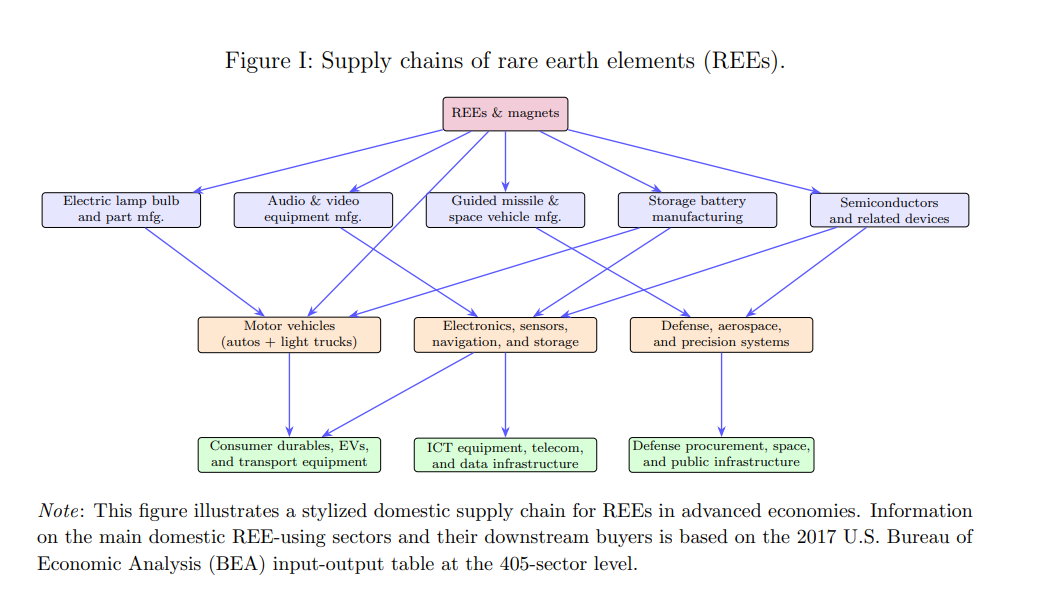
- Production networks amplify the shock. Rare-earth-intensive industries, especially motor vehicles, electrical equipment, electronics, semiconductors, and defense-related production, are not only direct users of rare earths, they also supply inputs to other sectors. This creates both backward and forward propagation effects.
- Country exposure varies considerably. Differences reflect the size of rare-earth-intensive sectors, their use of intermediate inputs, factor shares, and their position within national production networks. Germany has high direct value-added exposure, whereas the United States experiences strong network amplification because of the centrality of sectors such as motor vehicles, electrical equipment, and electronics.
- Japan is the most exposed economy in the real-GDP exercise. Under the authors’ alternative real-GDP measure, an 80% supply reduction lowers GDP by approximately 2.3% in Japan, 2.1% in Germany, and 1.5% in the United States.
- Substitution is crucial. When firms have greater ability to replace rare earths or adjust production technologies over longer horizons, aggregate losses become very small, approximately 0.006% on average across countries in the high-substitution scenario.
- The key parameter is substitution between rare earths and other intermediate inputs. The authors find that this elasticity explains approximately 97% of the difference between the low- and high-substitution cases.
- Rare earths matter because of their strategic applications, not because they are a large share of total input costs. Their importance comes from their role in enabling products such as permanent magnets, electric vehicles, wind turbines, electronics, semiconductors, and defense equipment.
Macroeconomic Effects of Rare Earths Supply Chain Disruptions
Authors: Christian Bogmans, Maximiliano Jerez-Osses, Jorge Alberto Miranda Pinto, Jean-Marc Natal
From: IMF
