Meritocracy around the world
In this paper, Bandiera et al. examine worker-job matching patterns across countries and their relationship to economic development. The authors estimate a general equilibrium model using microdata on worker skills and job skill requirements from the Programme for the International Assessment of Adult Competencies (PIAAC), a representative sample of over 120,000 working-age individuals across 28 middle- and high-income countries. Their findings include:
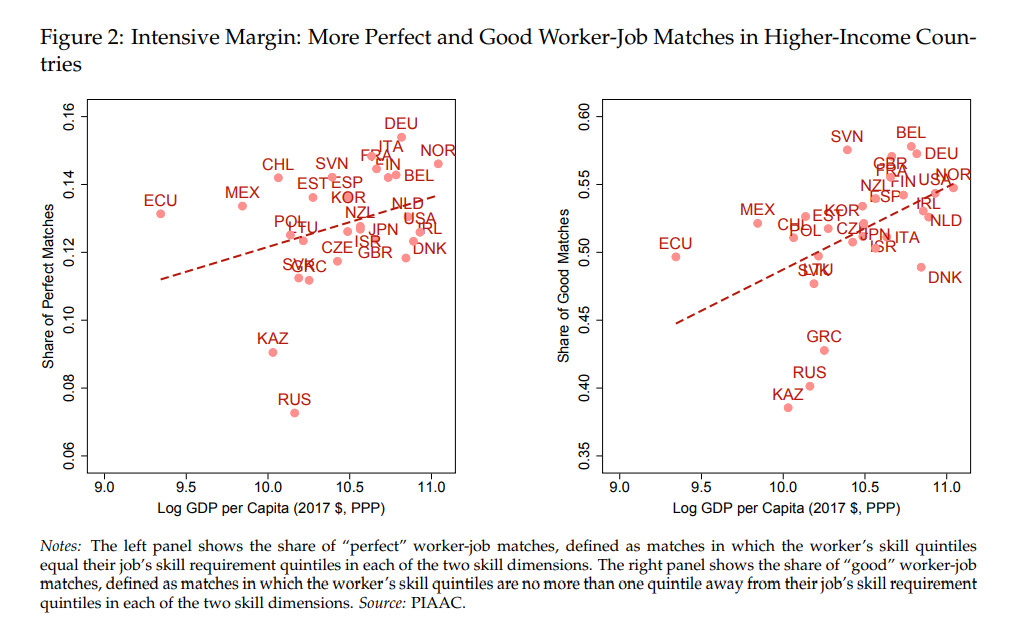
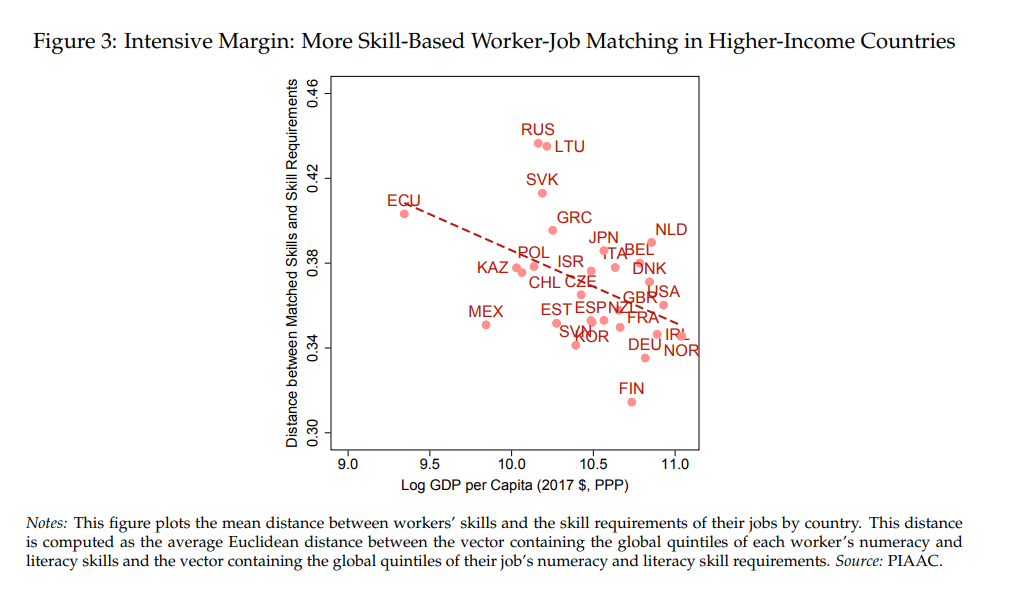
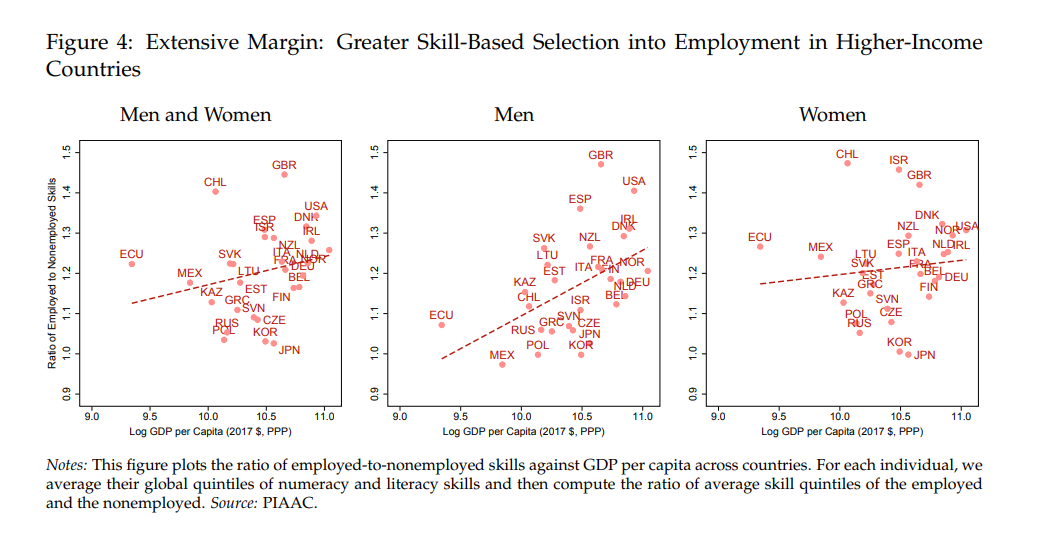
Higher-income countries show stronger skill-based sorting of workers to jobs along both intensive and extensive margins:
- Workers’ skills are better aligned with job skill requirements (intensive margin).
- Employed workers are more positively selected on skills (extensive margin)
Three key mechanisms behind these patterns are identified:
- Endowments: Higher-income countries have better alignment between worker skill distributions and job skill requirement distributions.
- Technology: Higher-income countries show stronger complementarities between worker skills and job skill requirements in production. Giving all countries access to frontier technology reduces cross-country variation in output per worker by 35%.
- Matching frictions: Higher-income countries have less severe idiosyncratic matching frictions.
The authors conclude that greater meritocracy in high-income countries is mostly a consequence, rather than a source, of economic development. They suggests policies aimed at improving worker-job matching alone will not effectively reduce cross-country income differences unless combined with interventions that enhance match productivity.
Meritocracy across Countries
Authors: Oriana Bandiera, Ananya Kotia, Ilse Lindenlaub, Christian Moser, Andrea Prat
From: London School of Economics, Yale University, Columbia University
The interaction between meritocracy and inequality
In this paper, Paul-Henri Moisson asks the question: How do individuals behave in a society that rewards “merit”, despite not all individuals being on the same starting line? To answer this question, Moisson develops a model based on a canonical career-concerns framework where: a) Agents publicly choose among several activities (e.g., academic majors, jobs) to exert effort; b) Agents differ in a privately observable characteristic (stemming from financial resources, human capital, social capital, etc.) called “head start,” which affects their performance; c) Effort and head starts are valued by the agents’ audience and agents care about the audience’s perception. Merit is then defined as a weighted combination of an agent’s expected talent, effort, and head start. He identifies two contrasting effects:
- A displacement effect: When talent image concerns dominate head-start image ones, a displacement effect arises: the “poor” (head start-wise) avoid the activity chosen by the “rich” to avoid a lower talent image.
- A distinction effect: While the poor would prefer to pool with the
rich, it is now the rich who separate from the poor by choosing an activity with even higher precision.
Moisson’s model predicts that:
- Displacement drags the poor towards activities with lower incentives on effort, while distinction pulls the rich towards activities with higher incentives.
- Higher head-start inequality reduces aggregate effort if displacement dominates, and increases it if distinction dominates. In both cases, it drives the rich and the poor apart.
Surprisingly, meritocracy achieves efficiency only if the weights on effort and head start are equal. For, any discrepancy between the two induces distortions in terms of activity and/or effort choices. Such equivalence goes against a responsibility-based view of merit, which would place a zero weight on head starts, and against the interpretation of the model in which head starts are but a privately observed component of talent, which would call for the same weight on talent and head start.
Meritocracy and Inequality
Author: Paul-Henri Moisson
From: Toulouse School of Economics


