Which macroeconomic indicators increase poverty the most?
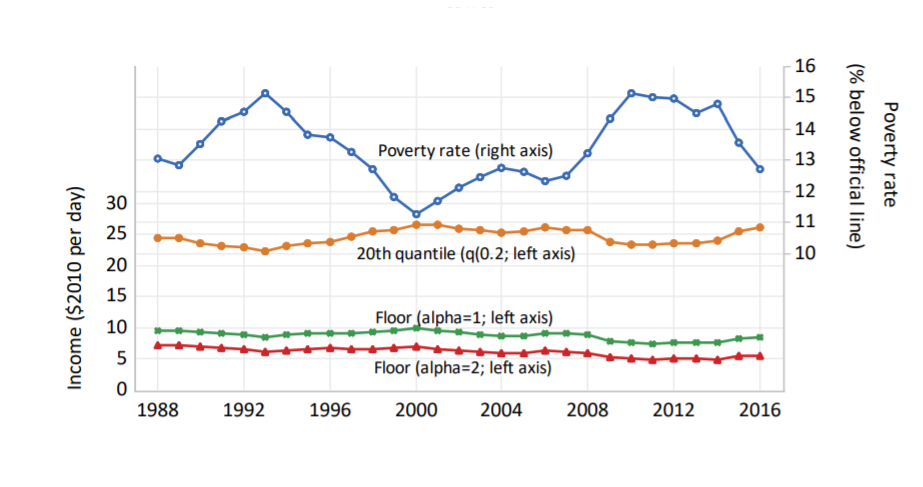
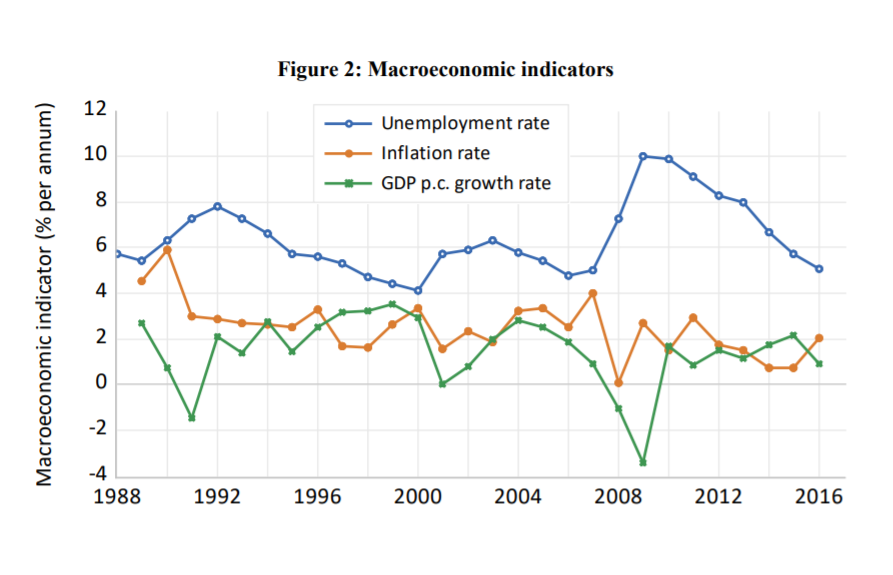
In this paper Martin Ravallion joins the critics of Okun’s “Misery Index” which attributes equal importance to inflation and unemployment in measuring the degree of economic distress felt by everyday people. Instead, Ravallion is attempting to analyze the relative importance of these two macro indicators on the real incomes of different economic groups namely, the poor, the middle income groups, and the rich. He uses micro data from 29 rounds of the U.S. Annual Social and Economic Supplement to the Current Population Survey, spanning the period from 1988 to 2016. For the macro data he uses the monthly unemployment rates published by the Federal Reserve, while the inflation rate is based on the Consumer Price Index as produced by the U.S. Bureau of Labor Statistics. The results of his regressions suggest that:
- The unemployment rate should have higher weight than inflation in a Misery Index calibrated to real incomes across the whole distribution, at least in this time period.
- Inflation matters more in the middle of the distribution than in the tails.
Macroeconomic Misery by Levels of Income in America
Author: Martin Ravallion
From: Georgetown University
What if the inflation indices are flawed?
Ravallion in his paper above uses the standard Consumer Price Index, even though he argues that with relative price changes and non-homothetic preferences, inflation rates based on the CPI may predict poorly at the tails as the weights may only be valid nearer the middle. Berk and Jaravel in this paper, undertake the task of quantifying the measurement errors associated with price indices. To this end they build a new dataset of harmonized barcode-level data on expenditures and prices for fast-moving and slow-moving consumer goods in thirty four countries, including developing (Brazil, China, India, and South Africa) and developed countries (the United States, Russia, and most European countries) for the last decade. They reach three important conclusions:
- The substitution bias and entry-exit bias in all countries lead to a large upward bias in standard inflation measures in almost all countries. When correcting for this bias, they find that most countries have experienced deflation in the past decade.
- When focusing on the fast-moving consumer goods data, they find that “inflation inequality” – i.e. inflation has been lower and product variety has increased faster in product categories catering to higher-income households – has been a worldwide phenomenon in the past ten years.
- Global market concentration and market power has remained stable over the past decade and did not constitute a significant source of inflation or inequality.
- Finally, standard purchasing power parity indices underestimate the price level in low-income countries and overestimate it in high-income countries, thus underestimating international inequality and overestimating world GDP per capita.
Prices and Global Inequality: New Evidence from Worldwide Scanner Data
Authors: Günter Beck, Xavier Jaravel
From: Siegen University, London School of Economics


