• Twitter
  • Search
e-axes

360° Econ View

The issues, the debates, and the research

  • Home
  • Useful Data
  • About
  • Contact
  • Home
  • Useful Data
  • About
  • Contact

Inequality

Urban Job Ladders and Market Power: Dual Engines of Inequality

Posted by e-axes on June 19, 2025

Read Next →

Inequality

Rethinking the Fight Against Inequality

Inequality

Are Billionaires Paying Taxes in France and the US?

Inequality

AI’s dual impact: reshaping skills and labor markets

How rising market power slows growth and concentrates wealth

Giammario Impullitti and Pontus Rendahl develop an economic model to explain three major US trends since 1980: rising market power (higher markups), slowing productivity growth, and increasing wealth inequality. Their framework links these trends to increased barriers to entry, which reduce competition. The model features heterogeneous households and oligopolistic firms that innovate and compete, with knowledge spillovers affecting growth. The model is calibrated to US data and simulates the impact of rising entry costs to match observed increases in markups.

Key findings

  • Rising entry barriers: Higher entry costs reduce competition, increasing markups and firm profits. This boosts asset returns and firm valuations, but also slows economic growth by reducing knowledge spillovers among firms.
  • Wealth inequality: The gap between asset returns and growth (the “return gap”) widens. Wealthy households, who save more in response to higher returns, benefit disproportionately, while poorer households—who mainly save for precaution—see little benefit. This deepens wealth inequality.
  • Quantitative results: The model replicates US trends: markups rise, growth falls, and the top 10% wealth share and Gini coefficient increase. Most households experience welfare losses, while only the top 1% (especially the top 0.1%) see gains.
  • Policy implication: Only increased entry barriers—not changes in taxes or R&D subsidies—can explain the simultaneous rise in markups, slower growth, and greater inequality.

Market power, growth and wealth inequality
Authors: Giammario Impullitti, Pontus Rendahl
From: University of Nottingham, Copenhagen Business School

Employer concentration and wage inequality in cities

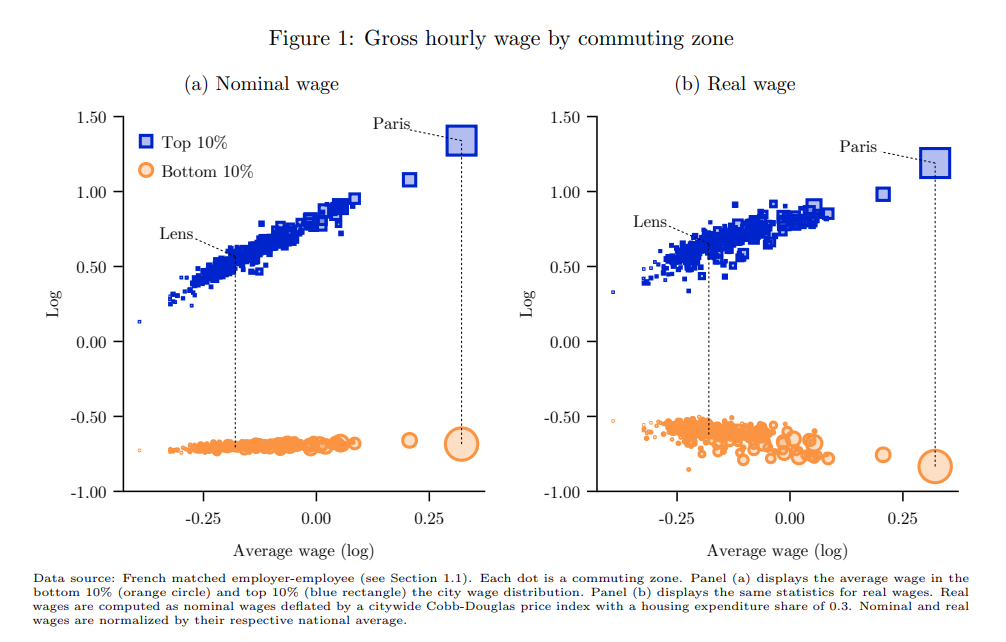
Hugo Lhuillier uses French matched employer-employee data to analyze wage inequality both between and within cities. The author estimates job wage premia (the extra pay associated with specific jobs, controlling for worker characteristics) using a two-way fixed effects model. The study documents where high- and low-paying jobs are located and how workers’ wages evolve as they switch jobs. A spatial model is developed where productive employers choose to locate in large cities to grow bigger, facing local labor market frictions and competition for workers. The model is quantitatively estimated to separate the effects of employer sorting, search frictions, and local productivity differences (TFP).

Key findings

  • Empirical facts:
    – Fact 1: High-paying jobs are disproportionately concentrated in large cities, while low-paying jobs are spread throughout all cities. For example, 17.9% of jobs in Paris are in the top 10% of the national job wage premia distribution, compared to only 6.9% in a median city like Lens. Low-paying jobs are equally present everywhere.
    – Fact 2: Wage gains from large cities accrue over time, not at entry. Starting wages for similar workers are nearly identical across cities, but the “job ladder” in large cities is steeper—job switchers in big cities experience higher wage growth than those in smaller cities. This dynamic accounts for most of the between-city wage variance.
  • Role of employers:
    The spatial sorting of productive employers into large cities, driven by their desire to sidestep search frictions and grow larger, is the primary source of higher average wages and greater wage inequality in those cities. This sorting explains both the higher average wage premia and the greater within-city wage dispersion observed in large urban areas.
  • Model validation and quantification:
    The estimated model shows that local TFP differences explain only a small fraction (about 3%) of the between-city wage premia variance. Instead, employer sorting and local labor market competition account for the bulk of observed wage disparities. The model replicates the empirical findings: high-paying jobs are clustered in large cities, low-paying jobs are ubiquitous, and the wage ladder is steeper in bigger cities.
  • Policy-relevant implications:
    The model predicts that all workers—including those with initially low real wages—enjoy higher lifetime real earnings in large cities due to faster wage growth. However, if job mobility slows (e.g., due to higher search frictions), the comparative advantage of large cities diminishes for both workers and employers, reducing spatial wage disparities and city size.

The Local Root of Wage Inequality
Author: Hugo Lhuillier
From: University of Chicago

Print Friendly, PDF & Email

e-axes

Read Next →

Inequality

Rethinking the Fight Against Inequality

Inequality

Are Billionaires Paying Taxes in France and the US?

Inequality

AI’s dual impact: reshaping skills and labor markets

Comments are Closed

Account

  • Login

Subscriptions

You are not logged in.
Login
Subscribe

Subscriptions

Subscribe

Most Read

  • Bank Heterogeneity and the Transmission of Monetary Tightening
  • Central Bank Losses and Public Debt: Constraints on Inflation Control
  • AI Valuations, Capital Investment, and Growth
  • How Firms’ Cost Expectations Shape Prices
  • Communicating Uncertainty: Fan Charts, Confidence, and Credibility
  • The AI Infrastructure Boom: Productive Investment or Financial Fragility?
  • Macroeconomic Risk: From Scenario Synthesis to Distributional Transmission
  • Measuring Expectations in Real Time: The Value and Limits of Kalshi Markets
  • Measuring Global Tensions Using AI
  • When Markets Drift from the Real Economy

Sections

  • AI
  • Banking
  • Books
  • Brexit
  • CBDC
  • China
  • Climate
  • COVID-19
  • Crypto
  • Demographics
  • Economic Growth
  • Economic Science
  • Economics of Information
  • Emerging Markets
  • Eurozone
  • Financial Markets
  • Geoeconomics
  • Geopolitics
  • India
  • Inequality
  • Inflation
  • International Economics
  • Macro
  • Markets
  • Monetary Policy
  • Oil
  • Politics & Economics
  • Taxation
  • Tech
  • Trade
  • U.S.
  • Ukraine-Russia War
  • Uncategorized
  • Useful Data

© 2026 e-axes

  • Privacy Policy & Terms of Service

Theme by Anders Norén

This website uses cookies to improve your experience. We'll assume you're ok with this, but you can opt-out if you wish.
Cookie settingsAccept
Privacy & Cookies Policy

Privacy Overview

This website uses cookies to improve your experience while you navigate through the website. Out of these cookies, the cookies that are categorized as necessary are stored on your browser as they are as essential for the working of basic functionalities of the website. We also use third-party cookies that help us analyze and understand how you use this website. These cookies will be stored in your browser only with your consent. You also have the option to opt-out of these cookies. But opting out of some of these cookies may have an effect on your browsing experience.
Necessary
Always Enabled
Necessary cookies are absolutely essential for the website to function properly. This category only includes cookies that ensures basic functionalities and security features of the website. These cookies do not store any personal information.
SAVE & ACCEPT