How AI reshapes skill demand and valuation
Mäkelä and Stephany, in this paper, examine the impacts of artificial intelligence (AI) on the demand and compensation for skills in the U.S. labor market. The study utilizes a large dataset of approximately 12 million online job vacancies from 2018 to 2023 to investigate both internal (within-job) and external (across occupations, industries, and regions) effects of AI adoption. Some of the findings include:
Internal effects:
- Demand for skills:
– AI roles are associated with a 22% higher likelihood of demanding complementary skills and a 34.8% lower likelihood of demanding substitutable skills.
– Certain complementary skills (e.g., technical proficiency, digital literacy) show particularly strong demand in specific AI role categories.
- Valuation of skills:
– Surprisingly, both complementary and substitutable skills are associated with slightly lower salaries in AI roles (4.1% and 8.2% respectively).
– Some specific combinations of AI roles and complementary skills show small positive salary effects.
External effects:
- The growth of AI roles is associated with increased demand for complementary skills and decreased demand for substitutable skills in non-AI roles across occupations, industries, and regions.
- The complementary effect is larger than the substitution effect. For example, in Management and Business Operations, for every substitutable role lost, there are about 1.5 complementary roles gained.
- Industry-level and regional effects are more significant than occupation-level effects.
- The researchers estimate that AI adoption is linked to a net job growth of 287,593 per year over the observation period (2018-2023), accounting for growth in non-AI complementary roles, decline in non-AI substitutable roles, and growth of AI roles.
- These findings were replicated for the UK and Australia, suggesting broader applicability.
The study concludes that AI adoption is reshaping labor markets by shifting demand toward complementary skills, even in non-AI roles, while also leading to some substitution effects. This nuanced impact challenges prevailing narratives of net displacement and emphasizes the importance of targeted policy interventions and strategic workforce planning.
Complement or substitute? How AI increases the demand for human skills
Authors: Elina Mäkelä, Fabian Stephany
From: University of Oxford
Which countries have a labor force with skills for thriving in the AI era
Based on the recent OECD 2023 Survey of Adult Skills, the key findings regarding which countries have a labor force with the necessary skills for future jobs like using AI include:
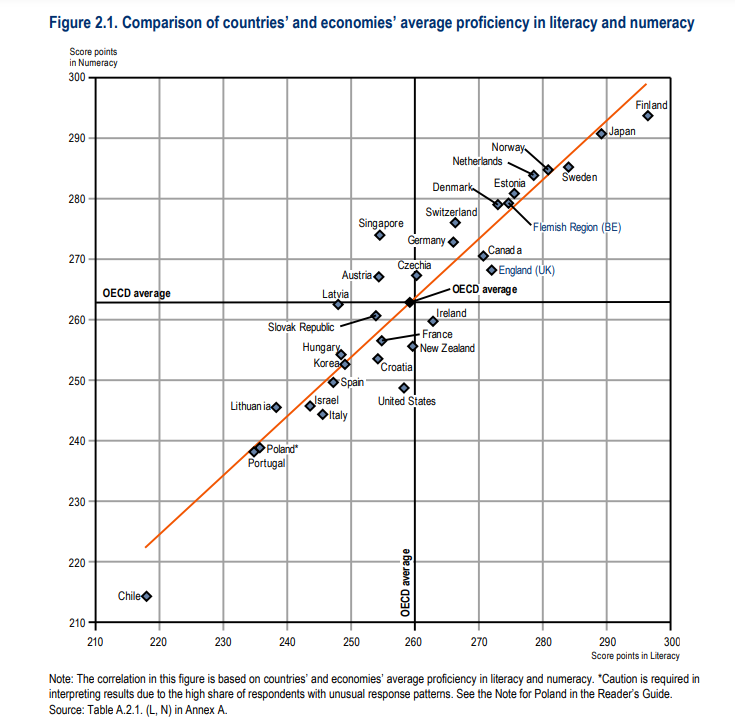
- Finland, Japan, the Netherlands, Norway and Sweden are the best-performing countries in all three skill domains assessed (literacy, numeracy and adaptive problem solving). Specifically, Finland has the highest average literacy (296 points) and numeracy (294 points) scores. Finland and Japan have the highest average scores in adaptive problem solving (276 points each).
- Eleven countries consistently perform below the OECD average in all skills domains: Chile, Croatia, France, Hungary, Israel, Italy, Korea, Lithuania, Poland, Portugal, Spain.
- On average across OECD countries, nearly one-fifth of adults are considered low performers. This ranges from 7% in Japan (lowest share of low performers) to 44% in Chile (highest share).
- Over the past decade, average literacy proficiency has remained stable or declined in most participating countries, with only Finland and Denmark showing significant improvements.
- The share of low-performing adults in literacy increased in 14 countries, with no country seeing a reduction. For numeracy, the share of low performers increased in 9 countries and decreased only in Canada, Finland and Singapore.
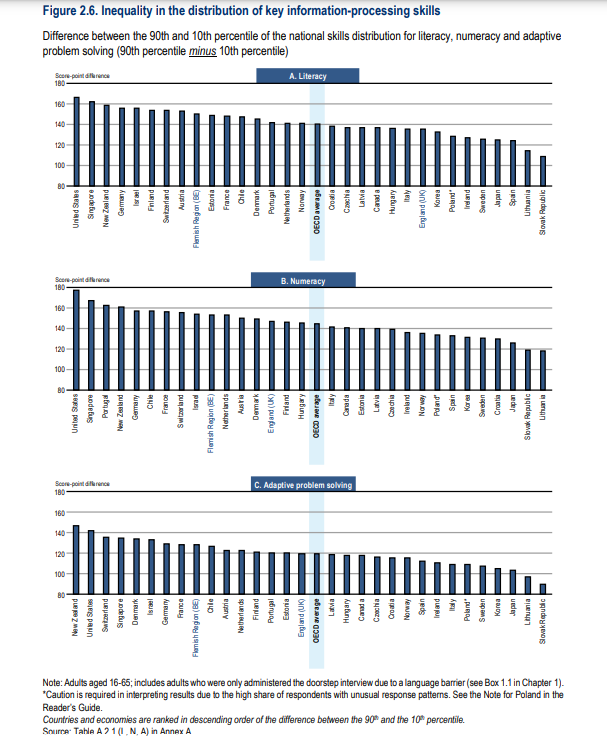
- Singapore and the United States display the largest skills inequalities in literacy and numeracy as of 2023.
In summary, Nordic countries and Japan appear best positioned in terms of workforce skills for future jobs involving AI, while several Southern and Eastern European countries, as well as Chile, lag behind. However, most countries are seeing concerning trends of stagnation or decline in key skills, particularly among lower-skilled adults.
Do Adults Have the Skills They Need to Thrive in a Changing World?
By: OECD


