
• Twitter
  • Search
e-axes

360° Econ View

The issues, the debates, and the research

  • Home
  • Useful Data
  • About
  • Contact
  • Home
  • Useful Data
  • About
  • Contact

Emerging Markets

The coming debt wave

Posted by e-axes on January 27, 2022

Read Next →

Emerging Markets

Argentina: From Reform Success to New Crisis

Emerging Markets

On preemptive capital controls

Emerging Markets

On the debt of emerging markets

Orthodox and heterodox option of debt reduction for EMDEs

Debt in emerging market and developing economies (EMDEs) is at its highest level in half a century. In this paper Kose et al. suggest orthodox as well as heterodox options for EMDEs to lower the debt burden.
Orthodox options include:
Fiscal consolidation by cutting budget deficits and privatizing a broad array of government assets. Interestingly enough, they argue for raising wealth taxes mainly on the rich so that deficit cutting policies don’t impact adversely low- and middle-income citizens. Relying on rapid growth to reduce debt has not been a successful strategy in the past at the exception of episodes when debt ramped up quickly after one-off shocks such as wars and was then followed by a rapid growth period.
Heterodox options include:
Inflation as a reduction strategy would mostly be useful for a one-off reduction in high debt levels, but if high debt levels are the result of persistent spending pressures or revenue weakness, a bout of surprise inflation cannot reduce elevated debt levels in a lasting manner. Financial repression, is another option especially since many EMDEs have already implemented interest rate controls during the pandemic. Finally, there is the option of default which of course imposes long-term costs.
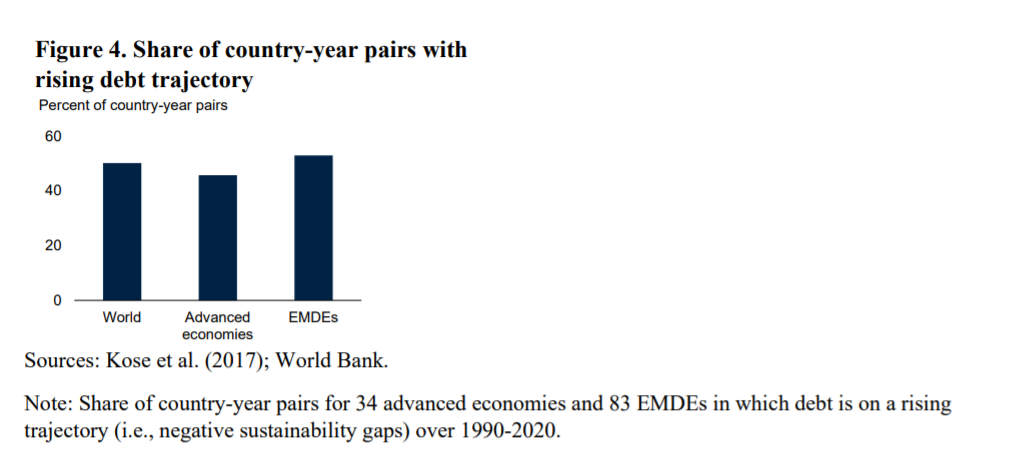
The Aftermath of Debt Surges
Authors: M. Ayhan Kose, Franziska Ohnsorge, Carmen Reinhart, Kenneth Rogoff
From: World Bank, Harvard University

Caught between a rock and a hard place

As the Fed is contemplating rate increases, EMDEs with high public and private debt, foreign exchange exposures, and lower current-account balances saw already larger movements of their currencies relative to the US dollar. As a result, some have already started to adjust monetary policy and are preparing to scale back fiscal support to address rising debt and inflation. Danninger et al. in this policy brief, also suggest allowing their currencies to depreciate while raising their own interest rates despite the fact that such measures make supporting a weak domestic economy more difficult.
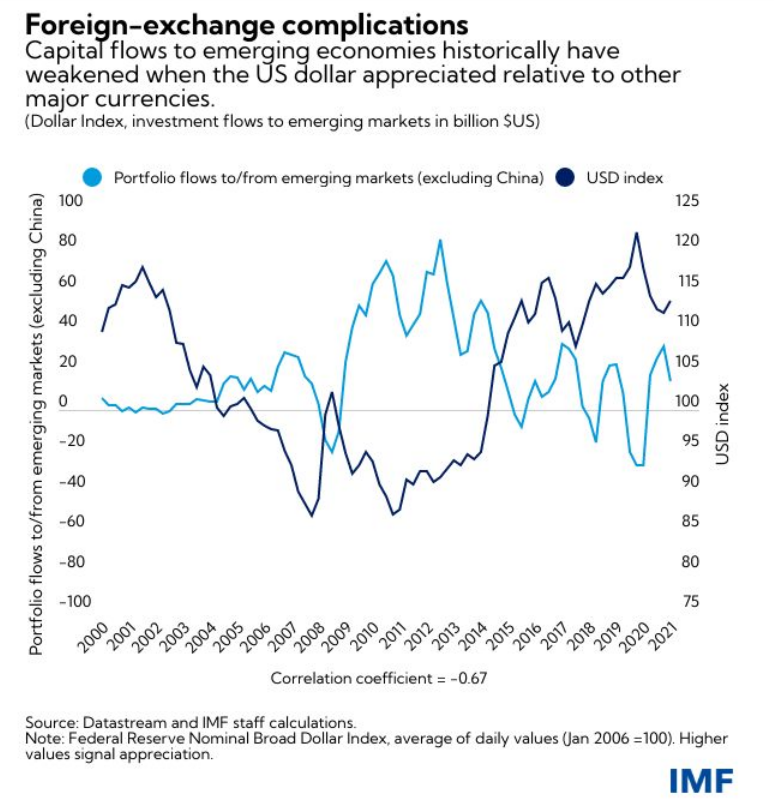
Emerging Economies Must Prepare for Fed Policy Tightening
By: Stephan Danninger, Kenneth Kang, Hélène Poirson – IMF

How can the IMF protect emerging markets’ debt sustainability

The IMF builds in interest rate penalties for large or prolonged borrowings from the financial facilities offered to stressed middle-income countries. The aim of these surcharges is to discourage countries from becoming over-reliant on Fund assistance and to help ensure that its revolving resources are available for all the new cases. In this policy brief, Patrick Honohan argues that the IMF should take the lead in protecting debt sustainability by reassessing, if not ending, its policy on interest surcharges for the large borrowings that are likely to be needed post pandemic.

The IMF should suspend interest rate surcharges on debt-burdened countries
By: Patrick Honohan – Peterson Institute for International Economics

Print Friendly, PDF & Email

e-axes

Read Next →

Emerging Markets

Argentina: From Reform Success to New Crisis

Emerging Markets

On preemptive capital controls

Emerging Markets

On the debt of emerging markets

Comments are Closed

Account

  • Login

Subscriptions

You are not logged in.
Login
Subscribe

Subscriptions

Subscribe

Most Read

  • Bank Heterogeneity and the Transmission of Monetary Tightening
  • Central Bank Losses and Public Debt: Constraints on Inflation Control
  • AI Valuations, Capital Investment, and Growth
  • How Firms’ Cost Expectations Shape Prices
  • Communicating Uncertainty: Fan Charts, Confidence, and Credibility
  • The AI Infrastructure Boom: Productive Investment or Financial Fragility?
  • Macroeconomic Risk: From Scenario Synthesis to Distributional Transmission
  • Measuring Expectations in Real Time: The Value and Limits of Kalshi Markets
  • Measuring Global Tensions Using AI
  • When Markets Drift from the Real Economy

Sections

  • AI
  • Banking
  • Books
  • Brexit
  • CBDC
  • China
  • Climate
  • COVID-19
  • Crypto
  • Demographics
  • Economic Growth
  • Economic Science
  • Economics of Information
  • Emerging Markets
  • Eurozone
  • Financial Markets
  • Geoeconomics
  • Geopolitics
  • India
  • Inequality
  • Inflation
  • International Economics
  • Macro
  • Markets
  • Monetary Policy
  • Oil
  • Politics & Economics
  • Taxation
  • Tech
  • Trade
  • U.S.
  • Ukraine-Russia War
  • Uncategorized
  • Useful Data

© 2026 e-axes

  • Privacy Policy & Terms of Service

Theme by Anders Norén

This website uses cookies to improve your experience. We'll assume you're ok with this, but you can opt-out if you wish.
Cookie settingsAccept
Privacy & Cookies Policy

Privacy Overview

This website uses cookies to improve your experience while you navigate through the website. Out of these cookies, the cookies that are categorized as necessary are stored on your browser as they are as essential for the working of basic functionalities of the website. We also use third-party cookies that help us analyze and understand how you use this website. These cookies will be stored in your browser only with your consent. You also have the option to opt-out of these cookies. But opting out of some of these cookies may have an effect on your browsing experience.
Necessary
Always Enabled
Necessary cookies are absolutely essential for the website to function properly. This category only includes cookies that ensures basic functionalities and security features of the website. These cookies do not store any personal information.
SAVE & ACCEPT