
• Twitter
  • Search
e-axes

360° Econ View

The issues, the debates, and the research

  • Home
  • Useful Data
  • About
  • Contact
  • Home
  • Useful Data
  • About
  • Contact

Emerging Markets

On the debt of emerging markets

Posted by e-axes on March 17, 2021

Read Next →

Emerging Markets

Argentina: From Reform Success to New Crisis

Emerging Markets

On preemptive capital controls

Emerging Markets

The coming debt wave

The doom loop in emerging markets

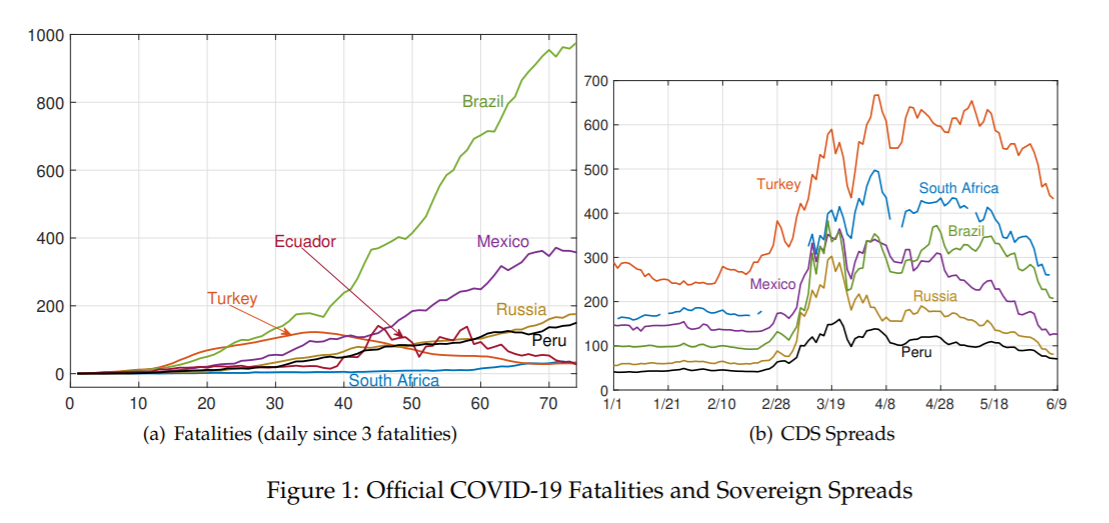
In this paper, Arellano et al. integrate a standard epidemiological susceptible-infected-recovered model into a sovereign default model in order to study how the epidemic impacts both economic activity and the likelihood of a debt crisis in emerging markets. Governments borrow internationally to smooth consumption during the lockdowns. But lockdowns depress output and lower the prospects of debt repayment. As a result, a highly indebted economy, with a looming debt crisis, chooses a less strict path of lockdowns because of its limited ability to use financial markets to support consumption. This leads to a higher death toll from the epidemic. Their models indicates that:

  • Lockdowns reduce output by 19% in present value and generate a debt crisis of 43 months with defaults. The first six months of the crisis feature high default intensity, the country defaults on more than 50% of the debt due; default intensity falls thereafter but remains elevated for 37 more months;
  • Debt relief programs can have profound positive effects: debt relief supports consumption, can reduce the severity of the debt crisis, and can save lives.

Deadly Debt Crises: COVID-19 in Emerging Markets
Authors: Cristina Arellano, Yan Bai, Gabriel Mihalache
From: University of Minnesota, University of Rochester, Stony Brook University

How debt relief to low-income countries can be derailed

There have been two initiatives by the G20 to help low-income countries during the pandemic: the Debt Service Suspension Initiative, which became operational in May 2020 and provides immediate relief to low-income countries during the pandemic, and the Common Framework for Debt Treatments which is designed to help debt-distressed sovereigns reschedule or reduce their liabilities and render their debt burden sustainable. Credit rating agencies though are threatening rating downgrades  casting a shadow over the prospects of the countries seeking relief. In this commentary Jayati Ghosh argues that:

If the G20 countries are serious about improving developing countries’ debt positions during the COVID-19 crisis, they should begin by supporting the temporary suspension of credit ratings. In the medium term, regulators must take action to ensure that rating agencies are fulfilling their intended market-stabilizing role. Tackling conflicts of interest – such as by limiting agencies’ dependence on payments from those they rate – is essential.

Credit-Rating Agencies Could Derail Economic Recovery
By: Jayati Ghosh – University of Massachusetts Amherst

Print Friendly, PDF & Email

e-axes

Read Next →

Emerging Markets

Argentina: From Reform Success to New Crisis

Emerging Markets

On preemptive capital controls

Emerging Markets

The coming debt wave

Comments are Closed

Account

  • Login

Subscriptions

You are not logged in.
Login
Subscribe

Subscriptions

Subscribe

Most Read

  • Public Debt Maturity and Macroeconomic Policy Transmission
  • Bank Heterogeneity and the Transmission of Monetary Tightening
  • AI Valuations, Capital Investment, and Growth
  • New and Noteworthy Books in Economics (September)
  • AI and the Natural Rate: Puzzle or Policy Challenge?
  • Macroeconomic Risk: From Scenario Synthesis to Distributional Transmission
  • Communicating Uncertainty: Fan Charts, Confidence, and Credibility
  • Transfers, Taxes, and the Ricardian Equivalence
  • Can Institutions Limit the Economic Damage of Populism?
  • Asia’s Expanding Non-Dollar Payment Networks

Sections

  • AI
  • Banking
  • Books
  • Brexit
  • CBDC
  • China
  • Climate
  • COVID-19
  • Crypto
  • Demographics
  • Economic Growth
  • Economic Science
  • Economics of Information
  • Emerging Markets
  • Eurozone
  • Financial Markets
  • Geoeconomics
  • Geopolitics
  • India
  • Inequality
  • Inflation
  • International Economics
  • Macro
  • Markets
  • Monetary Policy
  • Oil
  • Politics & Economics
  • Taxation
  • Tech
  • Trade
  • U.S.
  • Ukraine-Russia War
  • Uncategorized
  • Useful Data

© 2026 e-axes

  • Privacy Policy & Terms of Service

Theme by Anders Norén

This website uses cookies to improve your experience. We'll assume you're ok with this, but you can opt-out if you wish.
Cookie settingsAccept
Privacy & Cookies Policy

Privacy Overview

This website uses cookies to improve your experience while you navigate through the website. Out of these cookies, the cookies that are categorized as necessary are stored on your browser as they are as essential for the working of basic functionalities of the website. We also use third-party cookies that help us analyze and understand how you use this website. These cookies will be stored in your browser only with your consent. You also have the option to opt-out of these cookies. But opting out of some of these cookies may have an effect on your browsing experience.
Necessary
Always Enabled
Necessary cookies are absolutely essential for the website to function properly. This category only includes cookies that ensures basic functionalities and security features of the website. These cookies do not store any personal information.
SAVE & ACCEPT