• Twitter
  • Search
e-axes

360° Econ View

The issues, the debates, and the research

  • Home
  • Useful Data
  • About
  • Contact
  • Home
  • Useful Data
  • About
  • Contact

Macro

Why did worker power decline?

Posted by e-axes on August 11, 2020

Read Next →

Macro

Measuring Expectations in Real Time: The Value and Limits of Kalshi Markets

Macro

AI Valuations, Capital Investment, and Growth

Macro

AI and the Natural Rate: Puzzle or Policy Challenge?

…because firms’ market power in labor markets increased

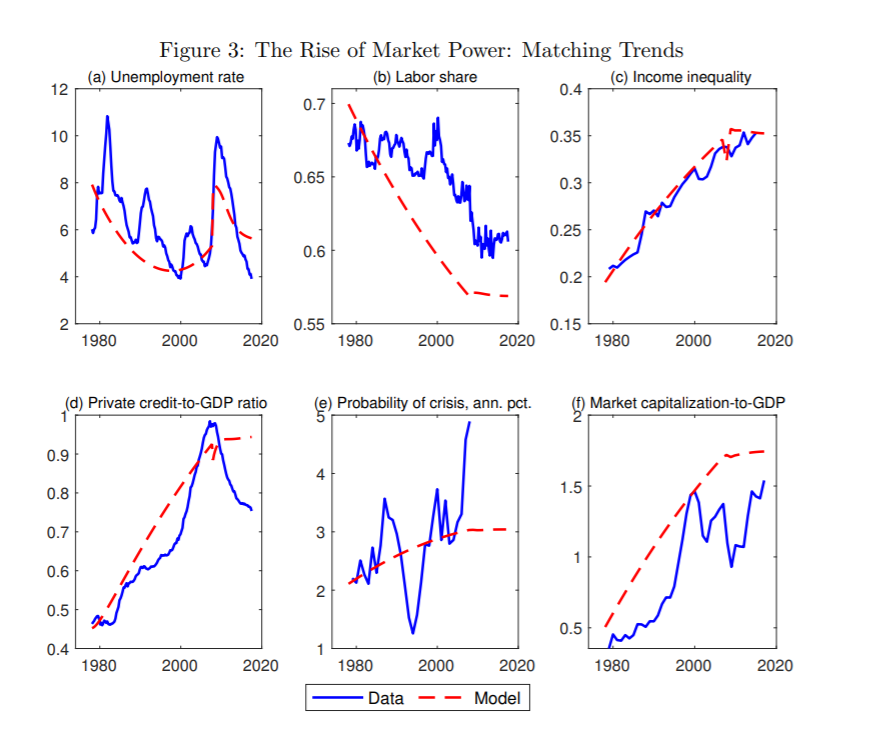
We develop a theoretical model in which the income distribution is endogenously determined by firms’ market power in both product and labor markets and the probability of financial crisis is endogenously determined by the accumulation of household credit. Using the model, we analyze the transitional dynamics of an economy undergoing structural changes in product and labor markets.
We find that the secular rise of firms’ market power in both product and labor markets can be an important driver behind a few secular trends experienced by the U.S. economy in the last four decades: the decrease in both the labor share and the capital share, the increase in the profit share, the increase in income inequality, the increase in credit-to-GDP ratio, and the associated rise in financial instability summarized by the probability of a financial crisis event. We also show that redistribution policies that moderate income inequality can be used as strong macroprudential tools in preventing financial crises.

Market Power, Inequality, and Financial Instability
Authors: Isabel Cairó and Jae Sim
From: Federal Reserve Board

…because unionization declined

Declining unionization, increasingly demanding and empowered shareholders, decreasing real minimum wages, reduced worker protections, and the increases in outsourcing domestically and abroad have disempowered workers with profound consequences for the labor market and the broader economy.
A decline in worker power would be expected to result in lower unemployment without generating inflation. That is because a decline in workers’ ability to share in profits may increase firms’ incentive to hire, and a decline in the availability of high-wage jobs reduces unemployed workers’ incentive to hold out in the hope of getting one of these jobs. The authors show that the decline in worker power is big enough to explain the decline in the average unemployment rate since the 1980s, and that industries with bigger falls in worker power had bigger falls in their unemployment rates.

Declining worker power and American economic performance
By: Anna Stansbury, Lawrence H. Summers – Harvard University

Print Friendly, PDF & Email

e-axes

Read Next →

Macro

Measuring Expectations in Real Time: The Value and Limits of Kalshi Markets

Macro

AI Valuations, Capital Investment, and Growth

Macro

AI and the Natural Rate: Puzzle or Policy Challenge?

Comments are Closed

Account

  • Login

Subscriptions

You are not logged in.
Login
Subscribe

Subscriptions

Subscribe

Most Read

  • Bank Heterogeneity and the Transmission of Monetary Tightening
  • Central Bank Losses and Public Debt: Constraints on Inflation Control
  • AI Valuations, Capital Investment, and Growth
  • How Firms’ Cost Expectations Shape Prices
  • Communicating Uncertainty: Fan Charts, Confidence, and Credibility
  • The AI Infrastructure Boom: Productive Investment or Financial Fragility?
  • Macroeconomic Risk: From Scenario Synthesis to Distributional Transmission
  • Measuring Expectations in Real Time: The Value and Limits of Kalshi Markets
  • Measuring Global Tensions Using AI
  • When Markets Drift from the Real Economy

Sections

  • AI
  • Banking
  • Books
  • Brexit
  • CBDC
  • China
  • Climate
  • COVID-19
  • Crypto
  • Demographics
  • Economic Growth
  • Economic Science
  • Economics of Information
  • Emerging Markets
  • Eurozone
  • Financial Markets
  • Geoeconomics
  • Geopolitics
  • India
  • Inequality
  • Inflation
  • International Economics
  • Macro
  • Markets
  • Monetary Policy
  • Oil
  • Politics & Economics
  • Taxation
  • Tech
  • Trade
  • U.S.
  • Ukraine-Russia War
  • Uncategorized
  • Useful Data

© 2026 e-axes

  • Privacy Policy & Terms of Service

Theme by Anders Norén

This website uses cookies to improve your experience. We'll assume you're ok with this, but you can opt-out if you wish.
Cookie settingsAccept
Privacy & Cookies Policy

Privacy Overview

This website uses cookies to improve your experience while you navigate through the website. Out of these cookies, the cookies that are categorized as necessary are stored on your browser as they are as essential for the working of basic functionalities of the website. We also use third-party cookies that help us analyze and understand how you use this website. These cookies will be stored in your browser only with your consent. You also have the option to opt-out of these cookies. But opting out of some of these cookies may have an effect on your browsing experience.
Necessary
Always Enabled
Necessary cookies are absolutely essential for the website to function properly. This category only includes cookies that ensures basic functionalities and security features of the website. These cookies do not store any personal information.
SAVE & ACCEPT