


How economic uncertainty affects consumers’ inflation expectations
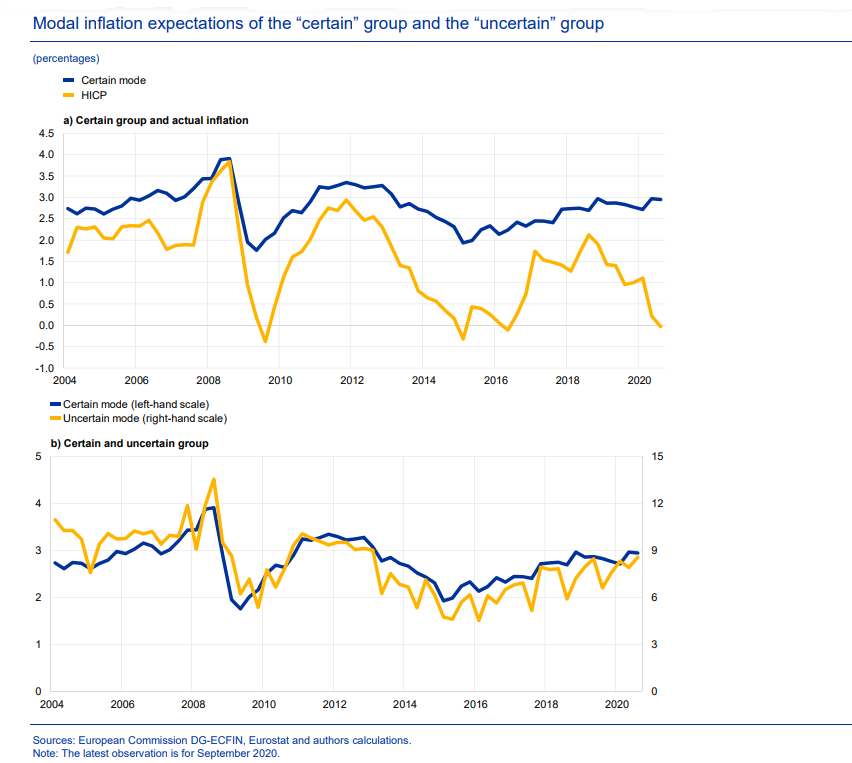
In this paper, Reiche and Meyler, investigate three issues that arise from the harmonized European Commission Consumer Surveys (ECCS). Namely: (a) Upward bias: the average inflation perception/expectation has tended to be systematically above, although co-moving with, actual inflation; (b) Heterogeneity: there is substantial heterogeneity both across countries and across individuals in terms of the levels of inflation expectations; (c) Negative relation relation with the state of the economy: there is an apparent negative correlation between inflation expectations and economic sentiment. They find:
- The upward bias seems to be related to the fact that agents who are more uncertain about the quantitative level of inflation typically report round figures (in multiples of five) as their inflation expectations.
- Rounding per se leads to higher inflation perceptions and expectations but is even more prevalent amongst some sociodemographic groups causing a striking heterogeneity.
- Consumers who have a negative attitude about the economy as a whole also tend to be more uncertain about the inflation outlook and report higher inflation expectations. This explains why reported inflation expectations might increase in periods of economic uncertainty – a finding that has questioned the efficacy of monetary policy as conducted by central banks.
Making sense of consumer inflation expectations: the role of uncertainty
Authors: Lovisa Reiche, Aidan Meyler
From: ECB
Consumers’ inflation expectations behave differently post-COVID
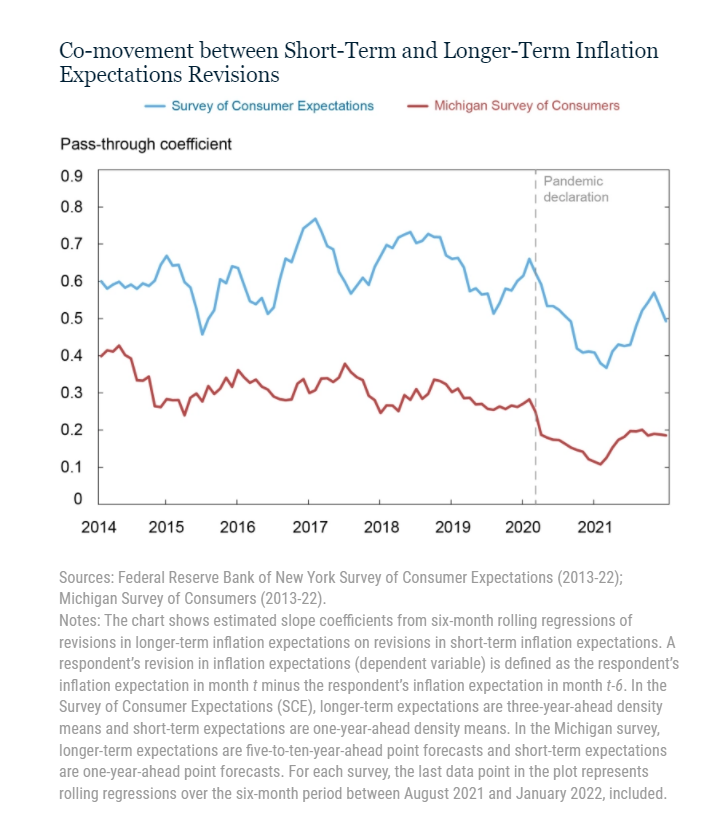
In this commentary, Armantier et al. look at how much consumers revise their inflation expectations in response to inflation surprises and whether there is pass-through of revisions in short-term inflation expectations to revisions in longer-term inflation expectations. They use data from the New York Fed’s Survey of Consumer Expectations (SCE) which is based on a rotating panel that follows individuals over time for up to twelve months. This survey allows the authors to measure the extent to which the same person revises their inflation expectations in response to inflation surprises. They also use data from the Michigan Survey of Consumers to measure the pass-through effect since the Michigan survey re-interviews a subset of respondents six months after the first interview. They find:
- Over the past two years, consumers’ shorter-horizon expectations have been highly attuned to current inflation news: one-year-ahead inflation expectations are very responsive to inflation surprises, in a pattern similar to what was witnessed before the pandemic.
- Three-year-ahead inflation expectations are now far less responsive to inflation surprises than they were before the pandemic, indicating that consumers are taking less signal from the recent movements in inflation about inflation at longer horizons than they did before.
- The pass-through from revisions in one-year-ahead expectations to revisions in longer-term expectations has declined during the pandemic relative to the pre-pandemic period.
Taken together, these findings show that consumers expect inflation to behave very differently than it did before the pandemic, with a smaller share of short-term movements in inflation expected to persist into the future.
What Are Consumers’ Inflation Expectations Telling Us Today?
Authors: Olivier Armantier, Leo Goldman, Gizem Koşar, Giorgio Topa, Wilbert van der Klaauw, John C. Williams
From: federal Reserve Bank of New York
