


Natural disasters and climate change beliefs
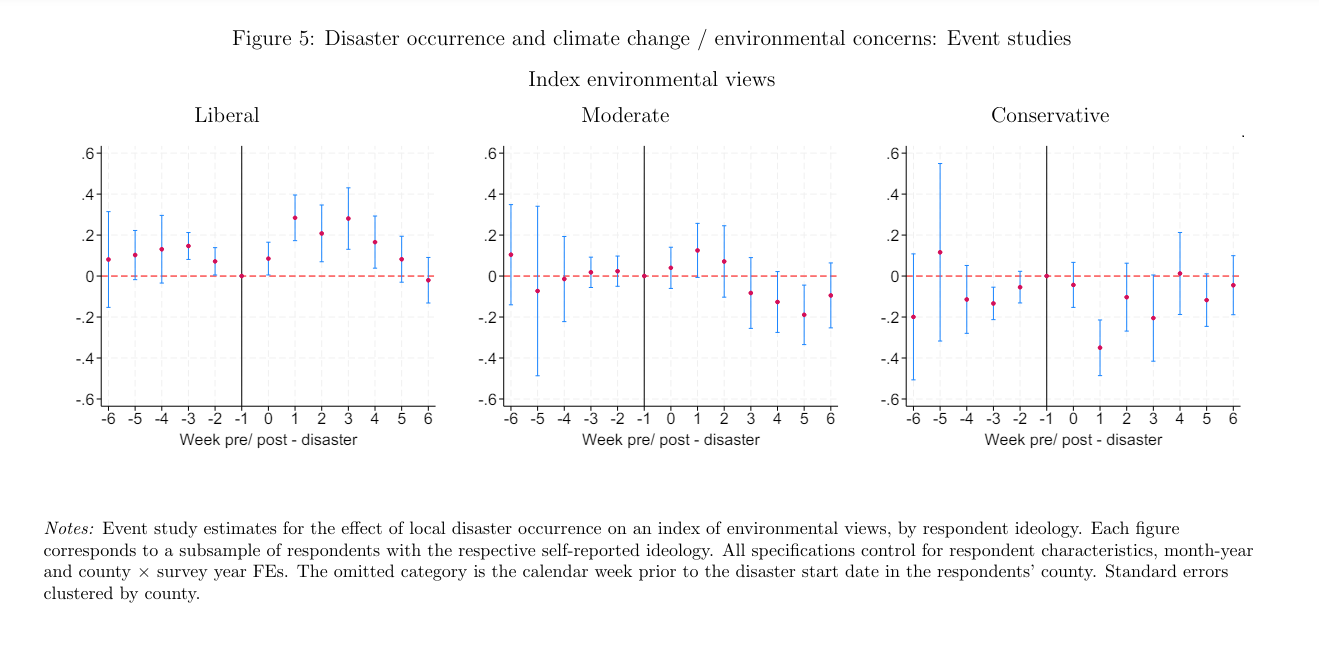
In this paper, Djourelova et al. present a comprehensive study of how the experience of natural disasters affects climate change beliefs and how these experiences interact with ideology. The authors link the exact start date and location of all disasters in the U.S. declared by the Federal Emergency Management Agency (FEMA) to individual climate change and environmental beliefs expressed in the Cooperative Election Study (CES). More specifically, they compare the beliefs of respondents who experienced a disaster in the four weeks before taking the survey to those of respondents who experienced a disaster in the four weeks after. The main conclusions drawn from the study:
- Exposure to natural disasters does not lead to a convergence in climate change beliefs as might be expected. Instead, there is a significant divergence, with liberals increasing their concern for climate change and environmental issues, while conservatives show a decrease in concern. This divergence widens the ideological gap by 11-17%, contrary to the predictions of standard learning models.
- The authors also highlight the role of conflicting ideological media discourse on climate change in the aftermath of disasters. Liberal media outlets are more likely to increase coverage of climate change and suggest a causal link between the disaster and climate change. In contrast, conservative media outlets are less likely to make such connections, sometimes even negating them or using a sarcastic tone. This difference in media coverage is suggested to mediate the polarizing effect of disaster exposure on environmental beliefs.
- The findings suggest that natural disasters, while making the debate around climate change more salient, also further polarize initial beliefs. This polarization can make it more challenging to build consensus on climate action, especially in times immediately following a disaster. Djourelova et al. argue that the aftermath of a disaster might not be the most opportune time to build consensus on climate action due to heightened ideological divides.
Experience, Narratives, and Climate Change Beliefs
Authors: Milena Djourelova, Ruben Durante, Elliot Motte, Eleonora Patacchini
From: Cornell University, National University of Singapore, Universitat Pompeu Fabra
Beliefs about climate and green investments
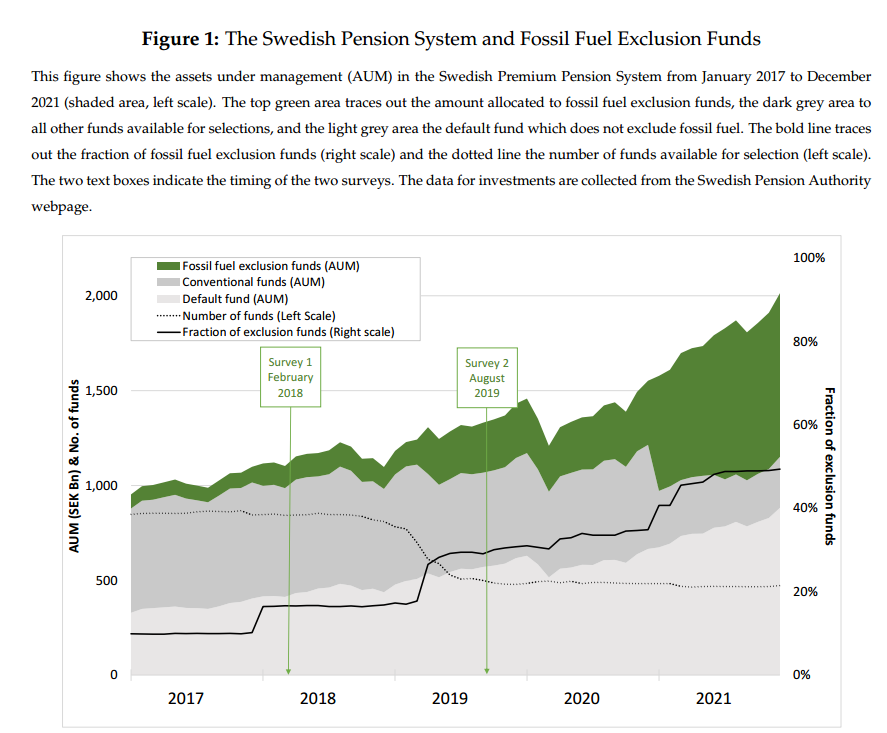
In this paper, Anderson and Robinson explore the impact of political polarization on green investment decisions, particularly within the context of retirement savings in Sweden. The authors administered a first survey in January and February 2018 in conjunction with Statistics Sweden (SCB) targeting 20,000 randomly selected individuals aged 18 to 65 of which 21% responded. The second survey was sent in August and September 2019 to those who responded to the first survey. Around 60% of the original respondents participated in the second survey resulting in a total of 2,561 complete responses. Anderson and Robinson then combined the survey responses with a) administrative data obtained from various sources, including the Swedish Tax Authority to collect information on demographic and wealth characteristics; and b) complete transaction histories from the Swedish Pension Agency (SPA) obtaining mutual fund choices for virtually every individual in their sample. Key findings include:
- Regional Political Polarization and Climate Change Beliefs: The authors find that after the intense heat wave of 2018 in Sweden, individuals in regions with a strong presence of a right-wing, anti-climate party (presumably the Sweden Democrats) became less concerned about climate change. In contrast, individuals in other regions became more concerned. This divergence in beliefs about climate change is attributed to political polarization, where individuals’ political affiliations and the dominant political ideology in their region influence their perception of climate change.
- Impact on Investment Decisions: The change in climate change beliefs had a tangible impact on how individuals allocated their retirement savings. Those who became more concerned about climate change were more likely to rebalance their retirement portfolios towards funds that feature fossil-fuel exclusions. Conversely, those who became less concerned were more likely to move their investments away from such funds, although this effect was less pronounced.
Climate Polarization and Green Investment
Authors: Anders Anderson, David T. Robinson
From: Stockholm School of Economics, Fuqua School of Business, Duke University
