The Phillips curve lives in Europe!
First, we confirm, using simple models and testing different cycle indicators, the existence of a Phillips curve in the euro area after the recent financial crisis.[…] Second, we proceed to its robust estimation. To account for model specification uncertainty, we estimate, using Dynamic Model Averaging, a battery of 630 models and we identify the main determinants of core inflation over the sample. […] Third, we estimate the slope of the Phillips curve and show that is relatively small.
Phillips curves in the euro area
Authors: Laura Moretti, Luca Onorante, Shayan Zakipour Saber
From: ECB
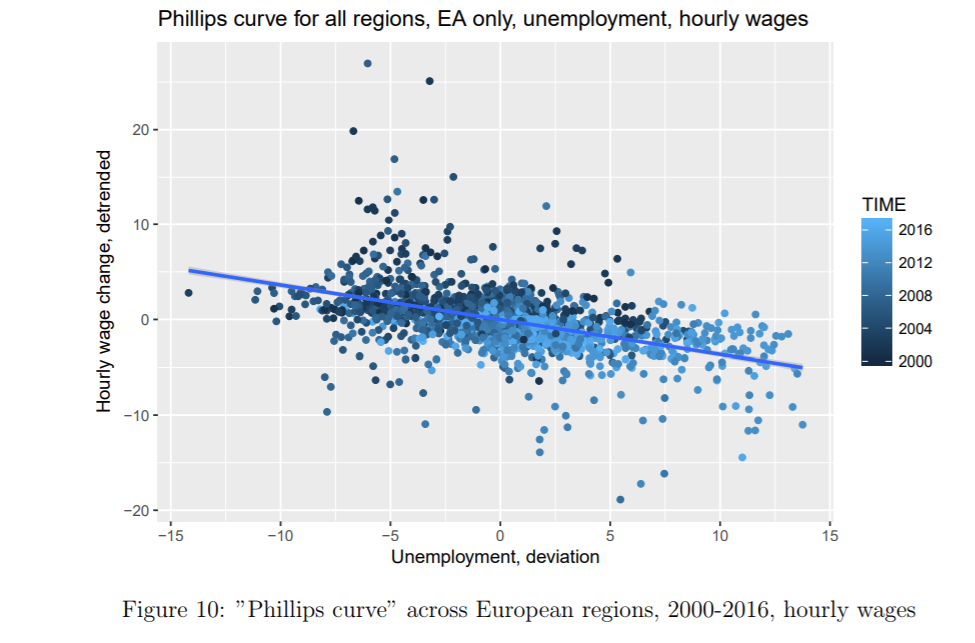
The Phillips curve at the regional level
Antoine Levy, after constructing measures of wage inflation in close to two hundred European sub-national data (at the NUTS-II level), shows that:
- Nominal wage growth responds strongly to local unemployment across labor markets in the monetary union;
- When unemployment is one percentage point higher in a region, nominal wage growth is reduced by 0.3 percentage points on average;
- The results are robust to the use of alternative proxies for slack in the labor market, including short-term unemployment, the employment-population ratio, and the output gap.; and
The euro area Phillips curve: identification with regional data
Authors: Antoine Levy
From: MIT
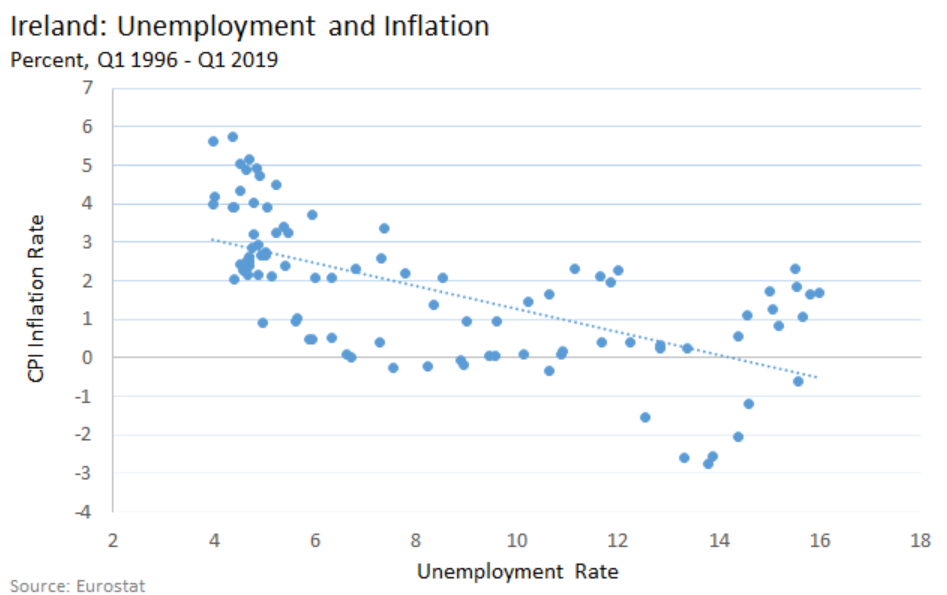
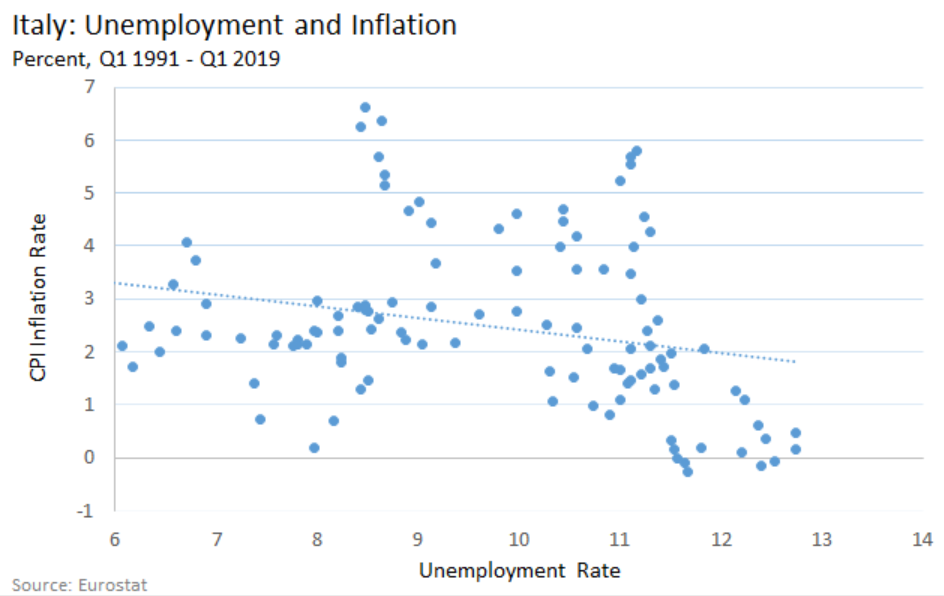
The Phillips curve at the national level
David Andolfatto reports the Phillips curve for all 19 member states and for the EMU as a whole. In this data, the negative relationship seems apparent in all but a few cases.
Does the Phillips Curve Live in Europe?
By: David Andolfatto – Federal Reserve Bank of St. Louis


