


How would Germany be affected by a stop of Russian energy imports
Bachmann et al. in this policy brief analyze the possible effect of a stop of Russian energy imports on the German economy. The argue that the short-term effect will be substantial i.e. a decline in the GDP of 0.5% and 3%. Their analysis critically hinges on the ease with which Russian gas imports (not so much oil imports) could be substituted with gas imports from other countries. To that extend, they use the multi-sectoral open economy model developed in Baqaae and Farhi (2021)1 that accounts for elasticities of substitution and reallocation between different intermediate inputs. They derive two scenarios:
- Scenario 1: The output costs of a Russian import stop remain firmly below 1% of Gross Domestic Product (GDP), or between 80 and 120 Euros per German citizen per year.
- Scenario 2: If it proves very difficult to substitute Russian gas in the short-run outside the electricity sector, the economic costs would rise to about 2-2.5% of GDP, or about 1000 Euros per German citizen over 1 year.
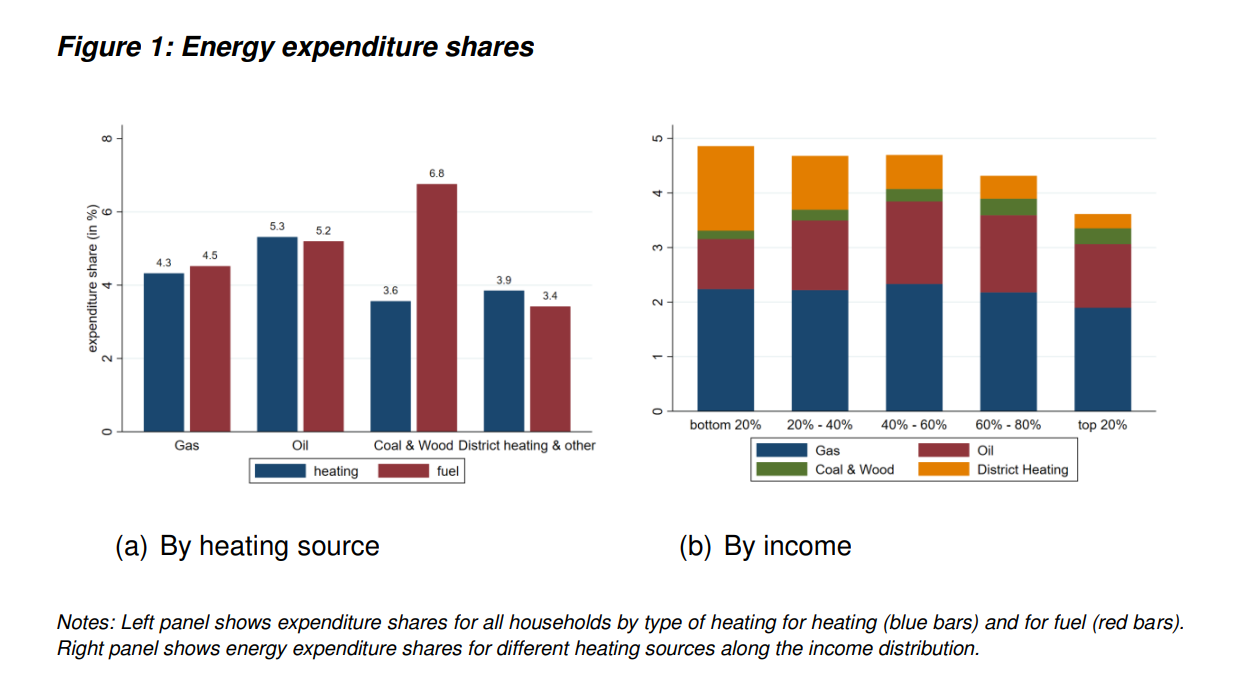
A targeted policy towards low-income households without reducing the incentives for households to save energy would be a cost effective way of ensuring a fair burden-sharing across households. It is important to maintain strong incentives for households to reduce gas usage.
What if? The economic effects for Germany of a stop of energy imports from Russia
Authors: Rüdiger Bachmann, David Baqaee, Christian Bayer, Moritz Kuhn, Andreas Löschel, Benjamin Moll, Andreas Peichl, Karen Pittel, Moritz Schularick
From: University of Notre Dame, University of California, Los Angeles, University of Bonn, Ruhr University Bochum, London School of Economics, University of Munich
1 Baqaee, David, and Emmanuel Farhi, (2021), "Networks, Barriers, and Trade. Working Paper.".
2 van der Mensbrugghe, D (2019), “The Environmental Impact and Sustainability Applied General Equilibrium (ENVISAGE) Model. Version 10.01”, Center for Global Trade Analysis, Purdue University.
3 European Commission (2020), “Energy prices and costs in Europe, Part II: Energy Costs for the economy, households and industry”, Commission Staff Working Document, COM(2020) 951 final.
