


A synthesis of recent findings on climate change’s global economic consequences
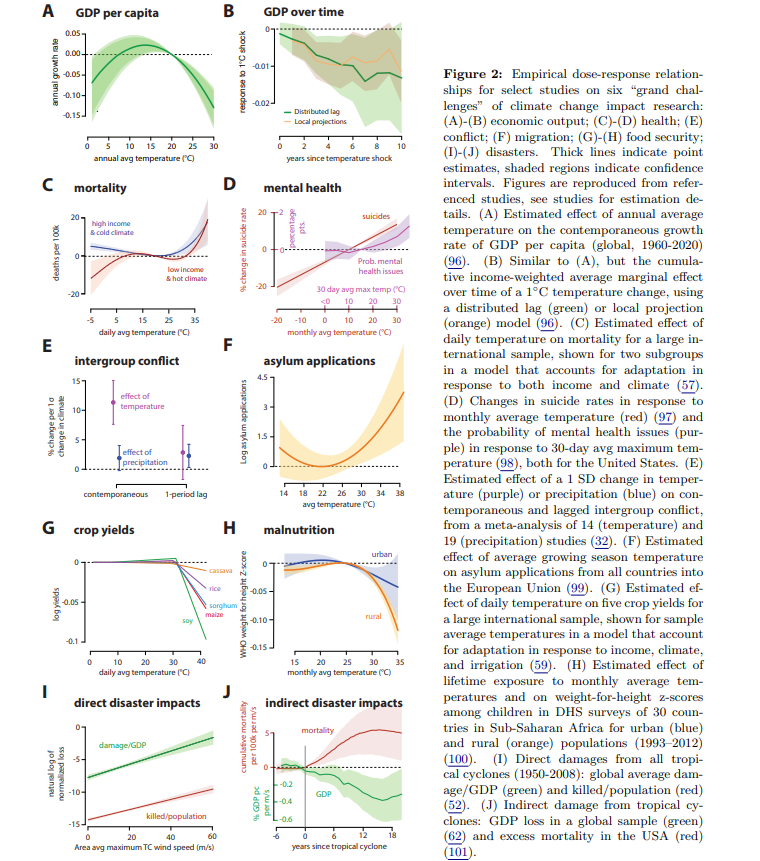
This working paper by Solomon Hsiang provides a comprehensive empirical review of how climate change affects the global economy across six critical dimensions. His main finding is that unmitigated climate change will likely generate substantial net negative global economic consequences that are highly unequal across regions and populations. The global consequences are likely to be large, negative, and potentially destabilizing.
Key empirical results across six “Grand Challenges”
1. Economic Output
- Temperature has a strong, nonlinear effect on GDP, with economic output peaking around 13-15°C. Hot and cold temperatures both reduce output relative to this optimum, with hot conditions reducing output roughly 1-2% per 1°C.
- Climate impacts exhibit “growth effects” rather than temporary “level effects,” meaning the negative impacts of adverse climate conditions persist for extended periods and do not fully recover.
- An empirically-based damage function projects that 3°C of warming would reduce global GDP per capita by approximately 19.6% by 2100 relative to a no-warming scenario.
- Recent updates incorporating methodological advances estimate the social cost of carbon (SCC) at roughly $2,000 per ton of CO2 (at a 2% discount rate).
2. Health
- Mortality exhibits a U-shaped relationship with temperature, with both heat and cold causing excess deaths. Adaptation is significant, particularly through infrastructure like air conditioning.
- One projection estimates warming will contribute roughly 73 deaths per 100,000 worldwide under high emissions scenarios, valued at approximately 3.2% of world GDP.
- Mental health impacts show a linear relationship with temperature, with warming increasing rates of depression, anxiety, and self-harm.
- Non-thermal health impacts (air pollution from wildfires, disease vectors, indirect deaths from disasters) may be even larger than direct thermal mortality.
- The partial SCC for mortality is estimated at $75.4/$32.5 (2024 USD) for high/moderate emissions scenarios.
3. Conflict
- Climate operates as an amplifier of pre-existing patterns of violence across the entire spectrum, from interpersonal violence to civil wars to institutional collapse.
- Warming increases intergroup conflict by approximately 11.3% per standard deviation increase in temperature, and interpersonal violence by 2.4%.
- The effects are log-linear rather than absolute, meaning they affect rich and poor countries proportionally similarly, though absolute impacts reflect baseline conflict levels.
- Anthropogenic climate change likely increased the risk of Syria’s recent civil conflict by 1.1-7.3%.
4. Food security
- Temperature is the dominant climate variable affecting crop yields, not precipitation. Crop yields exhibit sharp nonlinearity with daily temperatures, falling sharply above approximately 29°C.
- Historical agricultural productivity was reduced 21% during 1960-2015 due to warming.
- Impacts are highly heterogeneous geographically: major global breadbaskets face severe yield losses, while some high-latitude regions may see modest gains.
- Market-based valuations underestimate welfare impacts because food comprises a large income share for poor populations and cannot be easily substituted.
5. Disasters
- Direct damages from disasters are substantial, but indirect damages such as health impacts, economic disruption, and lost income, typically exceed direct damages by a factor of 10 or more and persist for years.
- The largest documented costs come from tropical cyclones and heat waves. Sea level rise impacts are concentrated in specific locations but can be severe.
- Private insurance markets show strain as insurers increase premiums or withdraw from high-risk regions. Public disaster assistance systems face fiscal sustainability challenges.
6. Migration
- Long-lasting climatic deterioration is generally associated with increased emigration, particularly from middle-income countries. Poor countries show evidence of populations becoming “trapped” by climate deterioration, lacking resources to migrate despite worsening conditions.
- Asylum applications increase nonlinearly with temperature, with projections suggesting a 190% increase in applications by 2100 under high emissions scenarios (30% under moderate scenarios).
Solomon Hsiang concludes by arguing that empirical evidence contradicted earlier assumptions about extensive adaptation and trade ameliorating most damages.
The Global Economic Impact of Climate Change: An Empirical Perspective
Authors: Solomon Hsiang
From: Stanford University
How climate change costs vary across American households
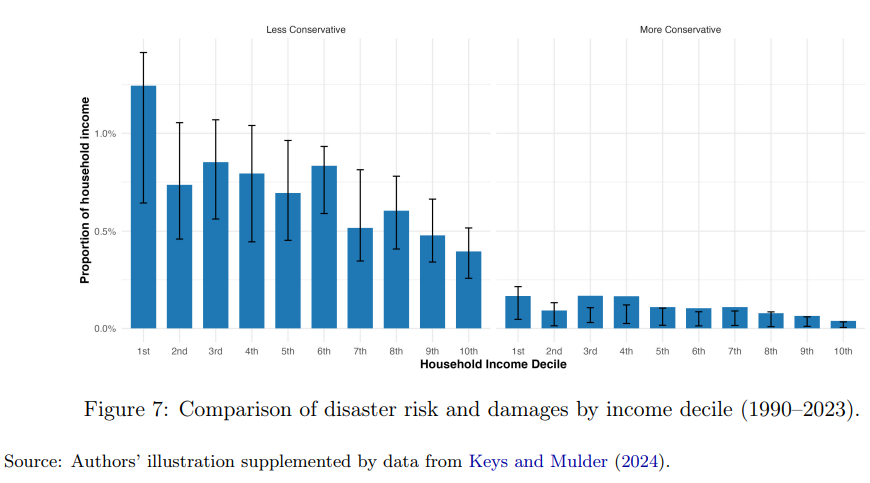
The paper by Kimberly A. Clausing, Christopher R. Knittel, and Catherine Wolfram, quantifies current climate-related costs to U.S. households using integrated microeconomic data: temperature reanalysis (1981-2024), mortality records, homeowners insurance data (47 million observations), residential energy consumption predictions via adaptive LASSO machine learning, disaster damages (1960-2024), and wildfire smoke exposure. The authors use climate models to attribute observed changes to anthropogenic climate change, employ dose-response functions to estimate nonlinear relationships between climate hazards and outcomes, and apply fixed effects regressions for mortality analysis. A two-scenario approach estimates conservative (25% storm, 50% wildfire damages climate-attributable) and less-conservative (50% storm, 80% wildfire) bounds.
Findings
- Overall burden: The authors estimate average annual climate costs to be $400-$900 per household ($50-110 billion nationally), with extreme weather events driving 80%+ of damages rather than steady temperature increases.
- Regional disparities: Pacific Division faces highest costs, estimated at $1,120/household from insurance and wildfire mortality; Middle Atlantic faces the lowest at $516/household.
- Mortality impacts: Wildfire smoke causes around 35,000 annual deaths. Heat effects are nearly neutral as declining cold deaths offset rising heat mortality. Direct disasters cause around 389 deaths annually.
- Regressivity: Lower-income households pay 5-8 times more as a share of income. Energy costs consume 10% of poorest households’ income versus 2.5% for richest. Black Americans show 2-3 times greater heat sensitivity; low-income populations disproportionately affected by wildfire smoke.
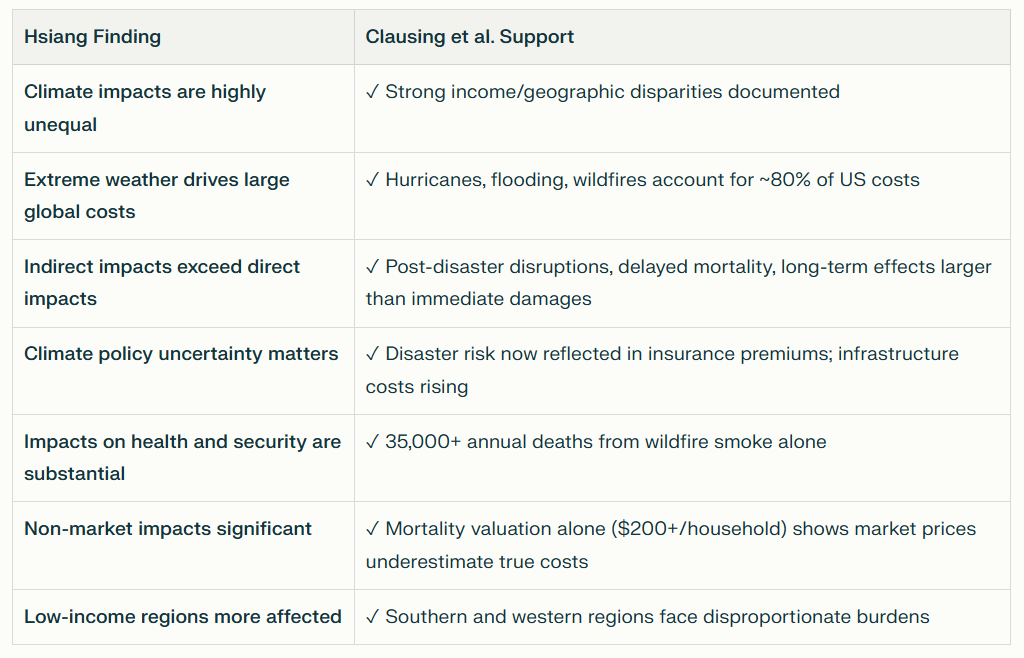
Distinction between the two papers: Hsiang emphasizes that chronic low-level pressures generate more global cost than acute disasters. Clausing et al. find the opposite for the US specifically: natural disasters (hurricanes, floods, wildfires) drive 80%+ of costs, while steady warming effects are modest. This reflects the US’s higher adaptive capacity and developed infrastructure—supporting Hsiang’s argument that low-income countries face larger burdens since they lack such adaptation mechanisms.
Who Bears the Burden of Climate Inaction?
Authors: Kimberly A. Clausing, Christopher R. Knittel, Catherine Wolfram
From: University of California, Los Angeles, MIT
