



Why some countries fall behind in technology
The paper by Daron Acemoglu, Ufuk Akcigit, and Simon Johnson develops a tractable framework to study how technology adoption and diffusion interact with economic development, with a particular focus on the role of managerial and institutional heterogeneity in shaping which firms adopt new technologies and how fast diffusion proceeds across countries and sectors.
Core model structure
The model is a dynamic framework in which firms face a choice between innovating (developing new technologies) and imitating (adopting existing technologies from more advanced firms). Productivity differences arise from both technology choice and from heterogeneity in firm‑level absorptive capacity, which depends on management quality, access to external knowledge, and the broader institutional environment (e.g., contract enforcement, credit markets, and regulatory costs). The framework embeds these technology choices within a long‑run development process, allowing heterogeneous selection of firms into innovation only when they attain sufficient productivity and absorptive capacity.
Findings
- Technology gaps drive persistent income gaps: Poorer countries systematically lag behind in adopting frontier technologies (e.g., ICT, advanced‑technology exports), and this “technology gap” explains a large part of cross‑country differences in income per capita.
- Lower absorptive capacity slows convergence: Weak education systems, poor management practices, regulatory barriers, and credit‑market frictions reduce countries’ absorptive capacity, so they adopt and implement frontier technologies more slowly, staying farther from the productivity frontier.
- Selection of high‑productivity, high‑absorptive‑capacity firms: The model emphasizes that innovation and frontier‑technology adoption are concentrated among firms that are already more productive and better at using external knowledge, which widens within‑country productivity dispersion and reinforces aggregate development gaps.
- Firm‑level reallocation and misallocation matter: Faster development is associated with more reallocation of resources toward technologically capable firms. In low‑income countries, misallocation is stronger, so many productive firms fail to adopt new technologies and grow, while less productive firms persist.
- Policy focus shifts from “access” to “absorptive capacity”: The framework suggests that policies should not only facilitate access to frontier technologies (e.g., via trade, FDI, or licensing) but also strengthen the underlying determinants of absorptive capacity—such as management quality, education, and contract enforcement—so that adopted technologies are actually used effectively.

Technology and Economic Development
Authors: Daron Acemoglu, Ufuk Akcigit, Simon Johnson
From: MIT, University of Chicago
Why some firms fall behind in technology
Xavier Cirera, Diego Comin, and Marcio Cruz introduce a novel grid-based framework to measure technology use in firms via the Firm Adoption of Technology (FAT) survey, covering 21,000+ establishments in 15 countries ( South Korea, Poland, Croatia, Chile, the Brazilian state of Ceará, Georgia, Vietnam, the Indian states of Uttar Pradesh, Tamil Nadu, Gujarat and Maharashtra, Ghana,
Bangladesh, Kenya, Cambodia, Senegal, Ethiopia, and Burkina Faso). The paper’s methodology centers on expert-ranked sophistication grids for 63 business functions (7 general, 56 sector-specific across 12 sectors) with 305 technologies, yielding MAX (most advanced tech adopted) and MOST (most widely used tech) indices to capture adoption vs. intensity of use.
Findings
- There is substantial dispersion in both MAX and MOST measures across establishments within and across countries and sectors (especially agriculture) and MOST displays a more skewed distribution than MAX. Within-country gaps increase with income per capita while sector fixed effects explain approximately 20% of the variance, similar to patterns observed in productivity.
- MAX increases steadily with establishment age, size, worker skills, exporter status, multinational affiliation, and management quality. In contrast, MOST flattens after ten years in low-income countries and among smaller establishments, reflecting stronger size effects in higher-income settings.
- Both MAX and MOST positively correlate with productivity and profitability, with stronger associations for MOST. These performance links hold similarly across income levels, challenging views that advanced technologies are inherently inappropriate for poorer countries.
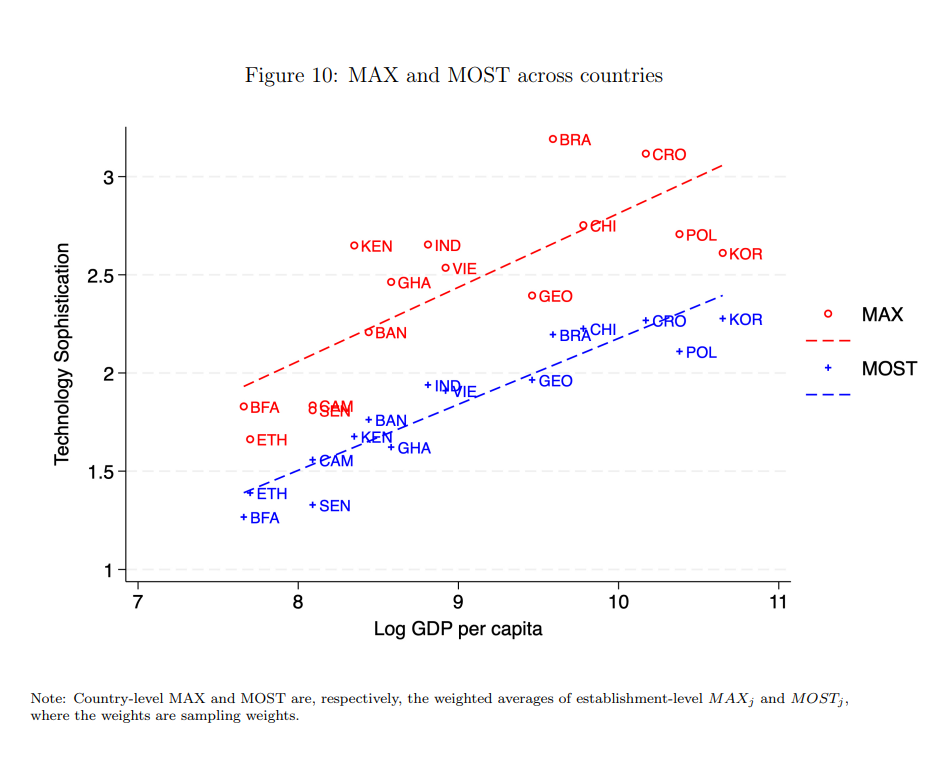
Technology Sophistication Across Establishments
Authors: Xavier Cirera, Diego Comin, Marcio Cruz
From: World Bank, Dartmouth College, IFC
