



Partisan bias in finance: evidence and implications
Elisabeth Kempf and Margarita Tsoutsoura, in this paper, provide a comprehensive review of the empirical literature studying how political polarization affects financial decisions of households, firms, and financial intermediaries. The authors discuss common empirical challenges in this field, including measurement of political affiliation and identification strategies and highlight the three main empirical approaches used in the literature:
a) Documenting partisan differences while controlling for observable characteristics;
b) Estimating within-partisan group changes around political events;
c) Exploiting the expansion of partisan news media as a quasi-natural experiment.
Some of their findings include:
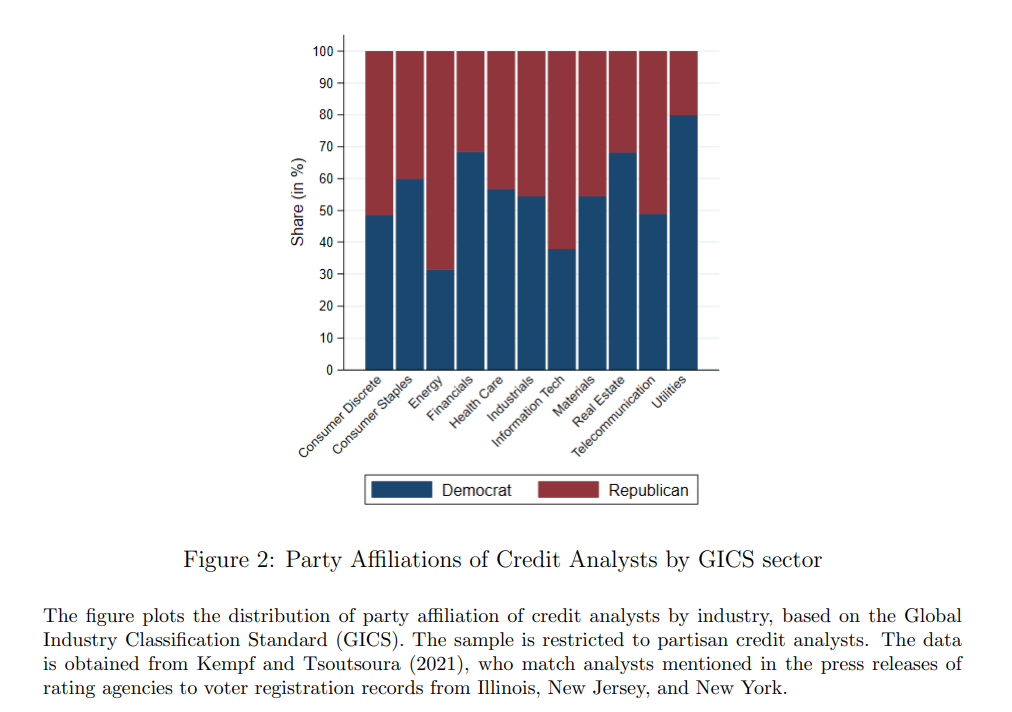
- Partisan Segregation: There is substantial partisan segregation in finance and corporate America, with executive teams often dominated by Republican executives.
- Partisan Views of the Economy: Political alignment with the government affects economic optimism and financial decisions of intermediaries, corporate executives, entrepreneurs, and households.
- Cross-sectional Investment Preferences: Democrats and Republicans differ in their views on corporate social responsibility, climate risk, and specific industries.
- Firm-level Effects:
– Partisan perception can influence firms’ cost of capital and investment decisions;
– Political homogeneity in teams may be associated with lower firm performance in some contexts. - Economic Magnitude: The effects of partisan bias are often economically significant, comparable to other important determinants of financial decisions.
- Increasing Trend: Many studies document an increase in partisan effects over time, especially after 2016.
The authors conclude that political polarization is evident in financial decisions across various settings, with consequences for trading volume, firms’ cost of capital, corporate investment, and asset prices.
Political Polarization and Finance
Authors: Elisabeth Kempf, Margarita Tsoutsoura
From: Harvard University, Washington University in Saint Louis
The partisan gap in inflation beliefs
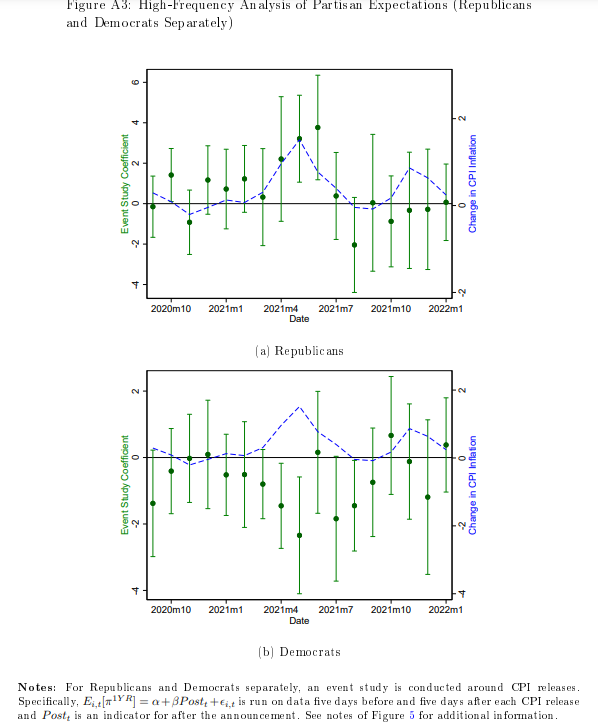
Binder et al. use data from the Michigan Survey of Consumers to analyze inflation expectations of Democrats, Republicans, and Independents from 2012 to 2024 in the U.S. The authors use an event study approach to analyze how partisan expectations respond differently to CPI releases and other macroeconomic announcements and exploit geographic variation in political composition to estimate an expectations-augmented Phillips curve at the MSA level. Finally, they conduct regression analyses to examine how political affiliation affects inflation expectations, controlling for demographic factors as well as counterfactual exercises to estimate the impact of expectations anchoring on realized inflation.
Key findings:
- During the COVID-19 era, Democrats’ inflation expectations remained strongly anchored, while Republicans’ expectations became less anchored and more volatile.
- Republicans’ expectations became more sensitive to various shocks, including CPI releases and energy prices.
- The partisan gap in inflation expectations widened significantly during the pandemic period.
- Using MSA-level data, the authors find that areas with higher concentrations of Republicans experienced higher realized inflation.
- Counterfactual exercises suggest that if all expectations had become as unanchored as those of Republicans, average inflation would have been 2-3 percentage points higher during much of the pandemic period.
- The partial de-anchoring of expectations appears to have played a role in increasing inflation and slowing its return to target levels.
- The authors discuss potential mechanisms for these effects, including intertemporal substitution in consumption, labor market dynamics, and firm pricing decisions.
Partisan Expectations and COVID-Era Inflation
Authors: Carola Binder, Rupal Kamdar, Jane M. Ryngaert
From: University of Texas at Austin, Indiana University, University of Notre Dame
