Are male and female workers perfectly substitutable?
Espinoza and al. estimate an aggregate production using linear and non-linear techniques and cross-country data at the aggregate, sectoral and firm levels for the manufacturing sector in China. They find that male and female labor are far from being perfect substitutes: the elasticity of substitution is below 1 for the aggregate sample (slightly higher for the sectoral and firm level samples). They argue that the macroeconomic implications of this finding are:
- Growth accounting exercises should recognize the role that past reductions in gender inequality have had for TFP growth;
- General equilibrium effects of policies on gender gaps could be significant, because the elasticity of substitution is not that high;
- Closing the gender gap in the labor force would lead to large increases in GDP (by 8 to 14 percent for the median advanced economy)
The Armistice of the Sexes: Gender Complementarities in the Production Function
Authors: Raphael A. Espinoza, Jonathan D. Ostry, Chris Papageorgiou
From: IMF
Cognitive skills: women’s comparative advantage
Nir Jaimovich, in this policy brief, documents a deterioration in the employment outcomes of high-skilled men in the US since 1980. In particular, he argues that:
- There has been a fall in the likelihood that a college-educated man is employed in a high-paying cognitive occupation;
- This is in stark contrast to the experience of high-skilled women whose likelihood of working in a good job rose. The key driver seems to be growing demand for social skills, such as empathy, communication, emotion recognition and verbal expression, in which evidence from psychological research indicates that women have a comparative advantage.
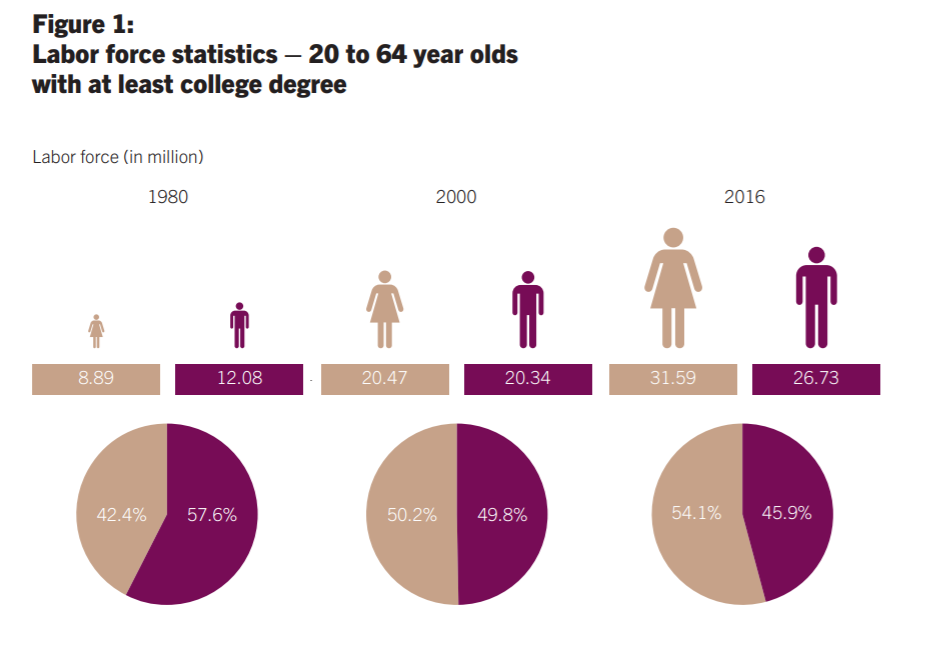
The end of men
Authors: Nir Jaimovich
From: University of Zurich
Female employment and its effect on business cycles
The US economy has been hampered over the last four decades by three trends: the productivity slowdown, the Great Moderation, and jobless recoveries. Economists seeking to explain these phenomena have generally looked to the impact that technological change has on labor demand. This paper proposes as an alternative explanation the rise and stabilisation of women’s participation in the workforce. In particular:
- The growth in women’s labor supply and relative productivity added substantially to TFP growth from the early 1980s, even if it depressed average labor productivity growth, contributing to the 1970s productivity slowdown;
- The lower cyclicality of female hours and their growing share can account for a large fraction of the reduced cyclicality of aggregate hours during the great moderation, as well as the decline in the correlation between average labor productivity and hours;
- The discontinued growth in female labor supply starting in the 1990s played a substantial role in the jobless recoveries following the 1990-1991, 2001 and 2007-2009 recessions.
Changing Business Cycles: The Role of Women’s Employment
Author: Stefania Albanesi
From: University of Pittsburgh


