


Uncertain policymakers!
In this paper, Cieslak et al. examine how policymakers’ perceptions of uncertainty and, in particular, their beliefs about higher-order moments of economic outcomes affect policy decisions. Towards this goal:
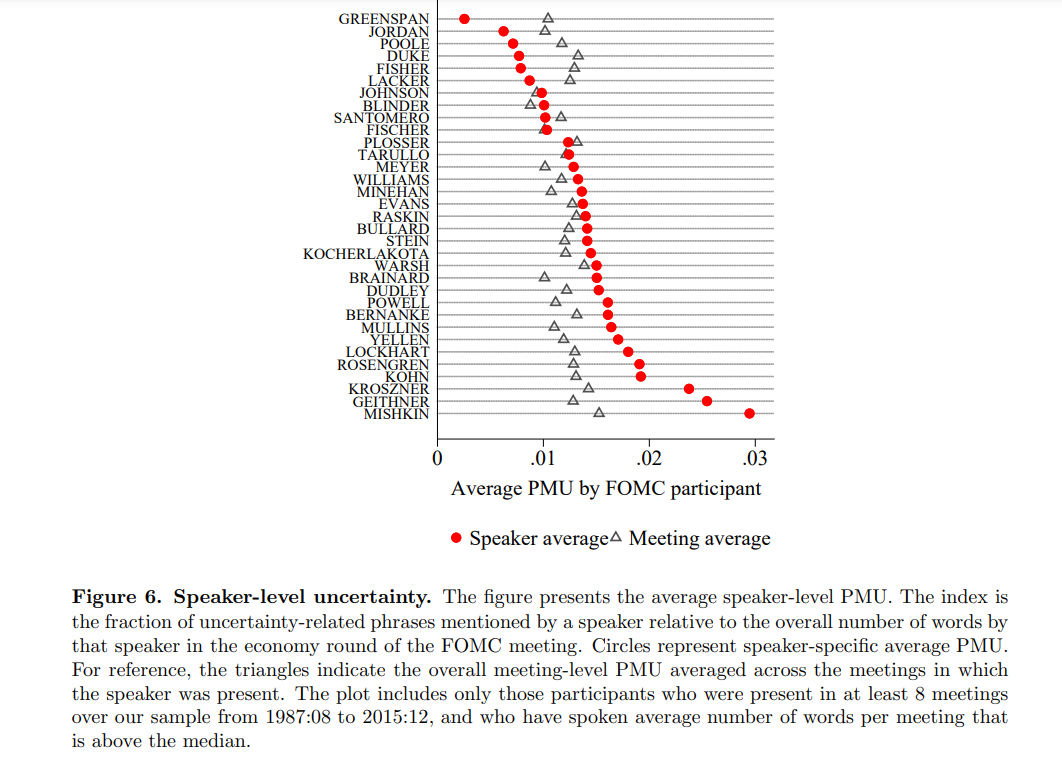
- They construct the policymakers’ uncertainty index, namely PMU, which is a count of phrases related to risk and uncertainty related to the discussion of the economy during every FOMC meeting from 1987–2015. The PMU indices depict the intensity with which policymakers express uncertainty when discussing the economic situation. The authors complement these indices with topic-specific measures of directional language, reflecting policymakers’ views about the path of inflation, real economy, and financial markets. The inflation PMU is, in fact, strongly procyclical.
- They develop a new textual measure of policy stance based on the balance of hawkish and dovish language, namely the hawk-dove score, of the FOMC members in the policy round of the meeting. The hawk-dove score varies in an intuitive way and is a highly significant predictor of the federal funds rate (FFR) target.
- They estimate a version of a policy rule in which they allow uncertainty to affect the strength of the policy response to projected inflation and growth and find that uncertainty leads to an amplification of the policy response to fluctuations in economic forecasts.
Consistent with models of inflation scares, policymakers place weight on low probability but costly and therefore salient events, but those events do not realize in our sample. Our results highlight the central role of policymakers’ beliefs in understanding how deviations from policy rules occur. They also cast light on plausible mechanisms to be incorporated in models of optimal policy choice under uncertainty.
Policymakers’ Uncertainty
Authors: Anna Cieslak, Stephen Hansen, Michael McMahon, Song Xiao
From: Duke University, Imperial College, Oxford University, London School of Economics
