• Twitter
  • Search
e-axes

360° Econ View

The issues, the debates, and the research

  • Home
  • Useful Data
  • About
  • Contact
  • Home
  • Useful Data
  • About
  • Contact

Monetary Policy

On average inflation targeting

Posted by e-axes on January 17, 2024

Read Next →

Monetary Policy

Macroeconomic Risk: From Scenario Synthesis to Distributional Transmission

Monetary Policy

Bank Heterogeneity and the Transmission of Monetary Tightening

Monetary Policy

When Debt Erodes Central Bank Independence

Average inflation targeting can be destabilizing

Honkapohja and McClung in this paper consider the question of whether average inflation targeting (AIT) can stabilize average inflation and anchor long-run expectations when key details of the policy regime are not public knowledge. The authors use a New Keynesian model with adaptive learning agents to analyze the performance of AIT to provide a detailed analysis of the potential de-anchoring risks associated with AIT. Honkapohja and McClung argue that:

The instability problem reflects a tension between stabilizing a finite moving average of inflation and stabilizing long-run inflation expectations which are influenced by data. Following a period of low inflation, the central bank aims for a period of high inflation. If agents underestimate the averaging window, they will confuse some part of the transitory rise in inflation for higher permanent inflation and raise long-run expectations accordingly. This de-anchoring of expectations from the target exacerbates the inflation overshooting of the target relative to the case of rational agents.

To mitigate this effect, the authors suggest either:

  • The adoption of an asymmetric policy that aims for overshooting of the inflation target but not undershooting of the target, can stabilize expectations under learning with opacity about the policy rule and averaging window.
  • The communication of the averaging window length i.e. the number of lags in the policy rule. If agents incorporate this information about the history-dependence of policy into learning, then the target steady state is fairly robustly stable, and AIT can even succeed in guiding the economy out of a liquidity trap.

On Robustness of Average Inflation Targeting
Authors: Seppo Honkapohja, Nigel McClung
From: Aalto University School of Business, Bank of Finland

Average inflation targeting is more robust than inflation targeting

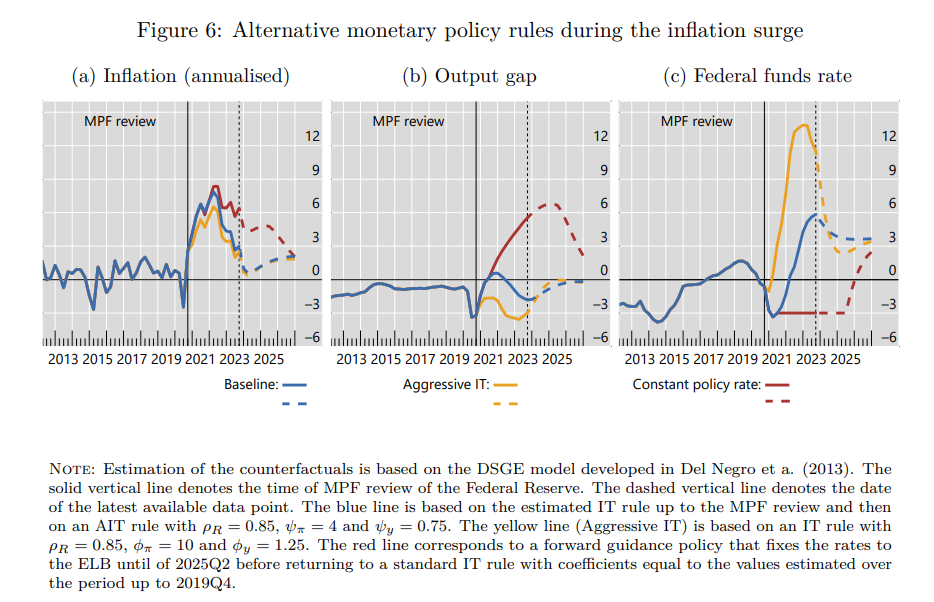
In this paper, de Fiore et al. discuss the performance of average inflation targeting compared to aggressive inflation targeting during the recent inflation surge. The authors use a medium-scale DSGE model to evaluate the role of different monetary policy rules in influencing the inflation path during 2019Q4-2023Q3. The analysis includes the estimation and simulations using the New York Fed model, and it considers alternative possible monetary policies of the Federal Reserve, such as an “aggressive” inflation targeting rule and an accommodative policy that provides forward guidance on future policy rates. They find:

We illustrate that the benefits of a dual mandate relative to a single mandate increase when the Phillips curve is flatter; that AIT rules tend to stabilize inflation and interest rates relative to IT rules but at the cost of higher output volatility; and that AIT is more robust than IT to a possible misperception of r∗.

Monetary policy frameworks away from the ELB
Authors: Fiorella De Fiore, Benoît Mojon, Daniel Rees, Damiano Sandri
From: BIS

Print Friendly, PDF & Email

e-axes

Read Next →

Monetary Policy

Macroeconomic Risk: From Scenario Synthesis to Distributional Transmission

Monetary Policy

Bank Heterogeneity and the Transmission of Monetary Tightening

Monetary Policy

When Debt Erodes Central Bank Independence

Comments are Closed

Account

  • Login

Subscriptions

You are not logged in.
Login
Subscribe

Subscriptions

Subscribe

Most Read

  • Gold, the Dollar, and the Geopolitics of Global Reserves
  • China and the Political Economy of Critical Minerals
  • Public Debt Maturity and Macroeconomic Policy Transmission
  • Bank Heterogeneity and the Transmission of Monetary Tightening
  • AI, Knowledge and the Future of Human Expertise
  • AI Valuations, Capital Investment, and Growth
  • New and Noteworthy Books in Economics (September)
  • AI and the Natural Rate: Puzzle or Policy Challenge?
  • Transfers, Taxes, and the Ricardian Equivalence
  • Can Institutions Limit the Economic Damage of Populism?

Sections

  • AI
  • Banking
  • Books
  • Brexit
  • CBDC
  • China
  • Climate
  • COVID-19
  • Crypto
  • Demographics
  • Economic Growth
  • Economic Science
  • Economics of Information
  • Emerging Markets
  • Eurozone
  • Financial Markets
  • Geoeconomics
  • Geopolitics
  • India
  • Inequality
  • Inflation
  • International Economics
  • Macro
  • Markets
  • Monetary Policy
  • Oil
  • Politics & Economics
  • Taxation
  • Tech
  • Trade
  • U.S.
  • Ukraine-Russia War
  • Uncategorized
  • Useful Data

© 2026 e-axes

  • Privacy Policy & Terms of Service

Theme by Anders Norén

This website uses cookies to improve your experience. We'll assume you're ok with this, but you can opt-out if you wish.
Cookie settingsAccept
Privacy & Cookies Policy

Privacy Overview

This website uses cookies to improve your experience while you navigate through the website. Out of these cookies, the cookies that are categorized as necessary are stored on your browser as they are as essential for the working of basic functionalities of the website. We also use third-party cookies that help us analyze and understand how you use this website. These cookies will be stored in your browser only with your consent. You also have the option to opt-out of these cookies. But opting out of some of these cookies may have an effect on your browsing experience.
Necessary
Always Enabled
Necessary cookies are absolutely essential for the website to function properly. This category only includes cookies that ensures basic functionalities and security features of the website. These cookies do not store any personal information.
SAVE & ACCEPT