

Policy Responses to Tax Competition
Edited by: David R. Agrawal, James M. Poterba, Owen M. Zidar – University of California, Irvine, MIT, Princeton University
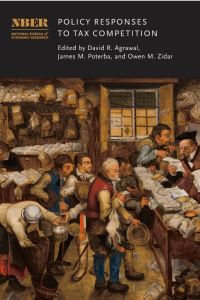 Policy Responses to Tax Competition provides an in-depth exploration of how jurisdictions design taxes on mobile economic factors. Tax competition between jurisdictions that seek to attract businesses and residents presents both opportunities and challenges. It can foster government efficiency and provide a counterweight to lobbying for increased spending, but it can also result in inefficiently low tax rates and revenue shortfalls as jurisdictions vie for tax bases. This volume examines the economic drivers and consequences of tax competition and presents empirical evidence on its effects.
Divided into three parts, the book first reviews existing research on the determinants and consequences of tax competition and related policy initiatives such as development incentives. The second section focuses on specific policies, such as the Kansas-Missouri noncompete pact and international measures like the OECD’s Base Erosion and Profit Shifting initiative, that are designed to limit tax competition. It also considers the economic responses to these policies, the distributional impact of competition-reducing policies, and potential strategic reactions of other governments. The final section presents case studies of the effects of various policies, including inter-municipal cooperation in France and corporate tax equalization in Switzerland.
The Enigma of Climate Inaction – Why Are We Doing Nothing (or Almost Nothing) in the Face of Catastrophe?
By: Frédéric Samama – Columbia University and Sciences Po

The Enigma of Climate Inaction explores humanity’s perplexing passivity in the face of the looming climate crisis—despite our having known about it for decades, the fact that we brought it into existence, and the existential threat it poses to our species.
Drawing on cutting-edge insights from cognitive science, anthropology, history, economy, finance, and philosophy, Samama argues that our success in accessing resources has bred an overconfidence in the systems that enable it. By uncovering the roots of our inaction, he moves beyond merely identifying the problem and offers a framework for action. He invites readers to experience a jolt in perspective—one that prompts a re-evaluation of our relationship with nature and our sense of responsibility.
This powerful and innovative examination of the cognitive and societal blind spots that obstruct urgent climate action and solutions provided will be especially valuable for professionals in environmental policy, the social sciences and humanities, and finance.
Drawing on the all-too-familiar reality of our inaction on climate change, Frédéric Samama offers a deeply innovative, interdisciplinary perspective that leads to a powerful idea: our past successes have created societal ‘bubbles’ that now hold us back from the exploration and adaptation we urgently need. This book is a timely and creative call to rethink how societies learn, evolve, and build resilience. A brilliant and essential contribution from someone who deeply understands both the financial and institutional landscapes.”
Philippe Aghion, Collège de France
Shared Prosperity in a Fractured World: A New Economics for the Middle Class, the Global Poor, and Our Climate
By: Dani Rodrik – Harvard University
 Fighting climate change, saving democracy, and eradicating poverty are urgent global challenges, yet the world’s leaders continue to pursue outdated policies that focus on one while worsening the tradeoffs between each of them. Shared Prosperity in a Fractured World shows how the nations of the world can achieve all three objectives.
Dani Rodrik provides a bold new vision of globalization, one in which we accelerate the green transition to achieve a sustainable planet, shore up the middle class to restore democracy’s foundations, and hasten economic revitalization in the developing world to put an end to poverty. The rising tide of authoritarianism has demonstrated our inability to alleviate economic anxieties. Economic nationalism has raised the specter of increased protectionism and deteriorating prospects for economic growth. And automation and other new technologies have undercut the advantages of low-cost, unskilled labor in manufacturing and export-oriented industrialization. Rodrik reveals how we can restore prosperity through new forms of collaborative public-private action—to promote renewables and green industries, middle-class jobs, and enhanced productivity in labor-absorbing services—even in the absence of global cooperation. He explains why this new kind of globalization must also recognize the legitimate desire of governments to pursue their economic, social, and security interests autonomously.
Turning conventional economic wisdom on its head, Shared Prosperity in a Fractured World builds on practices that work while radically transforming those that don’t, presenting a grounded, clear-eyed approach to tackling the problems that affect us all, at home and around the world.
Anticipating Instability – Assessing and Removing Risks Before They Happen
By: Bruce Bueno de Mesquita, Alastair Smith – New York University
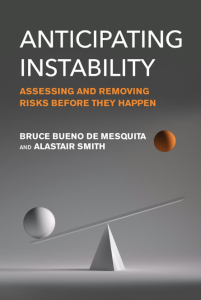 Anticipating Instability puts forward a general theory of politics that attempts to explain the very many destabilizing political events in history that did not happen. Although most of us do not pay close attention to what did not occur, research shows that fear of nonevents does more to redefine how people are governed than does the actual realization of coups and revolutions.
In unraveling the dogs that didn’t bark, Bruce Bueno de Mesquita and Alastair Smith analyze how, when, and why leaders who believe their hold on power is at risk focus their political survival efforts on adjusting their policy choices or shifting their government’s accountability. Such adjustments are the essential factors that determine whether a society becomes freer, more transparent, and prosperous—or more oppressive, corrupt, and impoverished.
The book is unique in that it develops a general theory of politics using game theory reasoning and then tests dozens of hypotheses derived from the theory’s logic using both statistical methods and illustrative case studies.
