

Imperfect Knowledge Economics: Exchange Rates and Risk
By: Roman Frydman, Michael D. Goldberg – New York University, University of New Hampshire
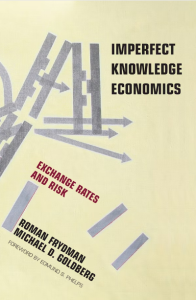 Frydman and Goldberg offer a long-overdue response to the shortcomings of conventional economic models. Drawing attention to the inherent limits of economists’ knowledge, they introduce a new approach to economic analysis: Imperfect Knowledge Economics (IKE). IKE rejects exact quantitative predictions of individual decisions and market outcomes in favor of mathematical models that generate only qualitative predictions of economic change. Using the foreign exchange market as a testing ground for IKE, this book sheds new light on exchange-rate and risk-premium movements, which have confounded conventional models for decades.
If you are looking for a way to escape from the Procrustean bed of rational expectations equilibrium—and, if you pay attention to real-world data, you should be—try reading this imaginative and intelligent book. It will amply repay your efforts.
Alan S. Blinder, Princeton University
The Fall and Rise of American Finance: from J.P. Morgan to Blackrock
By: Scott Aquanno, Stephen Maher – Ontario Tech University, SUNY Cortland
 The Fall and Rise of American Finance traces the collapse and reconstitution of American financial power from the disintegration of robber baron J. P. Morgan’s vast empire to the rise of finance behemoth BlackRock. Contrary to what is taken for common sense by figures from Hillary Clinton to Bernie Sanders, Maher and Aquanno insist that financialization did not imply the hollowing out of the “real” economy or the retreat of the state. Rather, it served to intensify competitive discipline to maximize efficiency, profits, and the exploitation of labor—with the support of an increasingly authoritarian state.
Taming the Cycles of Finance? Central Banks and the Macro-prudential Shift in Financial Regulation
By: Matthias Thiemann – Sciences Po Paris
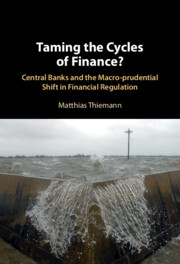 Macroprudential regulation is a set of economic and policy tools that aim to mitigate risk in the financial and banking systems. It was largely developed in response to the financial crisis of 2007-08, turning central banks into de facto financial policemen. Taming the Cycles of Finance traces the post-crisis rise of macroprudential regulation and argues that, despite its original aims, it typically supports finance in times of crisis but fails to curb it in times of booms. Investigating how different macroprudential frameworks developed in the UK, the USA and the Eurozone, the book explains how central bank economists went about building early warning systems to identify fragilities in the financial system. It then shows how administrative and political constraints limited the effects of this shift, as central banks were wary of intervening in a discretionary manner and policymakers were opposed to measures to limit credit growth.
Breaking the Mould: Reimagining India’s Economic Future
By: Raghuram Rajan, Rohit Lamba – University of Chicago, Pennsylvania State University
 India is at a crossroads today. Its growth rate, while respectable relative to other large countries, is too low for the jobs its youth needs. Intense competition in low-skilled manufacturing, increasing protectionism globally and growing automation make the situation still more difficult. Divisive majoritarianism does not help. India broke away from the standard development path—from agriculture to low-skilled manufacturing, then high-skilled manufacturing and, finally, services—a long time back by leapfrogging the intermediate steps. Rather than attempting to revert to development paths that may not be feasible any more, India must embark on a truly Indian path.
In this book, the authors explain how economic development can be accelerated by investing in people’s human capital, expanding opportunities in high-skilled services and manufacturing centered on innovative new products, and making India a ferment of ideas and creativity.
