• Twitter
  • Search
e-axes

360° Econ View

The issues, the debates, and the research

  • Home
  • Useful Data
  • About
  • Contact
  • Home
  • Useful Data
  • About
  • Contact

Macro

Macro policy and heterogeneous agents

Posted by e-axes on March 31, 2021

Read Next →

Macro

Measuring Expectations in Real Time: The Value and Limits of Kalshi Markets

Macro

AI Valuations, Capital Investment, and Growth

Macro

AI and the Natural Rate: Puzzle or Policy Challenge?

The household balance sheet channels of monetary policy

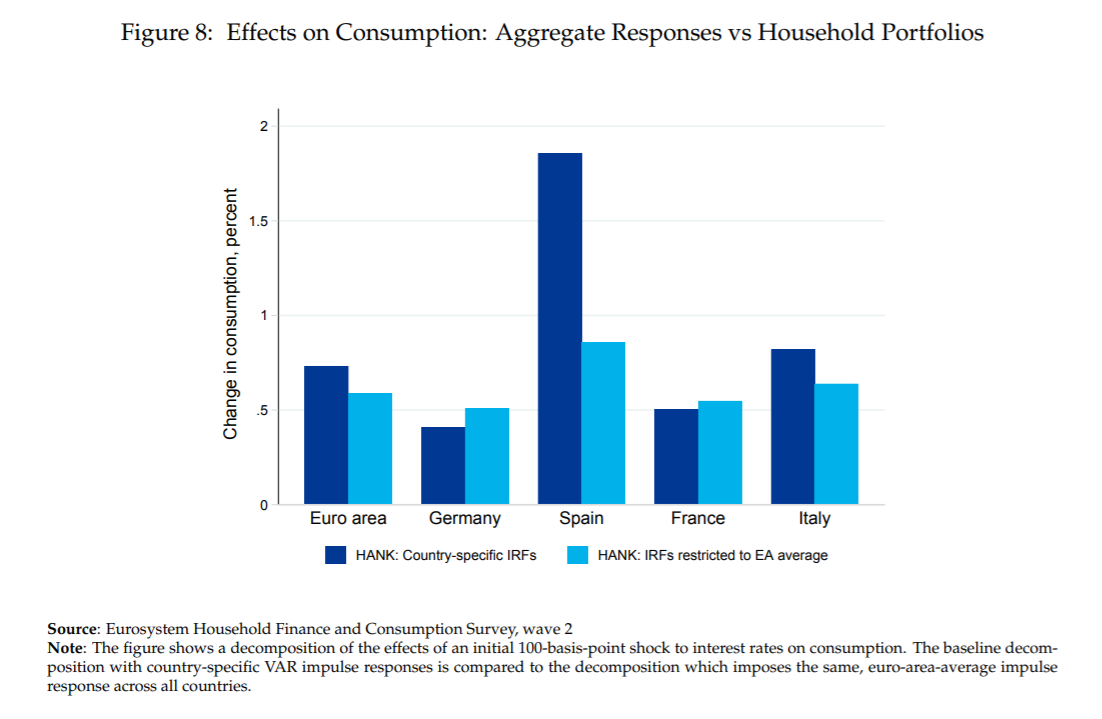
In this paper Slacalek et al. quantify the various transmission mechanisms of monetary policy to household consumption in the four largest countries in the euro area, namely Germany, France, Italy and Spain. They divide households in three classes: non hand-to-mouth, wealthy hand-to-mouth and poor hand-to-mouth based on their holdings of liquid and illiquid wealth. They combine cross-country micro data on income and household portfolios with structural VARs estimates of how monetary policy affects inflation, asset prices, and aggregate employment. Their main findings include:

  • The general equilibrium effect of an unexpected monetary easing on households’ labor income works through an expansion in aggregate demand and an increment in house prices. These are the principal determinants of the effect of monetary policy on aggregate consumption across countries;
  • This finding suggests that households with low liquidity account for the lion share of the consumption response to monetary policy shocks;
  • There are significant differences across countries: Germany displays the weakest response and Spain the strongest one to a common monetary shock.

Household Balance Sheet Channels of Monetary Policy: A Back of the Envelope Calculation for the Euro Area
Authors: Jiri Slacalek, Oreste Tristani, Giovanni L. Violante
From: ECB, Princeton University

When households have present bias

How does the household balance sheet channels of monetary and fiscal policies works when households have present bias time preferences and naive beliefs? This is the question that Laibson et al. are trying to answer in this paper. Their model is set in a partial equilibrium and includes households with low, moderate and high levels of wealth and income. Household balance sheets include a savings account and a house on the asset side, while on the liabilities side there are credit card debt and mortgages. In their model, households can borrow on their credit cards as well as against their home by refinancing their mortgage. In an economy with present-biased households:

Fiscal policy is a powerful and robust tool for macroeconomic stabilization. Monetary policy is a powerful yet sensitive policy tool. Present bias creates both high MPCs and a large share of constrained households. These households are quick to spend down liquidity, making fiscal policy a high-powered tool for generating a short-run consumption boom. Present bias increases the potency of monetary policy for a similar reason: rate cuts produce cash-out refinances, which mirror the liquidity injection features of fiscal policy. Though powerful, the refinancing channel of monetary policy is sensitive to refinancing inertia. Procrastination increases the lag between rate cuts and refinancing, generating a milder but longer-lived stimulus.

Present Bias Amplifies the Household Balance-Sheet Channels of Macroeconomic Policy
Authors: David Laibson, Peter Maxted, Benjamin Moll
From: Harvard University, London School of Economics

Print Friendly, PDF & Email

e-axes

Read Next →

Macro

Measuring Expectations in Real Time: The Value and Limits of Kalshi Markets

Macro

AI Valuations, Capital Investment, and Growth

Macro

AI and the Natural Rate: Puzzle or Policy Challenge?

Comments are Closed

Account

  • Login

Subscriptions

You are not logged in.
Login
Subscribe

Subscriptions

Subscribe

Most Read

  • Bank Heterogeneity and the Transmission of Monetary Tightening
  • Central Bank Losses and Public Debt: Constraints on Inflation Control
  • AI Valuations, Capital Investment, and Growth
  • How Firms’ Cost Expectations Shape Prices
  • Communicating Uncertainty: Fan Charts, Confidence, and Credibility
  • The AI Infrastructure Boom: Productive Investment or Financial Fragility?
  • Macroeconomic Risk: From Scenario Synthesis to Distributional Transmission
  • Measuring Expectations in Real Time: The Value and Limits of Kalshi Markets
  • Measuring Global Tensions Using AI
  • When Markets Drift from the Real Economy

Sections

  • AI
  • Banking
  • Books
  • Brexit
  • CBDC
  • China
  • Climate
  • COVID-19
  • Crypto
  • Demographics
  • Economic Growth
  • Economic Science
  • Economics of Information
  • Emerging Markets
  • Eurozone
  • Financial Markets
  • Geoeconomics
  • Geopolitics
  • India
  • Inequality
  • Inflation
  • International Economics
  • Macro
  • Markets
  • Monetary Policy
  • Oil
  • Politics & Economics
  • Taxation
  • Tech
  • Trade
  • U.S.
  • Ukraine-Russia War
  • Uncategorized
  • Useful Data

© 2026 e-axes

  • Privacy Policy & Terms of Service

Theme by Anders Norén

This website uses cookies to improve your experience. We'll assume you're ok with this, but you can opt-out if you wish.
Cookie settingsAccept
Privacy & Cookies Policy

Privacy Overview

This website uses cookies to improve your experience while you navigate through the website. Out of these cookies, the cookies that are categorized as necessary are stored on your browser as they are as essential for the working of basic functionalities of the website. We also use third-party cookies that help us analyze and understand how you use this website. These cookies will be stored in your browser only with your consent. You also have the option to opt-out of these cookies. But opting out of some of these cookies may have an effect on your browsing experience.
Necessary
Always Enabled
Necessary cookies are absolutely essential for the website to function properly. This category only includes cookies that ensures basic functionalities and security features of the website. These cookies do not store any personal information.
SAVE & ACCEPT