
• Twitter
  • Search
e-axes

360° Econ View

The issues, the debates, and the research

  • Home
  • Useful Data
  • About
  • Contact
  • Home
  • Useful Data
  • About
  • Contact

Monetary Policy

Is forward guidance effective?

Posted by e-axes on January 18, 2024

Read Next →

Monetary Policy

Central Bank Losses and Public Debt: Constraints on Inflation Control

Monetary Policy

Communicating Uncertainty: Fan Charts, Confidence, and Credibility

Monetary Policy

Macroeconomic Risk: From Scenario Synthesis to Distributional Transmission

Forward guidance is effective

In this paper, Koeda and Wei, present a macro-finance shadow-rate term structure framework to analyze the linkages between macroeconomics and finance at and near the effective lower bound (ELB) through a state-dependent forward guidance. The authors apply this framework to the United States and provide several key findings, including the impact of outcome-based forward guidance during the global financial crisis (GFC) and the COVID-19 pandemic. Their findings include:

  • Effectiveness of Outcome-Based Forward Guidance: The authors demonstrate that outcome-based forward guidance is effective and has significant monetary-easing effects on the real economy during periods at the effective lower bound (ELB), such as the global financial crisis (GFC) and the COVID-19 pandemic.
  • Impact on Unemployment Rate: Koeda and Wei find that the unconventional monetary policies lowered the unemployment rate by 0.8 percent during both the GFC and the pandemic, with outcome-based forward guidance contributing more in the former than in the latter ELB period (about 0.30 percent versus 0.15 percent).

Forward Guidance and Its Effectiveness: A Macro-Finance Shadow-Rate Framework
Authors: Junko Koeda, Bin Wei
From: Waseda University, Federal Reserve Bank of Atlanta

Forward guidance led to policy errors

The Fed and the ECB fell into the forward guidance trap after the pandemic, argues Athanasios Orphanides in this paper. Both central banks provided appropriate accommodation during the pandemic but failed to unwind this accommodation in a timely manner guiding real interest rates to inappropriately negative levels as the economy recovered. This led to high inflation. The policy error can be traced to decisions regarding forward guidance on policy rates. Orphanides highlights the importance of a forward-looking rule that properly adjusts the nominal interest rate with the evolution of the inflation outlook as a superior guide for systematic monetary policy. As can be seen from the figure below, for over a year before lift-off, as inflation rose and the inflation outlook deteriorated, both the Fed and ECB kept guiding real interest rates to lower and more negative levels.
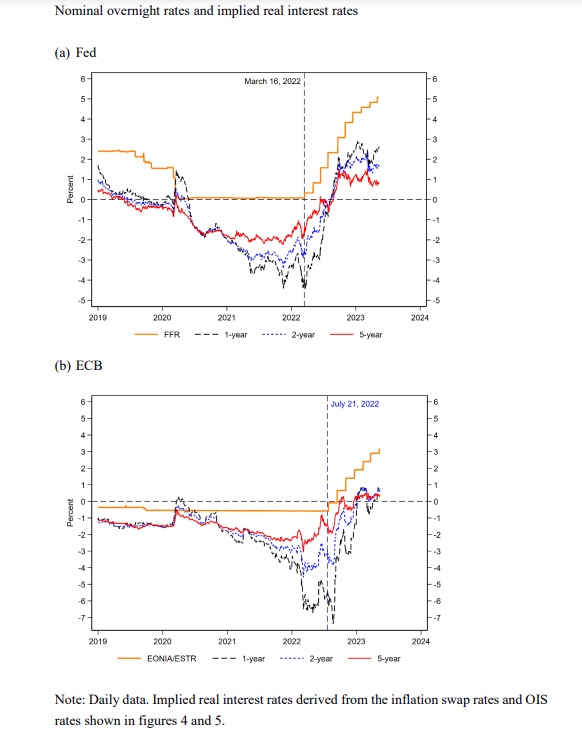
How can we explain why the Fed fell into this trap? Two elements in the Fed’s implementation of forward guidance induced a significant delay in the policy response to an unexpected increase in inflation: First, a decision to move from forecast-based to outcome-based forward guidance; And second, an implicit commitment to a gradual reduction of net asset purchases (tapering), and to raising policy rates only after net asset purchases ended.

How did forward guidance lead the ECB into this trap? Two elements induced a significant delay in the ECB’s policy response to an unexpected increase in inflation: First, a calendar-based implementation of two asset purchase programs, with a preannounced schedule of net purchases (over a year, on some occasions). Second, a commitment to raising policy rates only after net asset purchases ended—a “sequencing” restriction that was an important component of the ECB’s forward guidance.

The Forward Guidance Trap
Author: Athanasios Orphanides
From: MIT

Print Friendly, PDF & Email

e-axes

Read Next →

Monetary Policy

Central Bank Losses and Public Debt: Constraints on Inflation Control

Monetary Policy

Communicating Uncertainty: Fan Charts, Confidence, and Credibility

Monetary Policy

Macroeconomic Risk: From Scenario Synthesis to Distributional Transmission

Comments are Closed

Account

  • Login

Subscriptions

You are not logged in.
Login
Subscribe

Subscriptions

Subscribe

Most Read

  • Bank Heterogeneity and the Transmission of Monetary Tightening
  • Central Bank Losses and Public Debt: Constraints on Inflation Control
  • AI Valuations, Capital Investment, and Growth
  • How Firms’ Cost Expectations Shape Prices
  • Communicating Uncertainty: Fan Charts, Confidence, and Credibility
  • The AI Infrastructure Boom: Productive Investment or Financial Fragility?
  • Macroeconomic Risk: From Scenario Synthesis to Distributional Transmission
  • Measuring Expectations in Real Time: The Value and Limits of Kalshi Markets
  • Measuring Global Tensions Using AI
  • When Markets Drift from the Real Economy

Sections

  • AI
  • Banking
  • Books
  • Brexit
  • CBDC
  • China
  • Climate
  • COVID-19
  • Crypto
  • Demographics
  • Economic Growth
  • Economic Science
  • Economics of Information
  • Emerging Markets
  • Eurozone
  • Financial Markets
  • Geoeconomics
  • Geopolitics
  • India
  • Inequality
  • Inflation
  • International Economics
  • Macro
  • Markets
  • Monetary Policy
  • Oil
  • Politics & Economics
  • Taxation
  • Tech
  • Trade
  • U.S.
  • Ukraine-Russia War
  • Uncategorized
  • Useful Data

© 2026 e-axes

  • Privacy Policy & Terms of Service

Theme by Anders Norén

This website uses cookies to improve your experience. We'll assume you're ok with this, but you can opt-out if you wish.
Cookie settingsAccept
Privacy & Cookies Policy

Privacy Overview

This website uses cookies to improve your experience while you navigate through the website. Out of these cookies, the cookies that are categorized as necessary are stored on your browser as they are as essential for the working of basic functionalities of the website. We also use third-party cookies that help us analyze and understand how you use this website. These cookies will be stored in your browser only with your consent. You also have the option to opt-out of these cookies. But opting out of some of these cookies may have an effect on your browsing experience.
Necessary
Always Enabled
Necessary cookies are absolutely essential for the website to function properly. This category only includes cookies that ensures basic functionalities and security features of the website. These cookies do not store any personal information.
SAVE & ACCEPT