


Should r* be solely measured as the return to government bonds?
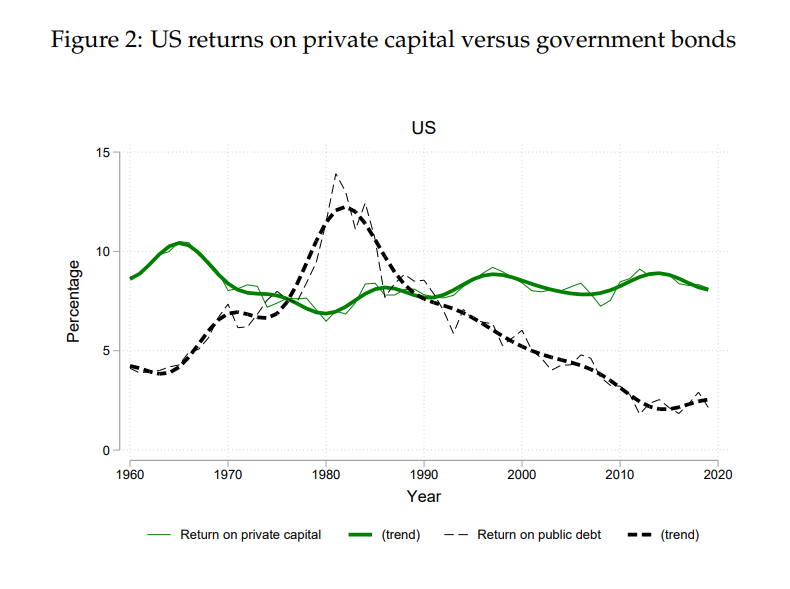
In this paper, Ricardo Reis shows empirically that if r* is measured as the return on private capital then after taking into consideration different views on what is capital, or different advanced economies, the robust finding is that r* has been constant or has slightly risen. At the same time, because the return on government bonds has fallen, there has emerged a large wedge between these two rates of return in the economy.
He then develops a new Keynesian model for monetary policy and solves for equilibria with nominal rigidities while focusing on long-run steady states, so that these are, in some interpretations, versions of r*. Reis finds that a rise in the misallocation of investment because of financial frictions explains the wedge between the return on government bonds and the return on private capital. Some important implications of this theory:
- The return on government bonds is the right focus to understand if monetary policy will be constrained, but the return on private capital is the right object to focus on to measure the transmissions of monetary policy to investment.
- There is a need for effective policies aimed at improving the mechanisms by which the economy allocates capital to different agents. This can be achieved either by better regulation, lowering market power in the financial industry, or promoting financial innovation.
All together, focusing exclusively on the return on government bonds as the measure of r*, while neglecting the return on private capital, leads to the wrong policy advice. Was this a cause of the rise in inflation in 2021-22? Perhaps, since this framework contributed to a tolerance towards higher inflation and elevated inflation expectations as well as a focus on aggregate demand.
Has monetary policy cared too much about a poor measure of r-star?
Author: Ricardo Reis
From: LSE
