


Macro analysis with alternative big data
In this paper, Yang et al., create a knowledge graph (KG) which highlights the linkages between traditional economic variables and massive alternative big data variables. They extract these variables and linkages by applying advanced natural language processing tools on the massive dataset that consists of academic literature and research reports. They use the KG-model in forecasting and test their hypothesis that short term forecasting relies more on data, while long term forecasting relies more on capturing the underlying logic in the problem:
- The baseline model is more of a pure data-driven model, whereas the KG-based model tries to capture the underlying logic.
- The better long term performance of the KG-based model serves as a confirmation that the relationships described in the knowledge graph correctly represent the true logic of the economic system under investigation.
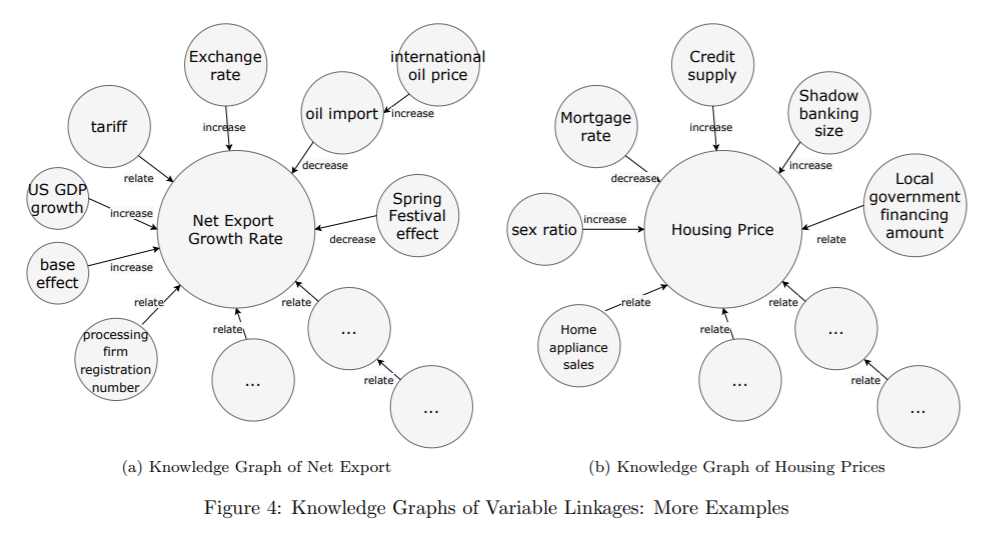
The Knowledge Graph for Macroeconomic Analysis with Alternative Big Data
Authors: Yucheng Yang, Yue Pang, Guanhua Huang, Weinan E
From: Princeton University, Peking University, University of Science and Technology China
