Risky vs safe debt regimes
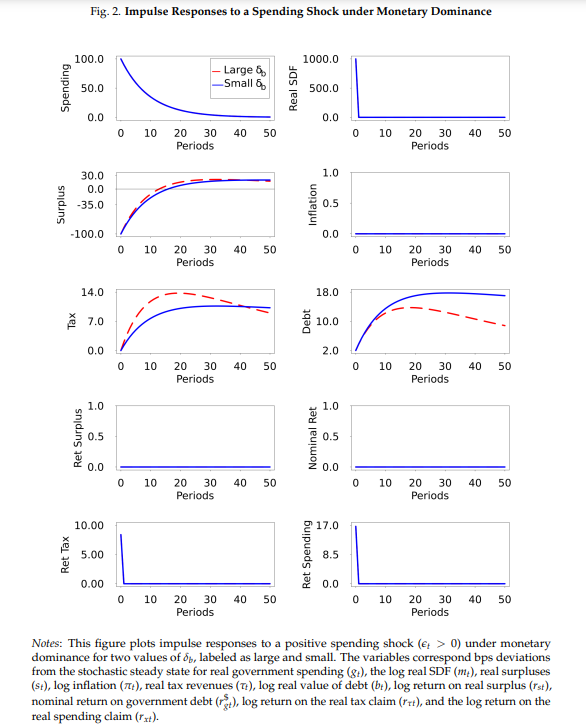
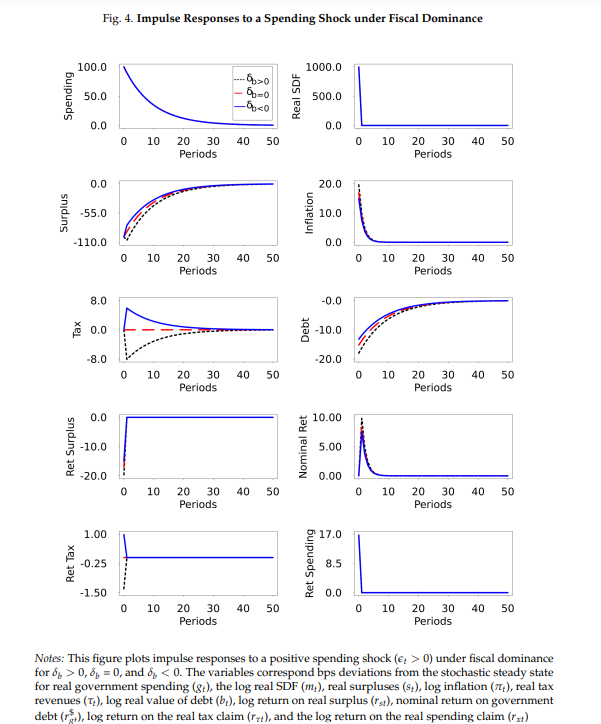
Gomez-Cram et al. explore the dynamics of government debt in mature economies, particularly focusing on the distinction between “safe” and “risky” debt regimes. The authors use a model adapted from previous work by the authors and others, including Leeper (1991), and is used to illustrate the implications of different policy regimes on government debt. They identify two policy regimes: a) Monetary Dominance, where the central bank leads by targeting inflation through adjustments in the nominal short rate and the fiscal authority adjusts taxes to stabilize debt, ensuring that government debt remains safe (risk-free); b) Fiscal Dominance where the fiscal authority does not fully offset spending shocks with future taxes, leading to a risky debt regime where bondholders bear the risk of fiscal expansions. Finally, government spending is modeled as a stochastic process, introducing shocks that affect the fiscal balance.
- Recent Trends: The authors argue that the recent experiences of the U.S. and other mature economies fit better with the risky debt regime. During the COVID-19 pandemic, U.S. Treasury yields increased in response to fiscal news, indicating that bondholders were bearing the risk of unfunded government spending.
- COVID-19 Case Study: The paper uses the COVID-19 pandemic as a case study. During this period, there were significant increases in government spending without corresponding increases in taxes. As a result, U.S. Treasury yields rose, and the real value of Treasurys was marked down by about 26% in real terms.
- Impact of Central Bank Interventions: Large-scale asset purchases by central banks provided temporary price support to government bonds but at a cost to taxpayers. The authors suggest that such interventions may impede the mark-to-market process, which is necessary for reflecting the true risk of government debt.
- Policy Implications: The findings suggest that policymakers need to consider the trade-offs between insuring taxpayers and bondholders. In a risky debt regime, large-scale asset purchases can distort incentives and impair price discovery in government bond markets.
- Empirical Evidence: The paper provides high-frequency evidence linking U.S. Treasury yield increases to adverse fiscal news during the COVID-19 period. This supports the view that the U.S. was operating under a risky debt regime during this time.
Government Debt in Mature Economies. Safe or Risky?
Authors: Roberto Gomez-Cram, Howard Kung, Hanno Lustig
From: New York University, London Business School, Stanford University
Elections and government debt
In this chapter of IMF’s Fiscal Monitor (April 2024) there is a discussion of the impact of elections on government spending in advanced countries, highlighting several key points:
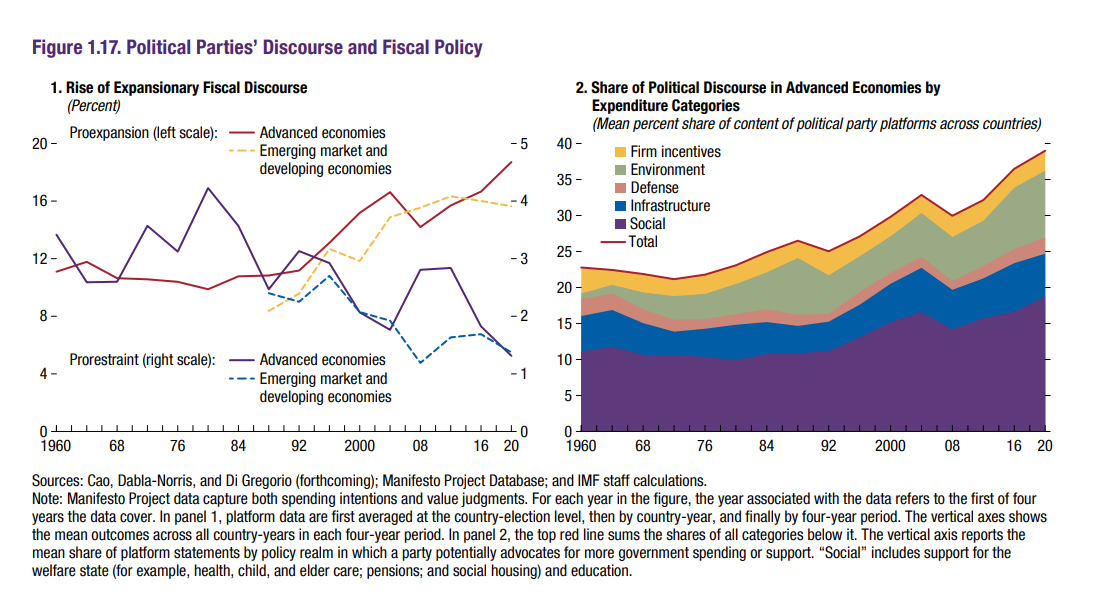
- Political Budget Cycles: The paper notes that election years often lead to fiscal slippages, a phenomenon known as “political budget cycles.” During election years, governments tend to increase spending and reduce revenues, resulting in higher fiscal deficits. The paper cites empirical evidence showing that deficit outturns in election years are typically higher by 0.3 percentage points of GDP compared to non-election years. This increase is primarily due to both higher spending and lower revenues.
- Increased Demand for Public Spending: The paper highlights that the 2024 election year is characterized by heightened demand for public spending. This demand is driven by electoral platforms that increasingly support higher social spending, including entitlements that are difficult to reverse. This trend is observed across the political spectrum, making fiscal consolidation challenging in the years following elections.
- Fiscal Slippages and Inflationary Pressures: The paper warns that fiscal slippages during election years can exacerbate inflationary pressures, particularly in economies that are already overheated. Although higher deficits during election years are often followed by fiscal adjustments in subsequent years, these adjustments tend to be partial, leading to increased fiscal volatility and potential adverse effects on long-term growth.
- Medium-Term Fiscal Outlook: Despite planned fiscal tightening in 2024, the paper expresses concerns about the risk of fiscal slippages due to the high number of elections. It emphasizes the need for decisive fiscal consolidation to ensure fiscal sustainability and reduce public debt levels over the medium term. The paper suggests that governments should phase out crisis-era fiscal measures and implement reforms to curb rising spending.