Central banks face a trade-off
Central banks need to answer: What economic problems, are not your job to worry about? What tools will you not use? Central banks need to choose the power and allure of trying to fix everything, and thus acting politically, vs. the limitations that allow independence.
Central Bank Independence
By: John Cochrane – Stanford University
Political pressure on central banks
Carola Conces Binder uses data from country reports on 118 central banks from 2010 to 2018 to analyze the effect of reported political pressure on central banks. She finds that 10% of central banks face political pressure in an average year. Even central banks with high legal independence frequently face pressure usually from governments with left-wing or nationalist executives, few checks and balances, or weak electoral competition.
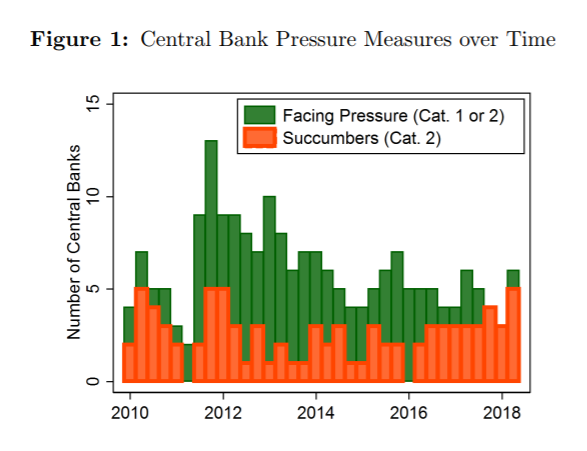
Political Pressure on Central Banks
Author: Carola Conces Binder
From: Haverford College
Central banking in a democratic society
[I]n an economy with fractional-reserve banking, the central bank is unavoidably the lender of last resort -liquidity reinsurer – to the private part of the monetary system; and that in that guise – the economic equivalent of the US cavalry – it inevitably has a role in prudential policy and supervision. And fourth that our democratic constitutionalist values demand that that prudential function be formalised, including specifying a clear objective for banking system resilience that can be monitored rather than just taken on trust.
How the ECB and other independent agencies reveal a gap in constitutionalism: a spectrum of institutions for commitment
By: Paul Tucker – Harvard University
(a worth while 15 min read)