


The 2026 GMT deal has unequal winners in the EU
How much new room does the January 2026 Side-by-Side agreement give EU member states to offer tax incentives to multinationals and is that room distributed fairly across the EU? This is the question Roel Dom is attempting to answer in this commentary.
The author focuses on a largely overlooked element of the January 2026 OECD “Side-by-Side” deal: the new Substance-Based Tax Incentive Safe Harbour (SBTI-SH). While the deal’s political headline was accommodating the US tax system within Pillar Two, the SBTI-SH quietly expands the space for EU governments to grant tax breaks to multinationals without triggering top-up taxation.
What the SBTI-SH does
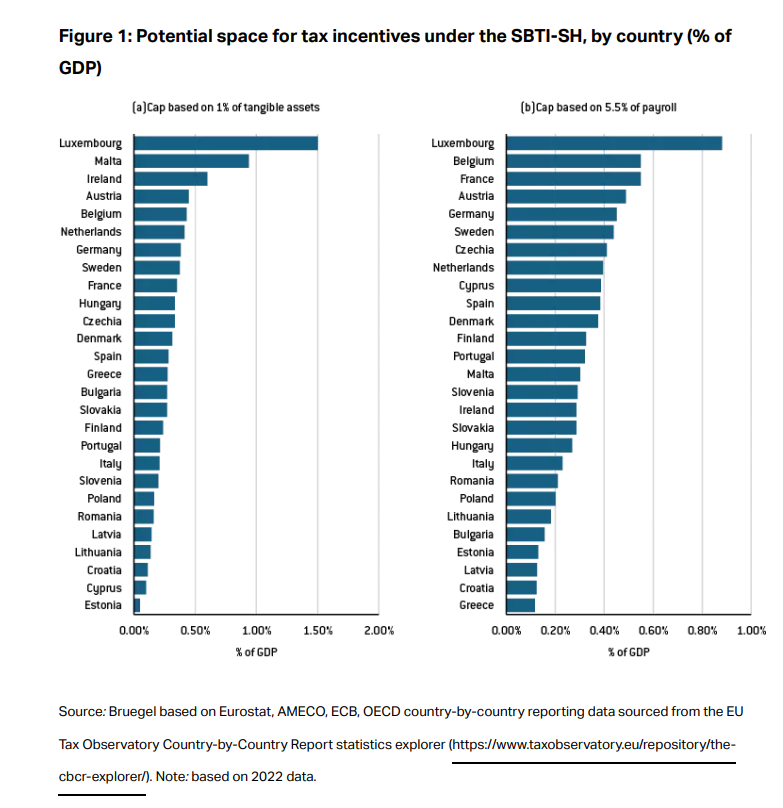
Under original Pillar Two rules, non-refundable tax incentives (like investment deductions) triggered top-up taxes, effectively nullifying them. The SBTI-SH changes this: non-refundable “Qualified Tax Incentives” (QTIs) that are strongly linked to real economic substance (payroll or tangible assets) can now reduce effective tax rates below 15% without triggering top-up taxation. The leeway is capped at the greater of 5.5% of payroll costs or 1% of the carrying value of tangible assets.
Who Benefits in the EU?
Using OECD country-by-country reporting data, the paper maps the potential leeway for each EU member state and finds three distinct groups:
- High leeway on both metrics (assets and payroll): Luxembourg, Austria, Belgium, the Netherlands, and Germany
- Leeway driven mainly by assets (capital-intensive): Malta, Ireland, Hungary, and Greece
- Leeway driven mainly by payroll (employment-heavy): France, Finland, Portugal, with Cyprus standing out particularly strongly
Countries like Estonia, Croatia, and Latvia have minimal leeway on either metric.
Roel Dom raises three concerns:
- Tax competition risk: The SBTI-SH opens a new channel for industrial-policy competition within the EU single market raising coordination concerns.
- Revenue trade-off: By limiting the extent to which tax incentives trigger top-up taxes, the SBTI-SH reduces minimum-tax revenues with significant variation across countries.
- US competitive advantage: The reform was primarily designed to reduce tax exposure for US subsidiaries of non-US multinationals, which may disadvantage EU firms relative to their US competitors.
How the global minimum tax amendments could reshape Europe’s tax incentives
By: Roel Dom – Bruegel
After the 2026 agreement, is the GMT still welfare-improving for most countries?
This is the question that Lídia Brun, Daniel Stöhlker, Jonathan Pycroft, and Maarten van ’t Riet analyze in this paper.
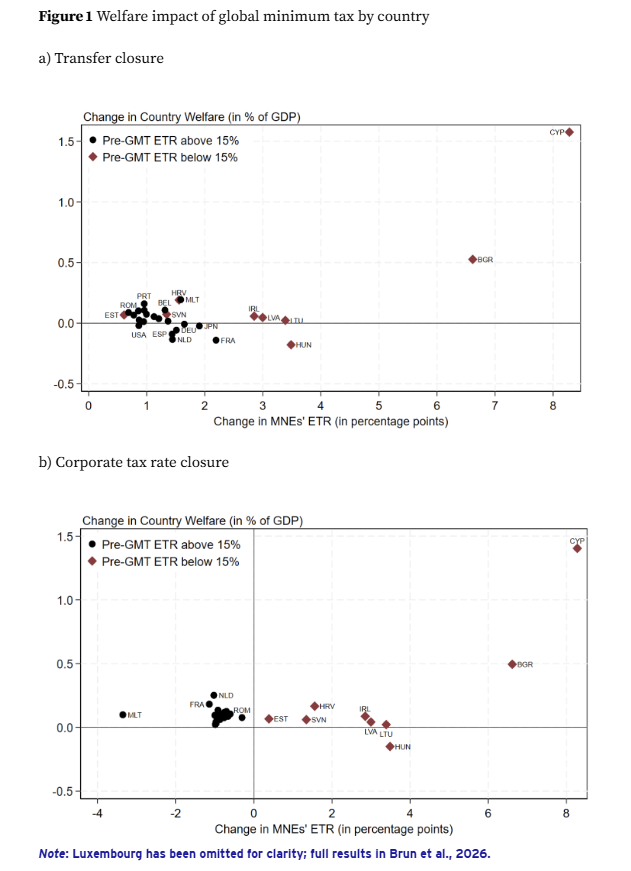
The authors use CORTAX, the European Commission’s computable general equilibrium (CGE) model for corporate taxation, covering all 27 EU member states plus the US, UK, Japan, and a representative tax haven. They measure welfare changes using compensating variation i.e. the monetary amount needed to make households indifferent between the pre- and post-GMT situations. Two scenarios are tested depending on how governments recycle the extra revenue raised by the GMT:
- Transfer closure: additional revenues are redistributed to households as lump-sum transfers
- Corporate Income Tax (CIT) rate closure: additional revenues are used to reduce statutory corporate tax rates (while staying at or above 15%), leaving corporate tax revenues revenue-neutral
Findings
- Global welfare is positive in both scenarios. Under either closure, the sum of welfare gains across countries exceeds losses, meaning winners could in principle compensate losers.
- National results are uneven. Under the transfer closure, some high-tax countries (notably France, Germany, and Spain) experience small welfare losses, while low-tax EU countries tend to gain. Under the CIT rate closure, welfare gains become almost universal.
- The optimal rate is slightly above 15%. The model finds that a GMT of 16% maximizes global welfare under the CIT rate closure, and 18% under the transfer closure, suggesting the agreed 15% is directionally right but marginally too low.
- US non-participation is second-order. Earlier related modelling finds that US opt-out has only minor effects on EU member states’ revenues a reassuring finding for the newsletter’s narrative about the GMT surviving Trump.
The global minimum tax: More winners than losers – even without the US
Authors: Lídia Brun, Daniel Stöhlker, Jonathan Pycroft, Maarten van ’t Riet
From: European Commission, Leiden University


