• Twitter
  • Search
e-axes

360° Econ View

The issues, the debates, and the research

  • Home
  • Useful Data
  • About
  • Contact
  • Home
  • Useful Data
  • About
  • Contact

Tech

If AI Is a Bubble, Who Goes Down With It?

Posted by e-axes on January 6, 2026

Read Next →

Tech

The AI Productivity Puzzle: What Corporate Executives Are Saying

Tech

Can AI Risks Be Insured?

Tech

Neural Networks: How AI is Reshaping Economic Modeling

Multiple equilibria in AI: Why high valuations are both justified and fragile

Ricardo Caballero, in this paper, applies the speculative-growth framework from Caballero et al. (2006) to model multiple equilibria in AI investment and valuation dynamics. The approach is built on three key conditions:

  1. Funding feedback mechanism: As AI displaces labor income, wealth concentrates among high-saving capital owners, whose savings rates push down interest rates, validating elevated asset valuations.
  2. Flat marginal product of capital (MPK) region: AI’s ability to substitute for labor across a broad range of tasks allows capital accumulation without rapidly diminishing returns. In this “AI deployment” region, each additional unit of AI displaces labor, keeping the effective capital-labor ratio constant.
  3. Intermediate adjustment costs: Asset prices can exceed replacement cost (Tobin’s q > 1), allowing capital gains to finance investment and expectations of future growth to be capitalized into current valuations.

Key findings

  • Multiple equilibria exist: The economy can rest at a low-capital equilibrium (high interest rates, no AI) or a high-capital equilibrium (low interest rates, saturated AI, high wages). A middle equilibrium is unstable.
  • Elevated valuations are integral, not irrational: The transition from low to high capital requires elevated asset prices throughout. High asset prices finance the investment boom that ultimately validates optimism—they are not symptoms of exuberance but equilibrium mechanisms.
  • Inherent fragility: The same mechanism enabling the boom enables its reversal. A loss of confidence, due to negative AI news or sentiment shift, can trigger a self-fulfilling crash, causing the economy to revert to the low-capital state. The January 2025 DeepSeek shock exemplifies this vulnerability.
  • Dynamic path characteristics: During the transition, Tobin’s q jumps, investment surges, interest rates decline as wealth accumulates, wages initially stagnate, as AI displaces labor, and the labor share compresses until AI saturates.
  • Implication: Both “bubble” and “not bubble” perspectives can be simultaneously correct. The high valuations are justified if growth materializes, but the transition is fragile and could unwind abruptly.

Speculative Growth and the AI “Bubble”
Author: Ricardo J. Caballero
From: MIT

AI’s historical precedents: Transformative booms often precede busts

This article puts forth some interesting ideas:

  • The current AI boom is multi-channel: a) unusually rapid consumer + firm adoption since the emergence of user-friendly chatbots (post–Nov 2022); b) a major surge in AI hardware/software investment; and c) a sharp re-rating of “Big Tech” equities.
  • Economic history suggests transformative technologies often experience booms with intermittent busts even when the technology ultimately becomes foundational (railroads, internet), implying that “bubble-like” dynamics can coexist with genuine long-run value.
  • The article distinguishes two bubble mechanisms worth monitoring: a financial-market bubble where prices driven by momentum and optimism beyond fundamentals, later reverse, and a real-economy/infrastructure bubble when overbuilding network capacity is followed by bankruptcies and financial stress, with railroads (panic of 1873) and dot-com offered as archetypes.
  • It lays out several plausible forward paths for AI:
    (i) “Dashed expectations” where AI delivers sectoral gains but aggregate productivity/profitability lags for years (common historically),
    (ii) A “profitability bust” where investment is real but AI software revenues fail to scale enough to justify spending even if AI users benefit,
    (iii) A shakeout within an ongoing boom, with few winners and many losers, driven by network effects and scale economies.
  • A key near-term tension flagged: chipmakers have captured substantial profits, while AI software monetization is still limited, raising the possibility that returns accrue primarily to a small set of winners and/or that parts of the AI supply chain become commoditized.
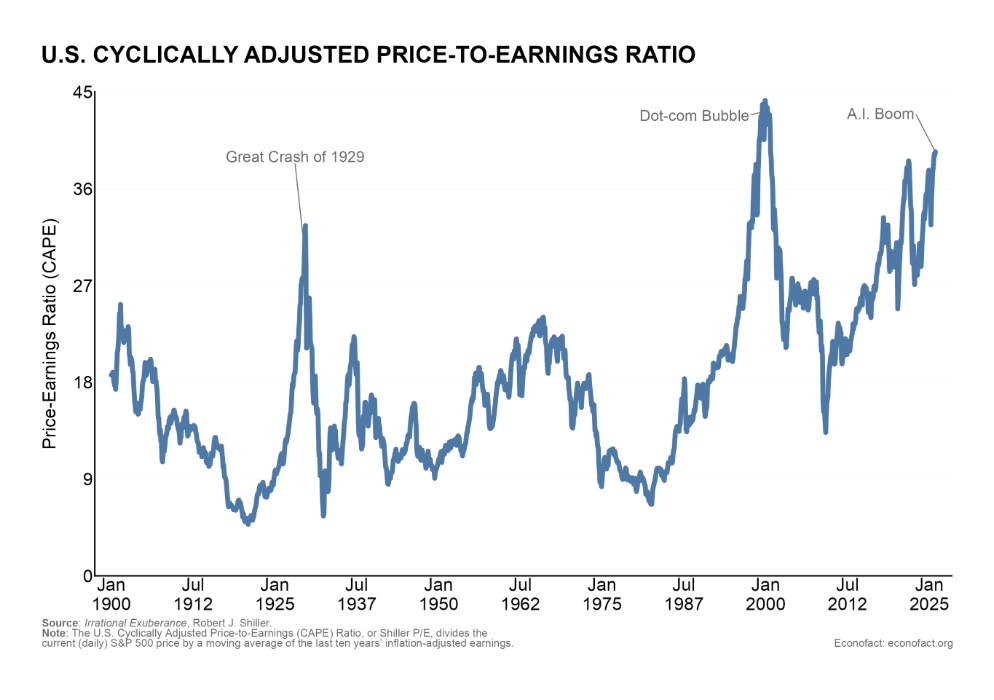

Tracking the AI Boom: Some Lessons From Economic History
By: Econofact

Who bears the risk if AI valuations break?

This article maps AI exposure across the full AI stack (hyperscalers, model developers, specialized chipmakers, networking/cooling suppliers, data-center operators, utilities, commodity producers), stressing that valuation shocks can cascade well beyond “Big Tech” into energy, real estate and materials. It highlights the concentration of market-cap in AI-exposed names, an estimated 44% of the S&P 500 via an AI basket, to motivate why any sharp repricing could be macro-relevant even before considering leverage.

Debt-financed infrastructure and power as a bottleneck

  • Unlike the above paper and article, this Bank of England article foregrounds the funding mix of the AI boom: trillions in projected AI data-center and energy CAPEX with a rising share financed by external debt and private credit. For example, Morgan Stanley’s estimate that around half of 2025–28 AI infrastructure spending is externally financed.
  • It stresses that this build-out is doubly constrained by compute and electricity, with data-center power demand expected to more than double and to require massive incremental generation capacity, making power availability and price a key determinant of both AI progress and credit risk.

Triggers for repricing and cross-market spillovers

  • The article provides a taxonomy of shock types that could force a reassessment of AI cash-flow paths: slower-than-expected capability progress, disappointing user adoption or monetization, binding constraints in power/data/chips, or algorithmic breakthroughs (like DeepSeek) that suddenly change which parts of the stack are valuable.
  • It extends the discussion beyond equities by tracing how an AI-driven shock could propagate through commodity markets, drawing analogies to past stress episodes such as the LME nickel squeeze.

Financial stability lens: from equity story to systemic risk

  • In contrast to the more “valuation versus fundamentals” framing of the above paper and article, this Bank of England article frames AI primarily as a financial-stability question: equity-heavy exposure so far has limited systemic risk, but the projected pivot toward debt-financed infrastructure materially increases the stakes.
  • The article emphasizes who holds the risk (banks, private credit funds, and leveraged investors in AI-sensitive equity and commodity positions) and underlines the danger of hidden leverage (e.g. Archegos-style structures) as a key amplifying mechanism in any AI-related asset-price correction.
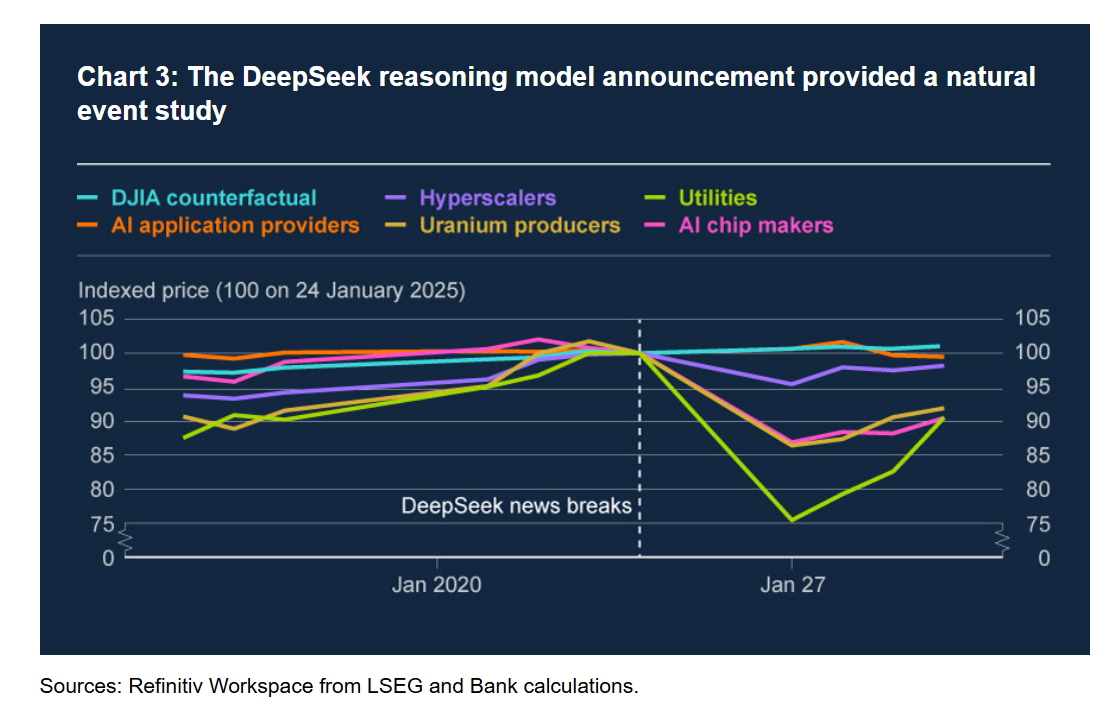

All chips in! Would a fall in AI-related asset valuations have financial stability consequences?
By: Bank of England

Print Friendly, PDF & Email

e-axes

Read Next →

Tech

The AI Productivity Puzzle: What Corporate Executives Are Saying

Tech

Can AI Risks Be Insured?

Tech

Neural Networks: How AI is Reshaping Economic Modeling

Comments are Closed

Account

  • Login

Subscriptions

You are not logged in.
Login
Subscribe

Subscriptions

Subscribe

Most Read

  • Bank Heterogeneity and the Transmission of Monetary Tightening
  • Central Bank Losses and Public Debt: Constraints on Inflation Control
  • AI Valuations, Capital Investment, and Growth
  • How Firms’ Cost Expectations Shape Prices
  • Communicating Uncertainty: Fan Charts, Confidence, and Credibility
  • The AI Infrastructure Boom: Productive Investment or Financial Fragility?
  • Macroeconomic Risk: From Scenario Synthesis to Distributional Transmission
  • Measuring Expectations in Real Time: The Value and Limits of Kalshi Markets
  • Measuring Global Tensions Using AI
  • When Markets Drift from the Real Economy

Sections

  • AI
  • Banking
  • Books
  • Brexit
  • CBDC
  • China
  • Climate
  • COVID-19
  • Crypto
  • Demographics
  • Economic Growth
  • Economic Science
  • Economics of Information
  • Emerging Markets
  • Eurozone
  • Financial Markets
  • Geoeconomics
  • Geopolitics
  • India
  • Inequality
  • Inflation
  • International Economics
  • Macro
  • Markets
  • Monetary Policy
  • Oil
  • Politics & Economics
  • Taxation
  • Tech
  • Trade
  • U.S.
  • Ukraine-Russia War
  • Uncategorized
  • Useful Data

© 2026 e-axes

  • Privacy Policy & Terms of Service

Theme by Anders Norén

This website uses cookies to improve your experience. We'll assume you're ok with this, but you can opt-out if you wish.
Cookie settingsAccept
Privacy & Cookies Policy

Privacy Overview

This website uses cookies to improve your experience while you navigate through the website. Out of these cookies, the cookies that are categorized as necessary are stored on your browser as they are as essential for the working of basic functionalities of the website. We also use third-party cookies that help us analyze and understand how you use this website. These cookies will be stored in your browser only with your consent. You also have the option to opt-out of these cookies. But opting out of some of these cookies may have an effect on your browsing experience.
Necessary
Always Enabled
Necessary cookies are absolutely essential for the website to function properly. This category only includes cookies that ensures basic functionalities and security features of the website. These cookies do not store any personal information.
SAVE & ACCEPT