


AI’s historical precedents: Transformative booms often precede busts
This article puts forth some interesting ideas:
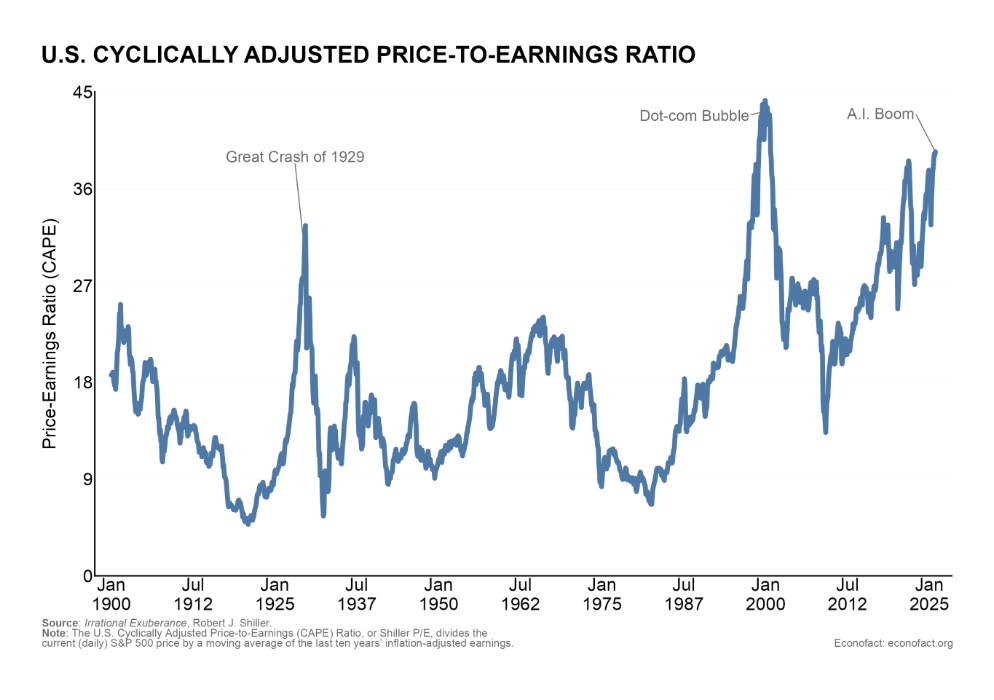
- The current AI boom is multi-channel: a) unusually rapid consumer + firm adoption since the emergence of user-friendly chatbots (post–Nov 2022); b) a major surge in AI hardware/software investment; and c) a sharp re-rating of “Big Tech” equities.
- Economic history suggests transformative technologies often experience booms with intermittent busts even when the technology ultimately becomes foundational (railroads, internet), implying that “bubble-like” dynamics can coexist with genuine long-run value.
- The article distinguishes two bubble mechanisms worth monitoring: a financial-market bubble where prices driven by momentum and optimism beyond fundamentals, later reverse, and a real-economy/infrastructure bubble when overbuilding network capacity is followed by bankruptcies and financial stress, with railroads (panic of 1873) and dot-com offered as archetypes.
- It lays out several plausible forward paths for AI:
(i) “Dashed expectations” where AI delivers sectoral gains but aggregate productivity/profitability lags for years (common historically),
(ii) A “profitability bust” where investment is real but AI software revenues fail to scale enough to justify spending even if AI users benefit,
(iii) A shakeout within an ongoing boom, with few winners and many losers, driven by network effects and scale economies. - A key near-term tension flagged: chipmakers have captured substantial profits, while AI software monetization is still limited, raising the possibility that returns accrue primarily to a small set of winners and/or that parts of the AI supply chain become commoditized.
Tracking the AI Boom: Some Lessons From Economic History
By: Econofact
Who bears the risk if AI valuations break?
This article maps AI exposure across the full AI stack (hyperscalers, model developers, specialized chipmakers, networking/cooling suppliers, data-center operators, utilities, commodity producers), stressing that valuation shocks can cascade well beyond “Big Tech” into energy, real estate and materials. It highlights the concentration of market-cap in AI-exposed names, an estimated 44% of the S&P 500 via an AI basket, to motivate why any sharp repricing could be macro-relevant even before considering leverage.
Debt-financed infrastructure and power as a bottleneck
- Unlike the above paper and article, this Bank of England article foregrounds the funding mix of the AI boom: trillions in projected AI data-center and energy CAPEX with a rising share financed by external debt and private credit. For example, Morgan Stanley’s estimate that around half of 2025–28 AI infrastructure spending is externally financed.
- It stresses that this build-out is doubly constrained by compute and electricity, with data-center power demand expected to more than double and to require massive incremental generation capacity, making power availability and price a key determinant of both AI progress and credit risk.
Triggers for repricing and cross-market spillovers
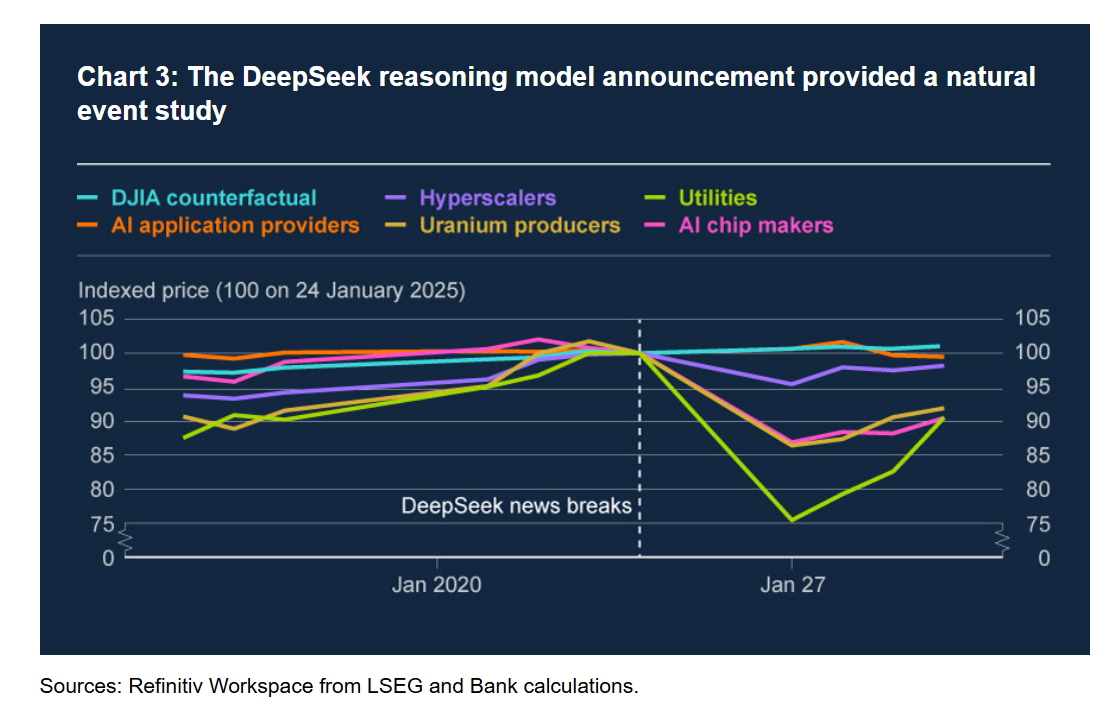
- The article provides a taxonomy of shock types that could force a reassessment of AI cash-flow paths: slower-than-expected capability progress, disappointing user adoption or monetization, binding constraints in power/data/chips, or algorithmic breakthroughs (like DeepSeek) that suddenly change which parts of the stack are valuable.
- It extends the discussion beyond equities by tracing how an AI-driven shock could propagate through commodity markets, drawing analogies to past stress episodes such as the LME nickel squeeze.
Financial stability lens: from equity story to systemic risk
- In contrast to the more “valuation versus fundamentals” framing of the above paper and article, this Bank of England article frames AI primarily as a financial-stability question: equity-heavy exposure so far has limited systemic risk, but the projected pivot toward debt-financed infrastructure materially increases the stakes.
- The article emphasizes who holds the risk (banks, private credit funds, and leveraged investors in AI-sensitive equity and commodity positions) and underlines the danger of hidden leverage (e.g. Archegos-style structures) as a key amplifying mechanism in any AI-related asset-price correction.
All chips in! Would a fall in AI-related asset valuations have financial stability consequences?
By: Bank of England
