
• Twitter
  • Search
e-axes

360° Econ View

The issues, the debates, and the research

  • Home
  • Useful Data
  • About
  • Contact
  • Home
  • Useful Data
  • About
  • Contact

Economic Growth

Pessimism about the well-being of the next generation

Posted by e-axes on March 17, 2025

Read Next →

Economic Growth

Global Growth Holds, But Risks Are Building

Economic Growth

New Research on the Economic Impact of the Middle East War

Economic Growth

Too Many Buildings, Too Few Machines: How the Composition of Credit Shapes Long-Run Growth

Well-being indicators for the future

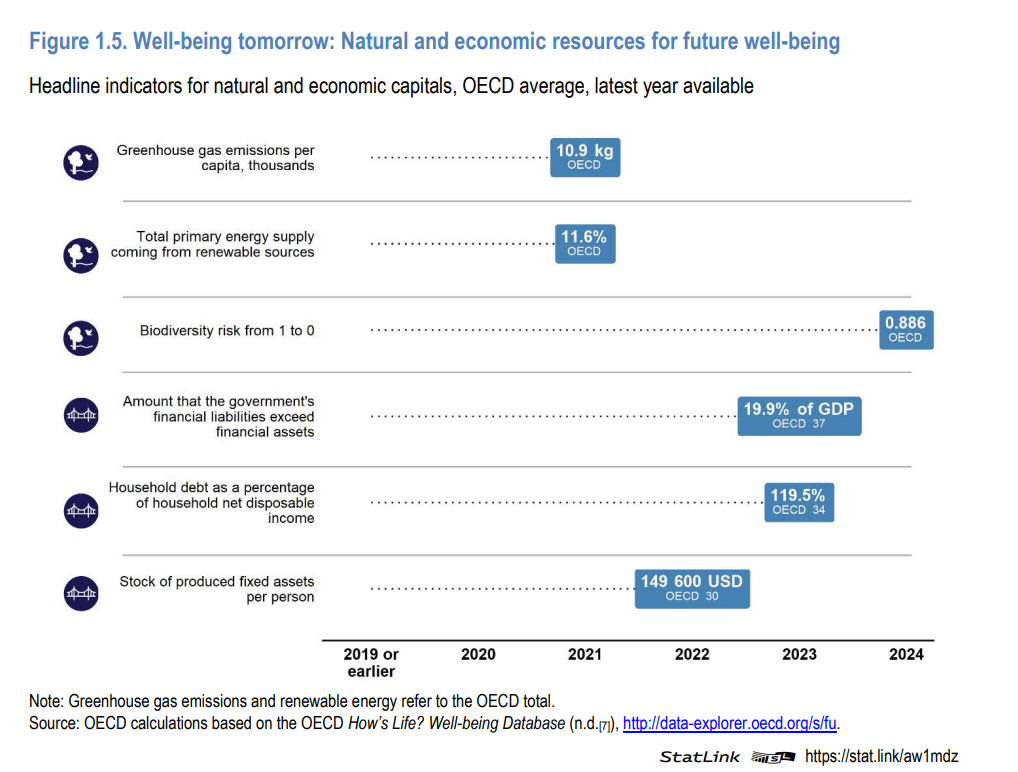
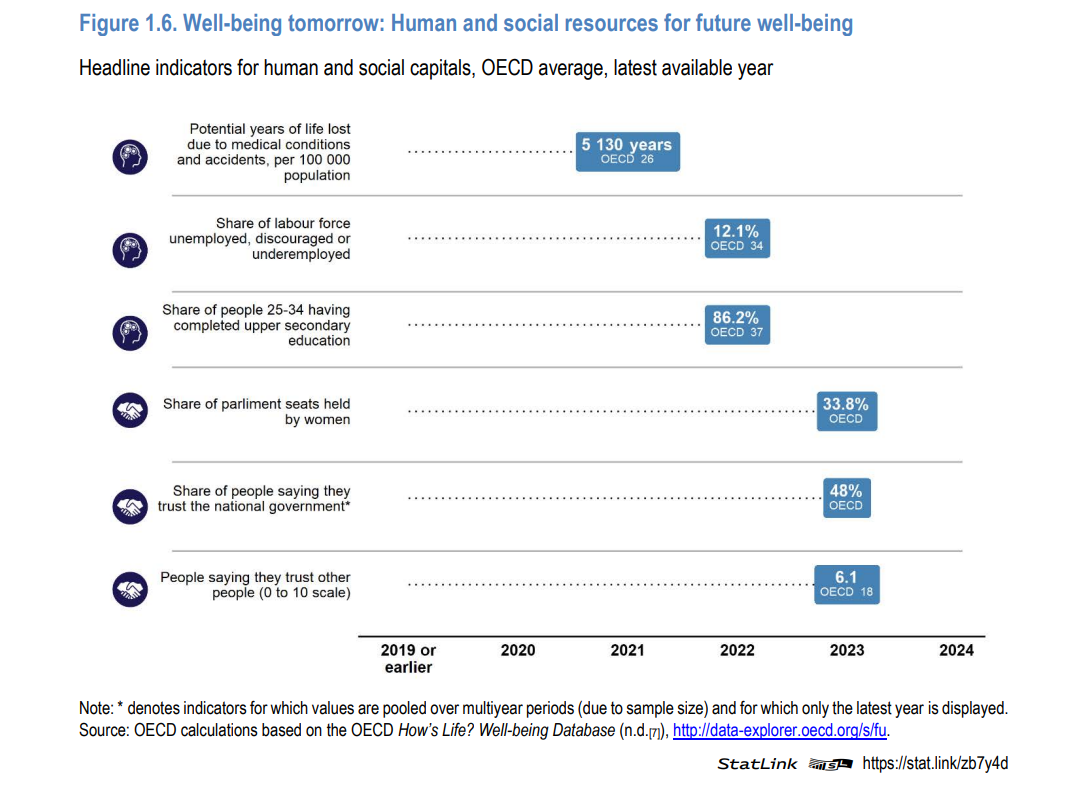
The OECD’s 6th edition of How’s Life? report provides important insights on the sustainability of well-being for the next generation.

  • Environmental challenges
    No OECD country is on track to meet 2030 climate targets in international agreements, posing significant threats to future generations. Climate impacts are already increasing, with approximately 15% of people across OECD countries exposed to extreme heat in 2023, up from 13% in the 2010s. Progress in preserving natural resources appears to be plateauing, with slowing improvements in recycling rates and protected area creation. Biodiversity risks have increased in most OECD countries, threatening ecosystem resilience.
  • Social capital and education concerns
    The report identifies concerning trends in social and human capital. Trust in government has declined in some OECD countries, while other social capital indicators like interpersonal trust show no improvement. Educational outcomes have deteriorated, with PISA results declining in nearly all OECD countries. These educational gaps significantly impact future well-being prospects, as individuals with tertiary education consistently outperform those with less education across all well-being dimensions.
  • Managing major transitions
    Future generations will inherit societies undergoing simultaneous technological and environmental transitions. While digitalization and AI offer new opportunities, they also present challenges that must be managed alongside the green transition. The report emphasizes that understanding the social context of these changes is essential for developing policies that enhance rather than undermine future well-being.
  • Policy direction for sustainable well-being
    To promote sustainable well-being within planetary boundaries, policies must facilitate significant behavioral changes in lifestyles and consumption patterns. Shifting emphasis from material consumption toward social well-being can strengthen societies by fostering purpose and belonging. This requires collective action beyond government, involving community-level initiatives and corporate responsibility in preserving the natural, human, and social capital future generations will depend upon.

How’s Life? 2024
By: OECD

Pessimism about the well-being of the next generation

A recent survey by the Pew Research Center in Washington, DC. looks at people’s expectations of next generation’s financial future.

Most say children will be worse off than their parents. A median of 57 percent of respondents share this view. Concern is especially high in advanced economies, including Canada and the United States and many European nations. “This pessimistic view about the economic future is shared by younger and older adults alike, as well as by people with higher and lower incomes.

According to Pew:

In most countries, people who consider the gap between the rich and the poor to be a very big problem are especially pessimistic about how children will fare financially when they grow up.
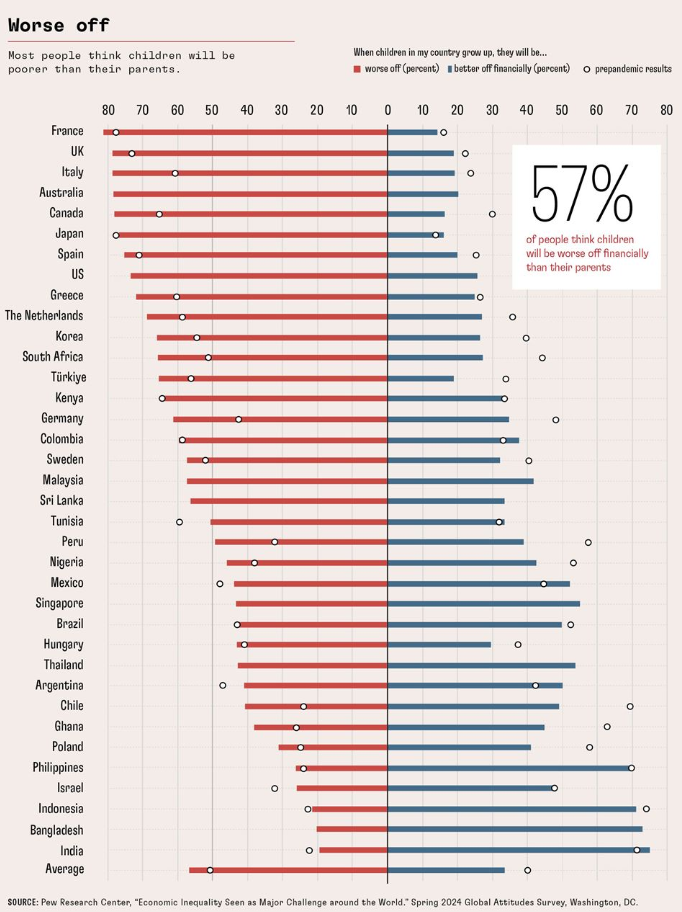

People in many countries are losing hope that children will be better off
Author: Marta Doroszczyk
From: IMF

Print Friendly, PDF & Email

e-axes

Read Next →

Economic Growth

Global Growth Holds, But Risks Are Building

Economic Growth

New Research on the Economic Impact of the Middle East War

Economic Growth

Too Many Buildings, Too Few Machines: How the Composition of Credit Shapes Long-Run Growth

Comments are Closed

Account

  • Login

Subscriptions

You are not logged in.
Login
Subscribe

Subscriptions

Subscribe

Most Read

  • Bank Heterogeneity and the Transmission of Monetary Tightening
  • Central Bank Losses and Public Debt: Constraints on Inflation Control
  • AI Valuations, Capital Investment, and Growth
  • How Firms’ Cost Expectations Shape Prices
  • Communicating Uncertainty: Fan Charts, Confidence, and Credibility
  • The AI Infrastructure Boom: Productive Investment or Financial Fragility?
  • Macroeconomic Risk: From Scenario Synthesis to Distributional Transmission
  • Measuring Expectations in Real Time: The Value and Limits of Kalshi Markets
  • Measuring Global Tensions Using AI
  • When Markets Drift from the Real Economy

Sections

  • AI
  • Banking
  • Books
  • Brexit
  • CBDC
  • China
  • Climate
  • COVID-19
  • Crypto
  • Demographics
  • Economic Growth
  • Economic Science
  • Economics of Information
  • Emerging Markets
  • Eurozone
  • Financial Markets
  • Geoeconomics
  • Geopolitics
  • India
  • Inequality
  • Inflation
  • International Economics
  • Macro
  • Markets
  • Monetary Policy
  • Oil
  • Politics & Economics
  • Taxation
  • Tech
  • Trade
  • U.S.
  • Ukraine-Russia War
  • Uncategorized
  • Useful Data

© 2026 e-axes

  • Privacy Policy & Terms of Service

Theme by Anders Norén

This website uses cookies to improve your experience. We'll assume you're ok with this, but you can opt-out if you wish.
Cookie settingsAccept
Privacy & Cookies Policy

Privacy Overview

This website uses cookies to improve your experience while you navigate through the website. Out of these cookies, the cookies that are categorized as necessary are stored on your browser as they are as essential for the working of basic functionalities of the website. We also use third-party cookies that help us analyze and understand how you use this website. These cookies will be stored in your browser only with your consent. You also have the option to opt-out of these cookies. But opting out of some of these cookies may have an effect on your browsing experience.
Necessary
Always Enabled
Necessary cookies are absolutely essential for the website to function properly. This category only includes cookies that ensures basic functionalities and security features of the website. These cookies do not store any personal information.
SAVE & ACCEPT