

• Twitter
  • Search
e-axes

360° Econ View

The issues, the debates, and the research

  • Home
  • Useful Data
  • About
  • Contact
  • Home
  • Useful Data
  • About
  • Contact

Monetary Policy

On the remuneration of bank reserves

Posted by e-axes on December 5, 2023

Read Next →

Monetary Policy

Central Bank Losses and Public Debt: Constraints on Inflation Control

Monetary Policy

Communicating Uncertainty: Fan Charts, Confidence, and Credibility

Monetary Policy

Macroeconomic Risk: From Scenario Synthesis to Distributional Transmission

The economic issues with providing reserves to the financial sector

In this paper De Grauwe and Ji raise concerns over central banks’ recent policy of renumerating bank reserves. Focusing on the Eurozone, they find that bank reserves held by credit institutions at the national central banks and the ECB amounted to €3.6 trillion in August 2023. In September 2023 the remuneration rate on these bank reserves held by commercial banks was raised to 4%. This means that the Eurosystem is paying out €146 billion in interest to credit institutions as of September 2023, every year.  Consequences for central banks and commercial banks:

  • When a central bank makes interest payments to commercial banks it transfers part of its profits to the banking sector. Central banks make a profit (seigniorage) because they have obtained a  monopoly from the state to create money. This monopoly profit should therefore be returned to the government that has granted the monopoly rights.
  • The remuneration of reserves reduces the incentives banks have to hedge their interest rate risk while it strengthens the equity position of reserve-rich banks, thereby giving them incentives to increase the loan supply and weakening the transmission of monetary policy.
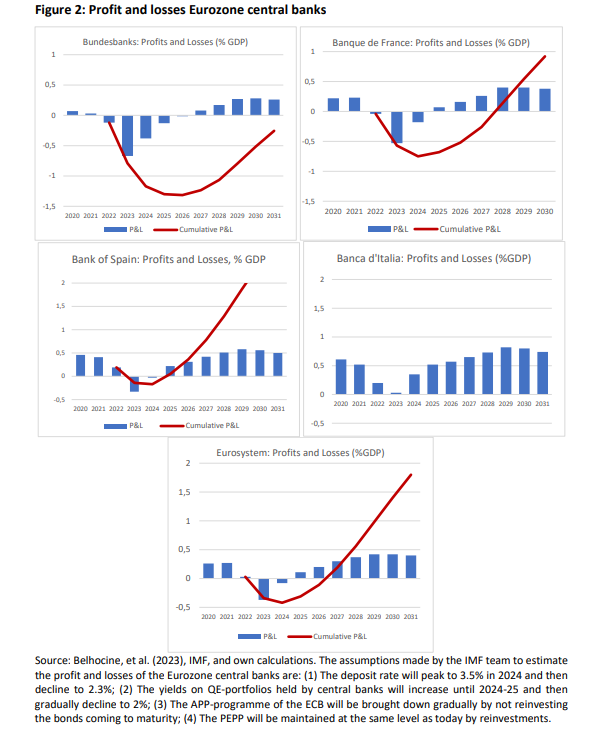
  • These reserve remunerations are so high that not only do they wipe out central banks’ profits, but they also push many of them into loss-making territory.
  • Large reserves must be backed by assets, mostly government bonds that have been issued at very low-interest rates. By paying an interest rate of 4% (Eurozone) to 5.15% (US) on bank reserves central banks are reducing government revenues by the same amount.

We proposed to use a system of two-tier minimum reserve requirements. This consists of freezing part of the existing bank reserves in non-interest-bearing deposits while remunerating the reserves in excess of these minimum requirements. This achieves two things. It allows for a drastic reduction in the transfer of central banks’ profits to private agents, and it makes it possible for the central banks to maintain their current operating procedure.

Fighting Inflation More Effectively Without Transferring Central Banks’ Profits to Banks
Authors: Paul De Grauwe, Yuemei Ji
From: LSE, University College London

The political issues with providing reserves to the financial sector

In this commentary, Lucrezia Reichlin at the provision of reserves to the financial sector from a political angle.  She argues that the issue boils down to  fiscal risk:

Since large reserves must be backed by assets, mostly Treasuries, the new system implies larger interest-rate risks, implying that central banks’ actions now have a greater fiscal impact.

Is this a problem?

In a unitary system, such as the United States or the United Kingdom, it merely implies a redistribution of risk within the government, between the central bank and the finance ministry. While this could create uncertainty about the institutional framework and potentially even undermine central bank independence, these risks are probably not particularly acute.

However, the situation for the ECB is far more complicated because there is no single fiscal authority or euro-denominated safe asset. This raises once again the issue of whether the monetary union’s fragmented governance structure will hinder the ECB from ensuring financial stability and efficient monetary policy.

The New Normal for Central Banks
By: Lucrezia Reichlin – London Business School


Print Friendly, PDF & Email

e-axes

Read Next →

Monetary Policy

Central Bank Losses and Public Debt: Constraints on Inflation Control

Monetary Policy

Communicating Uncertainty: Fan Charts, Confidence, and Credibility

Monetary Policy

Macroeconomic Risk: From Scenario Synthesis to Distributional Transmission

Comments are Closed

Account

  • Login

Subscriptions

You are not logged in.
Login
Subscribe

Subscriptions

Subscribe

Most Read

  • Bank Heterogeneity and the Transmission of Monetary Tightening
  • Central Bank Losses and Public Debt: Constraints on Inflation Control
  • AI Valuations, Capital Investment, and Growth
  • How Firms’ Cost Expectations Shape Prices
  • Communicating Uncertainty: Fan Charts, Confidence, and Credibility
  • The AI Infrastructure Boom: Productive Investment or Financial Fragility?
  • Macroeconomic Risk: From Scenario Synthesis to Distributional Transmission
  • Measuring Expectations in Real Time: The Value and Limits of Kalshi Markets
  • Measuring Global Tensions Using AI
  • When Markets Drift from the Real Economy

Sections

  • AI
  • Banking
  • Books
  • Brexit
  • CBDC
  • China
  • Climate
  • COVID-19
  • Crypto
  • Demographics
  • Economic Growth
  • Economic Science
  • Economics of Information
  • Emerging Markets
  • Eurozone
  • Financial Markets
  • Geoeconomics
  • Geopolitics
  • India
  • Inequality
  • Inflation
  • International Economics
  • Macro
  • Markets
  • Monetary Policy
  • Oil
  • Politics & Economics
  • Taxation
  • Tech
  • Trade
  • U.S.
  • Ukraine-Russia War
  • Uncategorized
  • Useful Data

© 2026 e-axes

  • Privacy Policy & Terms of Service

Theme by Anders Norén

This website uses cookies to improve your experience. We'll assume you're ok with this, but you can opt-out if you wish.
Cookie settingsAccept
Privacy & Cookies Policy

Privacy Overview

This website uses cookies to improve your experience while you navigate through the website. Out of these cookies, the cookies that are categorized as necessary are stored on your browser as they are as essential for the working of basic functionalities of the website. We also use third-party cookies that help us analyze and understand how you use this website. These cookies will be stored in your browser only with your consent. You also have the option to opt-out of these cookies. But opting out of some of these cookies may have an effect on your browsing experience.
Necessary
Always Enabled
Necessary cookies are absolutely essential for the website to function properly. This category only includes cookies that ensures basic functionalities and security features of the website. These cookies do not store any personal information.
SAVE & ACCEPT