• Twitter
  • Search
e-axes

360° Econ View

The issues, the debates, and the research

  • Home
  • Useful Data
  • About
  • Contact
  • Home
  • Useful Data
  • About
  • Contact

Climate

Climate policy and politics

Posted by e-axes on September 5, 2023

Read Next →

Climate

Is Economic Growth Compatible With Credible Climate Constraints?

Climate

Can Financial Markets and Economic Literacy Reshape the Politics of Climate? Action

Climate

The Cost of Inconsistent and Incredible Climate Policy

Fed vs. ECB: The divergent approaches to climate change mitigation

In this paper, DiLeo et al. develop a theoretical framework to describe how the domestic context and international norms influence the evolution of central bank policymaking. In particular, they analyze the adoption of climate-related norms by central banks as a two-stage process:

  • The first stage is one of “norm emergence” where government actors, think tanks and nongovernmental organizations (NGOs) try to convince individual central banks to adopt basic climate-related norms. This was a successful process in Europe as these “norm entrepreneurs” convinced the ECB to adopt basic climate-related norms. In the case of the Fed, the socio-political environment on climate action was highly fractious and norm entrepreneurs targeting the Fed were absent.
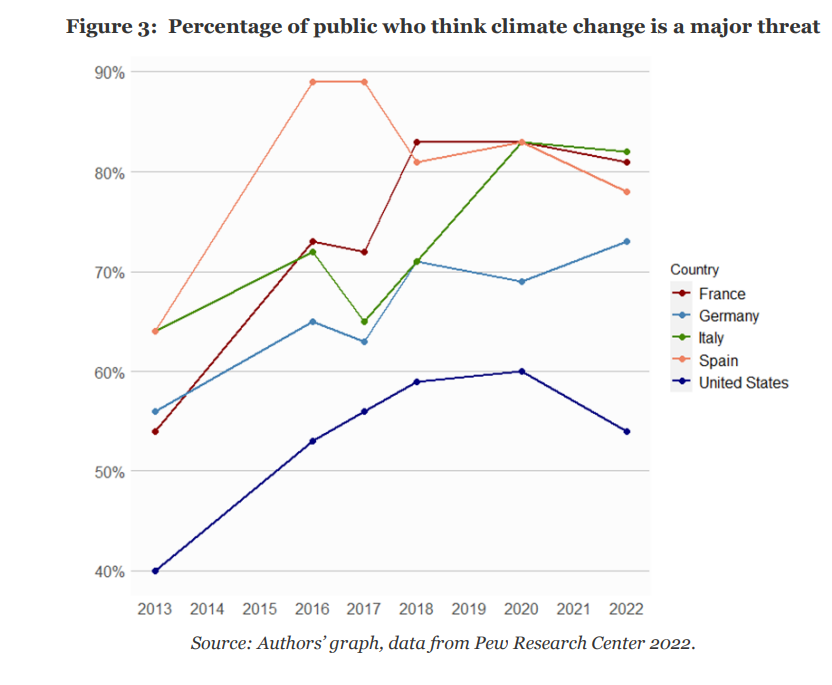
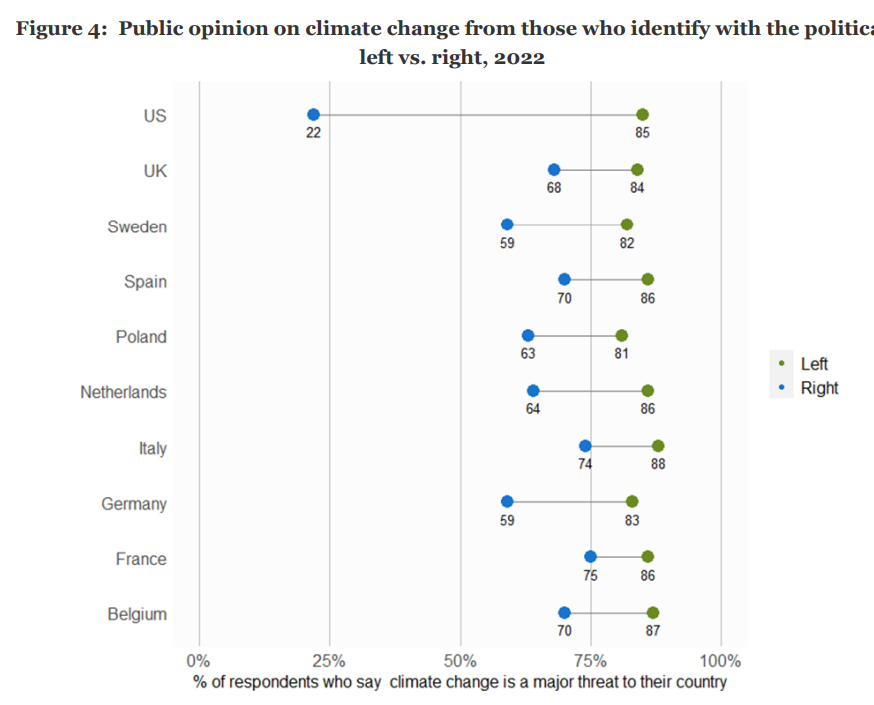
  • The second phase is one of “norm cascade,” where a critical mass of early NGFS members started to spread these new climate norms, leading to widespread international adoption of climate-related central bank policies. In the U.S., an influential domestic fossil fuel industry coupled with a polarized and partisan debate on climate change led the Fed to adopt a modest version of the foundational climate norms.

The current divergence is unlikely to disappear soon, as the forces of divergence are deeply rooted in domestic climate politics. At the same time, given the international interconnectedness of central banking, we expect global policy norms to provide sustained pressure toward convergence. In this context, the ECB could still scale back some of its proactive commitments (Van Doorslaer and Vermeiren 2022), although it is unlikely to entirely disavow its current stance. The Fed is likely to seek a more favorable compromise, such as assuring domestic audiences of policy restraint, while cooperating with international peers on less overt regulatory interventions.

Why the Fed and ECB Parted Ways on Climate Change: The Politics of Divergence in the Global Central Banking Community
Authors: Monica DiLeo, Glenn D. Rudebusch, Jens van ’t Klooster
From: University of Queensland, Australia, Brookings Institution & New York University, University of Amsterdam

Energy politics

In this paper, Colgan and Hinthorn highlight how political scientists view the debate over the adoption of climate change mitigation policies. They argue that they are mainly two ideological camps:

  • The first position, which they call climate consequentialism, suggests that policymakers must (eventually) face the environmental realities of climate change, and once they do, they can and will steer society toward a clean energy transition. This position is sometimes found among physical scientists who follow the Intergovernmental Panel on Climate Change and other scientific bodies, hoping politics will change as evidence of the environmental risk mounts.
  • The second position, which they call climate libertarianism, is the idea that once policymakers correctly price carbon (and other GHG emissions), thereby internalizing the economic externalities associated with climate change, the market will adjust and fix the problem without much further ado. Economists sometimes take this position.

[T]he body of research produced by political scientists is different from either of these two positions and shows that the problem is not simply a lack of political will. Making the clean energy transition happen is a political problem that is phenomenally complicated and filled with obstacles beyond those typically highlighted by either economics or physical sciences.[…] While the world is indeed beginning to engage in a clean energy transition away from oil and other fossil fuels, that transition can only be understood in the context in which oil is likely to be, at the global level, one of the largest primary energy sources for decades to come. Oil consumption might decline rapidly in some places, and some oil producers will be among the losers from the energy transition. Worldwide, however, the oil industry will continue to be a major force.

International Energy Politics in an Age of Climate Change
Authors: Jeff D. Colgan, Miriam Hinthorn
From: Brown University, MIT

Print Friendly, PDF & Email

e-axes

Read Next →

Climate

Is Economic Growth Compatible With Credible Climate Constraints?

Climate

Can Financial Markets and Economic Literacy Reshape the Politics of Climate? Action

Climate

The Cost of Inconsistent and Incredible Climate Policy

Comments are Closed

Account

  • Login

Subscriptions

You are not logged in.
Login
Subscribe

Subscriptions

Subscribe

Most Read

  • Bank Heterogeneity and the Transmission of Monetary Tightening
  • Central Bank Losses and Public Debt: Constraints on Inflation Control
  • AI Valuations, Capital Investment, and Growth
  • How Firms’ Cost Expectations Shape Prices
  • Communicating Uncertainty: Fan Charts, Confidence, and Credibility
  • The AI Infrastructure Boom: Productive Investment or Financial Fragility?
  • Macroeconomic Risk: From Scenario Synthesis to Distributional Transmission
  • Measuring Expectations in Real Time: The Value and Limits of Kalshi Markets
  • Measuring Global Tensions Using AI
  • When Markets Drift from the Real Economy

Sections

  • AI
  • Banking
  • Books
  • Brexit
  • CBDC
  • China
  • Climate
  • COVID-19
  • Crypto
  • Demographics
  • Economic Growth
  • Economic Science
  • Economics of Information
  • Emerging Markets
  • Eurozone
  • Financial Markets
  • Geoeconomics
  • Geopolitics
  • India
  • Inequality
  • Inflation
  • International Economics
  • Macro
  • Markets
  • Monetary Policy
  • Oil
  • Politics & Economics
  • Taxation
  • Tech
  • Trade
  • U.S.
  • Ukraine-Russia War
  • Uncategorized
  • Useful Data

© 2026 e-axes

  • Privacy Policy & Terms of Service

Theme by Anders Norén

This website uses cookies to improve your experience. We'll assume you're ok with this, but you can opt-out if you wish.
Cookie settingsAccept
Privacy & Cookies Policy

Privacy Overview

This website uses cookies to improve your experience while you navigate through the website. Out of these cookies, the cookies that are categorized as necessary are stored on your browser as they are as essential for the working of basic functionalities of the website. We also use third-party cookies that help us analyze and understand how you use this website. These cookies will be stored in your browser only with your consent. You also have the option to opt-out of these cookies. But opting out of some of these cookies may have an effect on your browsing experience.
Necessary
Always Enabled
Necessary cookies are absolutely essential for the website to function properly. This category only includes cookies that ensures basic functionalities and security features of the website. These cookies do not store any personal information.
SAVE & ACCEPT