


Rates of vaccination and international trade
In this paper Çakmaklı et al. estimate the economic costs of COVID-19 that are solely due to international linkages under inequitable vaccine distribution. They develop a framework that combines an epidemiological Susceptible-Infected-Recovered (SIR) model with international trade and production network. Their model implies that a country’s own pandemic not only impacts its own production and employment as a pure domestic supply shock, but it also impacts the production of intermediate inputs imported by other countries. The COVID related losses are estimated using OECD’s multi-industry multi-national input-output tables for 65 countries and 35 sectors. They conclude that:
We find that AEs [Advanced Economies] may bear somewhere from 13 percent to 49 percent of the global losses arising from an inequitable distribution of vaccines in 2021. Globalization might have amplified the effects of the pandemic but it is also imperative for an equitable distribution of the vaccines because this is the only way for open economies with international linkages to have a robust recovery.
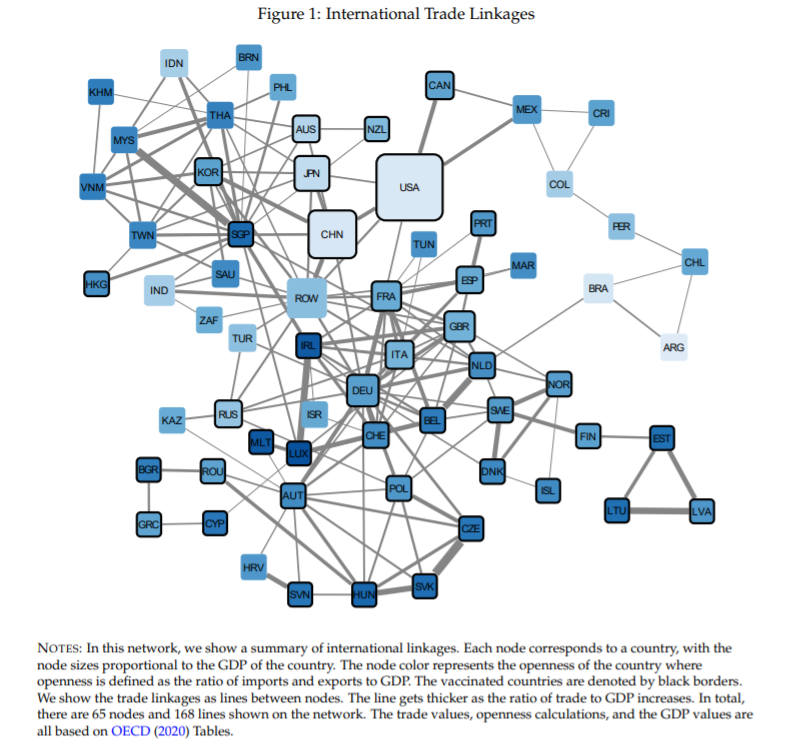
The Economic Case for Global Vaccinations: An Epidemiological Model with International Production Networks
Authors: Cem Çakmaklı, Selva Demiralp, Ṣebnem Kalemli-Özcan, Sevcan Yeşiltaş, Muhammed A. Yıldırım
From: Koç University, University of Maryland
