• Twitter
  • Search
e-axes

360° Econ View

The issues, the debates, and the research

  • Home
  • Useful Data
  • About
  • Contact
  • Home
  • Useful Data
  • About
  • Contact

COVID-19

The economics of vaccines

Posted by e-axes on August 24, 2021

Read Next →

COVID-19

Navigating ESG Reputational Risks

COVID-19

Policy lessons from the pandemic

COVID-19

What will happen to the excess household savings?

How to counter vaccine hesitancy?

Joshua Gans in this paper develops an interesting model with endogenous vaccine adoption driven by the prevalence of the virus. Gans is using a behavioral epidemiological model where individuals can take costly social distancing actions to manage their own infection risk if they remain unvaccinated. At the same time as prevalence decreases the incentives to get vaccinated disappear. As a result his findings include:

  • Policy interventions that directly target costs associated with vaccine adoption may counter vaccine hesitancy;
  • But interventions such as green passports are ineffective at improving vaccination rates and may actually reduce them as the restrictions imposed by passports reduce prevalence. This implies that vaccine passports actually function as a signal which assures others that someone has a lower risk of being infectious, but they are unlikely to be useful as a punitive tool to counter vaccine hesitancy.

Vaccine Hesitancy, Passports and the Demand for Vaccination
Author: Joshua S. Gans
From: University of Toronto

Rates of vaccination and international trade

In this paper Çakmaklı et al. estimate the economic costs of COVID-19 that are solely due to international linkages under inequitable vaccine distribution. They develop a framework that combines an epidemiological Susceptible-Infected-Recovered (SIR) model with international trade and production network. Their model implies that a country’s own pandemic not only impacts its own production and employment as a pure domestic supply shock, but it also impacts the production of intermediate inputs imported by other countries. The COVID related losses are estimated using OECD’s multi-industry multi-national input-output tables for 65 countries and 35 sectors. They conclude that:

We find that AEs [Advanced Economies] may bear somewhere from 13 percent to 49 percent of the global losses arising from an inequitable distribution of vaccines in 2021. Globalization might have amplified the effects of the pandemic but it is also imperative for an equitable distribution of the vaccines because this is the only way for open economies with international linkages to have a robust recovery.
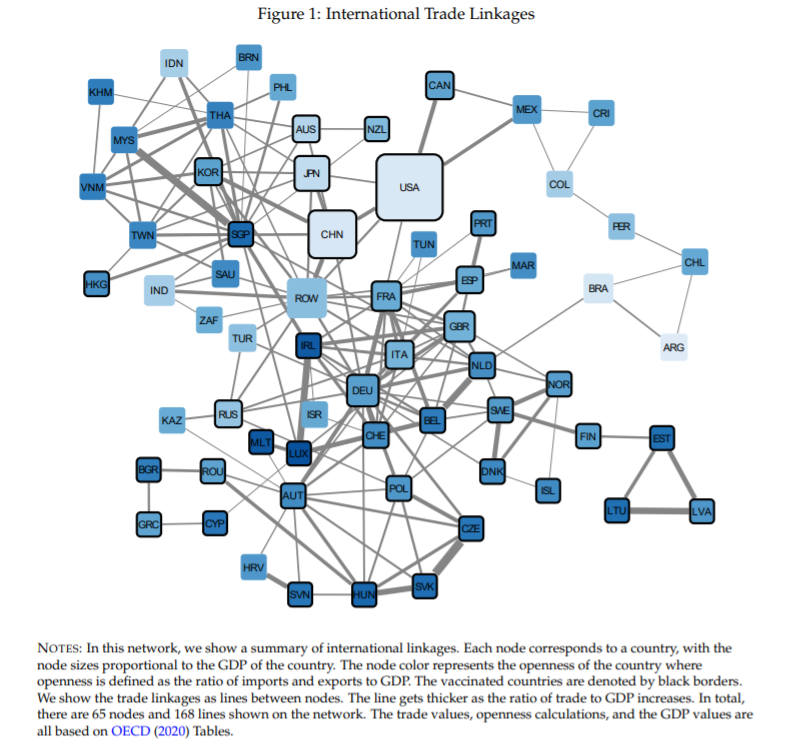

The Economic Case for Global Vaccinations: An Epidemiological Model with International Production Networks
Authors: Cem Çakmaklı, Selva Demiralp, Ṣebnem Kalemli-Özcan, Sevcan Yeşiltaş, Muhammed A. Yıldırım
From: Koç University, University of Maryland

Print Friendly, PDF & Email

e-axes

Read Next →

COVID-19

Navigating ESG Reputational Risks

COVID-19

Policy lessons from the pandemic

COVID-19

What will happen to the excess household savings?

Comments are Closed

Account

  • Login

Subscriptions

You are not logged in.
Login
Subscribe

Subscriptions

Subscribe

Most Read

  • Gold, the Dollar, and the Geopolitics of Global Reserves
  • China and the Political Economy of Critical Minerals
  • Public Debt Maturity and Macroeconomic Policy Transmission
  • Bank Heterogeneity and the Transmission of Monetary Tightening
  • AI, Knowledge and the Future of Human Expertise
  • AI Valuations, Capital Investment, and Growth
  • New and Noteworthy Books in Economics (September)
  • AI and the Natural Rate: Puzzle or Policy Challenge?
  • Transfers, Taxes, and the Ricardian Equivalence
  • Can Institutions Limit the Economic Damage of Populism?

Sections

  • AI
  • Banking
  • Books
  • Brexit
  • CBDC
  • China
  • Climate
  • COVID-19
  • Crypto
  • Demographics
  • Economic Growth
  • Economic Science
  • Economics of Information
  • Emerging Markets
  • Eurozone
  • Financial Markets
  • Geoeconomics
  • Geopolitics
  • India
  • Inequality
  • Inflation
  • International Economics
  • Macro
  • Markets
  • Monetary Policy
  • Oil
  • Politics & Economics
  • Taxation
  • Tech
  • Trade
  • U.S.
  • Ukraine-Russia War
  • Uncategorized
  • Useful Data

© 2026 e-axes

  • Privacy Policy & Terms of Service

Theme by Anders Norén

This website uses cookies to improve your experience. We'll assume you're ok with this, but you can opt-out if you wish.
Cookie settingsAccept
Privacy & Cookies Policy

Privacy Overview

This website uses cookies to improve your experience while you navigate through the website. Out of these cookies, the cookies that are categorized as necessary are stored on your browser as they are as essential for the working of basic functionalities of the website. We also use third-party cookies that help us analyze and understand how you use this website. These cookies will be stored in your browser only with your consent. You also have the option to opt-out of these cookies. But opting out of some of these cookies may have an effect on your browsing experience.
Necessary
Always Enabled
Necessary cookies are absolutely essential for the website to function properly. This category only includes cookies that ensures basic functionalities and security features of the website. These cookies do not store any personal information.
SAVE & ACCEPT