• Twitter
  • Search
e-axes

360° Econ View

The issues, the debates, and the research

  • Home
  • Useful Data
  • About
  • Contact
  • Home
  • Useful Data
  • About
  • Contact

Brexit

On post Brexit Britain

Posted by e-axes on July 7, 2021

Read Next →

Brexit

Ten Years After Brexit: What the Evidence Shows

Brexit

How to crash a currency

Brexit

Brexit and trade

The UK financial sector post-Brexit remains strong

Alexander Lehman explains that it’s the new post-Brexit financial regulation that has enabled  the UK banks, despite their diminished  stature, to remain (as of the end of 2020) the largest globally in terms of cross-border claims, and the second-most important in terms of foreign claims consolidated within the home base of internationally active banks. In particular:

  • The UK’s adherence to international norms, crucially the Basel framework, is not in doubt;
  • The UK’s new financial services law of April 2021 indicates that the Bank of England will need to take into account in its rulemaking the competitiveness of the UK financial markets;
  • A future regulatory framework will be defined in such a way as to provide greater flexibility and ability to respond to changes in international markets;
  • A further likely change in UK post-Brexit financial regulation will be a simplification of the regime for smaller banks.
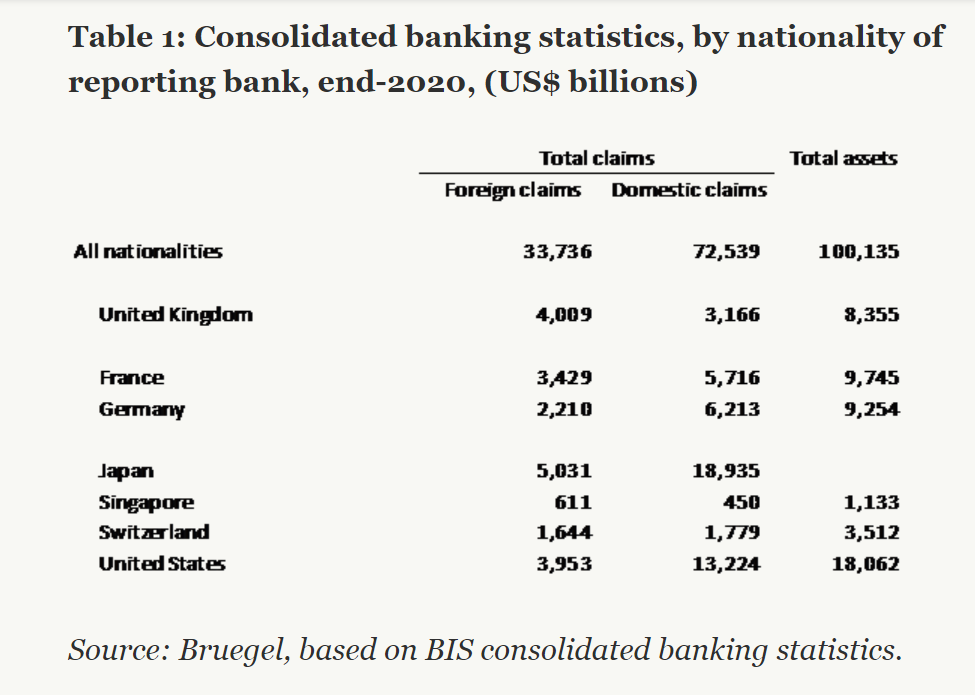

Banks post-Brexit: regulatory divergence or parallel tracks?
By: Alexander Lehmann – Bruegel

Changing attitudes towards immigration

The UK’s post-Brexit migration system, argues Jonathan Portes, rebalances the system from one which was essentially laissez-faire for Europeans, while quite restrictionist for non-Europeans, to a uniform system that, on paper at least, has relatively simple and transparent criteria, and covers up to half the UK labor market. More specifically, the new proposals represent a considerable liberalization for non-EU migrants, with lower salary and skill thresholds, and no overall cap on numbers. On the other hand, control on EU migration will be significantly tighter when compared to free movement.

So considerable uncertainty remains. Nevertheless, while the overwhelming consensus amongst economists that Brexit – and in particular the ‘hard’ Brexit pursued by the UK government – will have significant negative impacts on trade and investment, and hence on the broader UK economy, there is much more cause for optimism about the impacts of the new post-Brexit UK immigration system.
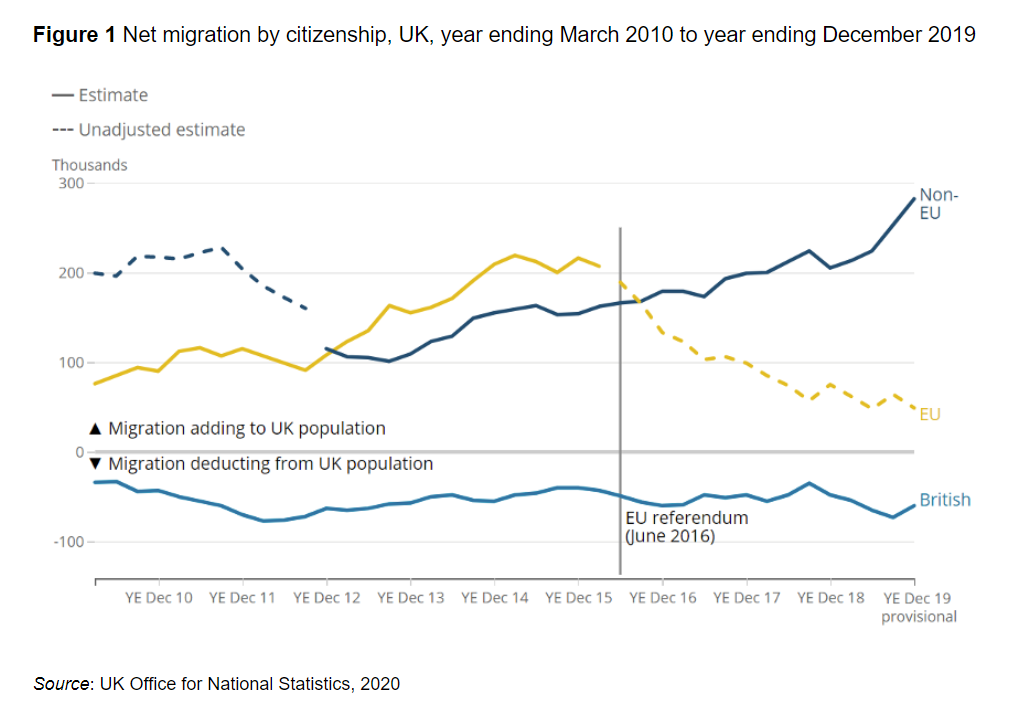

Immigration and the UK economy after Brexit
By: Jonathan Portes – King’s College

Wealth and support for Brexit

An interesting take from Green and Pahontu on who supports Brexit in the UK :

[W]ealth – via economic insurance and lower risk-aversion – increases support for a change to the status quo, once preferences are taken into account. Applying this argument to the Brexit case, we demonstrated that variation in personal wealth enables wealthier individuals to support Brexit, and less wealthy individuals to support Remain. We provide evidence that the mechanism linking wealth and higher Leave support is via wealthy voters’ expectation that Brexit would not impact their personal finances, and we show that an increase in wealth lowers risk-aversion. We explored these relationships using a rare combination of observational and experimental data across three separate contexts that included individual-level measures of wealth: a large cross-sectional electoral study, a separate panel study accounting for unobserved individual-level heterogeneity, and also using survey experiment.

Mind the Gap: Why Wealthy Voters Support Brexit
Authors: Jane Green, Raluca L. Pahontu
From: University of Oxford, London School of Economics

Print Friendly, PDF & Email

e-axes

Read Next →

Brexit

Ten Years After Brexit: What the Evidence Shows

Brexit

How to crash a currency

Brexit

Brexit and trade

Comments are Closed

Account

  • Login

Subscriptions

You are not logged in.
Login
Subscribe

Subscriptions

Subscribe

Most Read

  • Bank Heterogeneity and the Transmission of Monetary Tightening
  • Central Bank Losses and Public Debt: Constraints on Inflation Control
  • AI Valuations, Capital Investment, and Growth
  • How Firms’ Cost Expectations Shape Prices
  • Communicating Uncertainty: Fan Charts, Confidence, and Credibility
  • The AI Infrastructure Boom: Productive Investment or Financial Fragility?
  • Macroeconomic Risk: From Scenario Synthesis to Distributional Transmission
  • Measuring Expectations in Real Time: The Value and Limits of Kalshi Markets
  • Measuring Global Tensions Using AI
  • When Markets Drift from the Real Economy

Sections

  • AI
  • Banking
  • Books
  • Brexit
  • CBDC
  • China
  • Climate
  • COVID-19
  • Crypto
  • Demographics
  • Economic Growth
  • Economic Science
  • Economics of Information
  • Emerging Markets
  • Eurozone
  • Financial Markets
  • Geoeconomics
  • Geopolitics
  • India
  • Inequality
  • Inflation
  • International Economics
  • Macro
  • Markets
  • Monetary Policy
  • Oil
  • Politics & Economics
  • Taxation
  • Tech
  • Trade
  • U.S.
  • Ukraine-Russia War
  • Uncategorized
  • Useful Data

© 2026 e-axes

  • Privacy Policy & Terms of Service

Theme by Anders Norén

This website uses cookies to improve your experience. We'll assume you're ok with this, but you can opt-out if you wish.
Cookie settingsAccept
Privacy & Cookies Policy

Privacy Overview

This website uses cookies to improve your experience while you navigate through the website. Out of these cookies, the cookies that are categorized as necessary are stored on your browser as they are as essential for the working of basic functionalities of the website. We also use third-party cookies that help us analyze and understand how you use this website. These cookies will be stored in your browser only with your consent. You also have the option to opt-out of these cookies. But opting out of some of these cookies may have an effect on your browsing experience.
Necessary
Always Enabled
Necessary cookies are absolutely essential for the website to function properly. This category only includes cookies that ensures basic functionalities and security features of the website. These cookies do not store any personal information.
SAVE & ACCEPT