


The UK financial sector post-Brexit remains strong
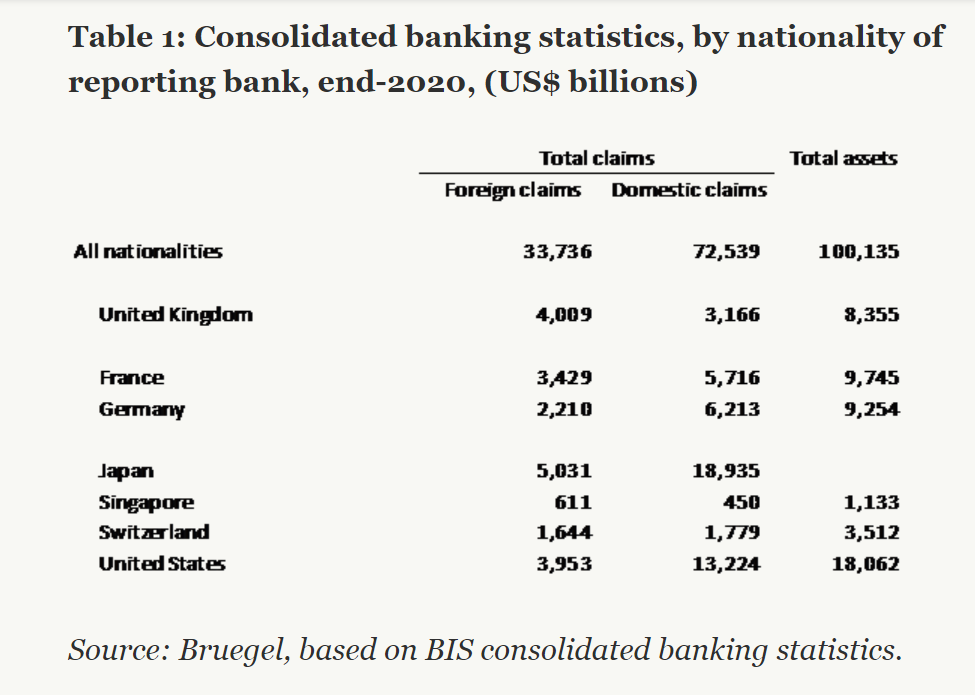
Alexander Lehman explains that it’s the new post-Brexit financial regulation that has enabled the UK banks, despite their diminished stature, to remain (as of the end of 2020) the largest globally in terms of cross-border claims, and the second-most important in terms of foreign claims consolidated within the home base of internationally active banks. In particular:
- The UK’s adherence to international norms, crucially the Basel framework, is not in doubt;
- The UK’s new financial services law of April 2021 indicates that the Bank of England will need to take into account in its rulemaking the competitiveness of the UK financial markets;
- A future regulatory framework will be defined in such a way as to provide greater flexibility and ability to respond to changes in international markets;
- A further likely change in UK post-Brexit financial regulation will be a simplification of the regime for smaller banks.
Banks post-Brexit: regulatory divergence or parallel tracks?
By: Alexander Lehmann – Bruegel
Changing attitudes towards immigration
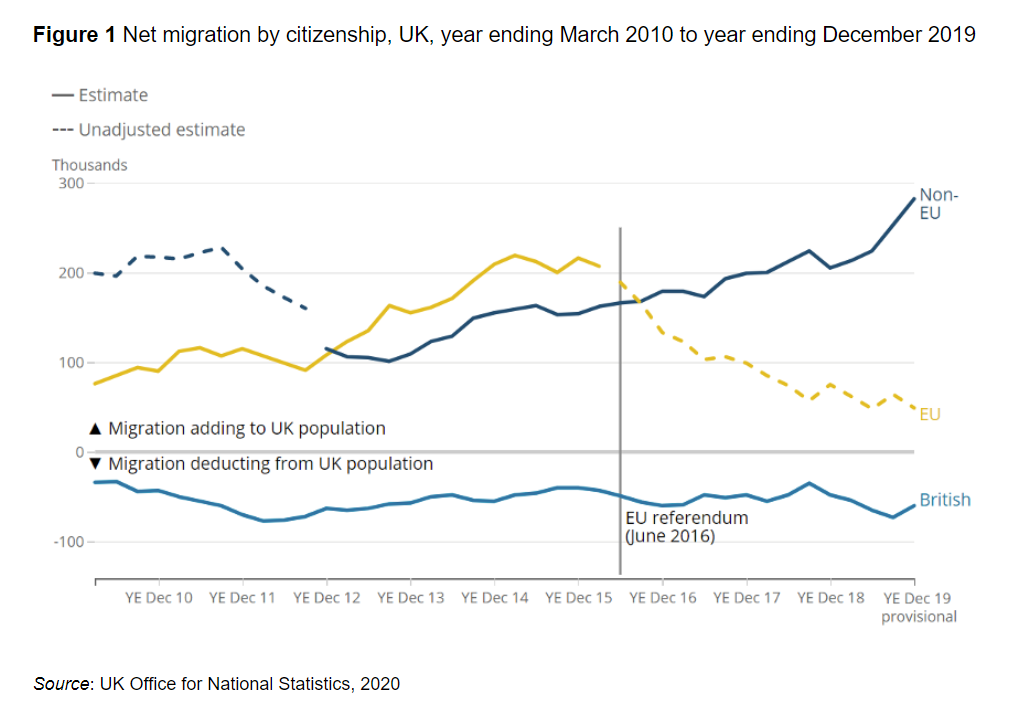
The UK’s post-Brexit migration system, argues Jonathan Portes, rebalances the system from one which was essentially laissez-faire for Europeans, while quite restrictionist for non-Europeans, to a uniform system that, on paper at least, has relatively simple and transparent criteria, and covers up to half the UK labor market. More specifically, the new proposals represent a considerable liberalization for non-EU migrants, with lower salary and skill thresholds, and no overall cap on numbers. On the other hand, control on EU migration will be significantly tighter when compared to free movement.
So considerable uncertainty remains. Nevertheless, while the overwhelming consensus amongst economists that Brexit – and in particular the ‘hard’ Brexit pursued by the UK government – will have significant negative impacts on trade and investment, and hence on the broader UK economy, there is much more cause for optimism about the impacts of the new post-Brexit UK immigration system.
Immigration and the UK economy after Brexit
By: Jonathan Portes – King’s College
