• Twitter
  • Search
e-axes

360° Econ View

The issues, the debates, and the research

  • Home
  • Useful Data
  • About
  • Contact
  • Home
  • Useful Data
  • About
  • Contact

India

What happened to India?

Posted by e-axes on January 15, 2020

Read Next →

India

Not all is well in India

India

India post-COVID

India

A Central Bank under attack

The economic problems

Duvvuri Subbarao explains why India’s growth has slumped to 5%. His main point is that growth has declined sharply because all growth drivers have petered out. Growth comes from private consumption, government consumption, investment and net exports:

  • The investment driver petered out some years ago as many projects got delayed or canceled because it became clear that they were based on a high-growth scenario, which was simply unrealistic;
  • Net exports used to contribute positively to growth, but they’re not doing so anymore. The global value chain model is eroding because of advances in machine learning, artificial intelligence and robotics. As a result, it will be difficult for India to replicate the China model of export-led growth;
  • Over the last five years, the single growth driver has been consumption, both government and private. Government is unable to expand spending further because of fiscal constraints. Private consumption has slumped because credit is being choked and households have run down their savings.

India’s Economy: When Will the Elephant Dance?
By: Duvvuri Subbarao, former governor of the Reserve Bank of India – University of Pennsylvania

The social problems

Balasubramanian and al., in this paper, describe the evolution of income inequality in India over the past couple of decades. They find that there has been a rapid increase in the top performing states in terms of per capita income since 2011 but the increase in inequality in urban India seems to be much higher than in rural areas.
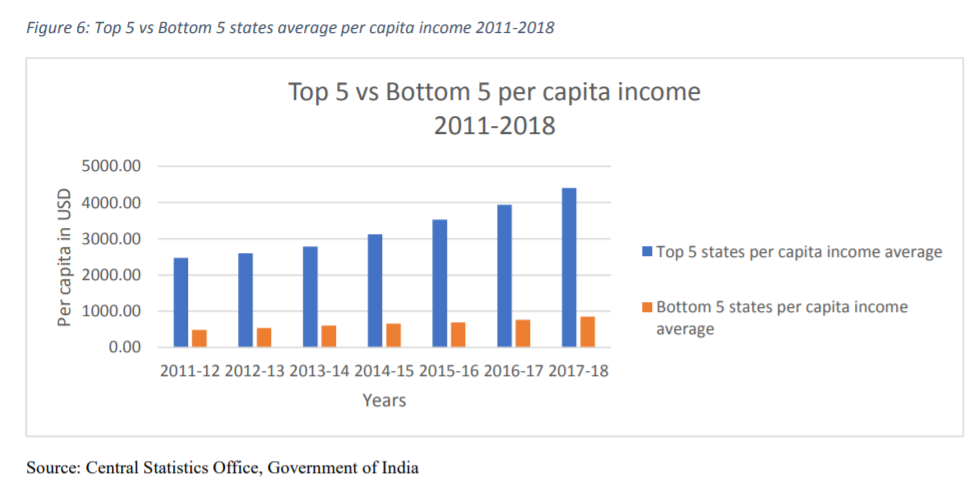

Inequality Dynamics amidst Rapid Growth: A Post Liberalization Indian Perspective
Authors: Sriram Balasubramanian, Rishabh Kumar, Prakash Loungani
From: IMF, California State University-San Bernardino

The political problems

Shashi Tharoor analyzes the political trends that have contributed to India’s current predicament. Five of them are:

  • The deepening of democracy which enabled the former underclass to become a potent political force;
  • The backlash against cultural globalization;
  • A revolt against the political insider class;
  • The liberalization of the statist Indian economy which empowered an increasingly wealthy business community;
  • The majority of India’s population (65%) are under 35, and young Indians are impatient for change and progress, tired of the old politics.

What Happened to India?
By: Shashi Tharoor – Indian National Congress

Print Friendly, PDF & Email

e-axes

Read Next →

India

Not all is well in India

India

India post-COVID

India

A Central Bank under attack

Comments are Closed

Account

  • Login

Subscriptions

You are not logged in.
Login
Subscribe

Subscriptions

Subscribe

Most Read

  • Bank Heterogeneity and the Transmission of Monetary Tightening
  • Central Bank Losses and Public Debt: Constraints on Inflation Control
  • AI Valuations, Capital Investment, and Growth
  • How Firms’ Cost Expectations Shape Prices
  • Communicating Uncertainty: Fan Charts, Confidence, and Credibility
  • The AI Infrastructure Boom: Productive Investment or Financial Fragility?
  • Macroeconomic Risk: From Scenario Synthesis to Distributional Transmission
  • Measuring Expectations in Real Time: The Value and Limits of Kalshi Markets
  • Measuring Global Tensions Using AI
  • When Markets Drift from the Real Economy

Sections

  • AI
  • Banking
  • Books
  • Brexit
  • CBDC
  • China
  • Climate
  • COVID-19
  • Crypto
  • Demographics
  • Economic Growth
  • Economic Science
  • Economics of Information
  • Emerging Markets
  • Eurozone
  • Financial Markets
  • Geoeconomics
  • Geopolitics
  • India
  • Inequality
  • Inflation
  • International Economics
  • Macro
  • Markets
  • Monetary Policy
  • Oil
  • Politics & Economics
  • Taxation
  • Tech
  • Trade
  • U.S.
  • Ukraine-Russia War
  • Uncategorized
  • Useful Data

© 2026 e-axes

  • Privacy Policy & Terms of Service

Theme by Anders Norén

This website uses cookies to improve your experience. We'll assume you're ok with this, but you can opt-out if you wish.
Cookie settingsAccept
Privacy & Cookies Policy

Privacy Overview

This website uses cookies to improve your experience while you navigate through the website. Out of these cookies, the cookies that are categorized as necessary are stored on your browser as they are as essential for the working of basic functionalities of the website. We also use third-party cookies that help us analyze and understand how you use this website. These cookies will be stored in your browser only with your consent. You also have the option to opt-out of these cookies. But opting out of some of these cookies may have an effect on your browsing experience.
Necessary
Always Enabled
Necessary cookies are absolutely essential for the website to function properly. This category only includes cookies that ensures basic functionalities and security features of the website. These cookies do not store any personal information.
SAVE & ACCEPT