America’s fiscal inflection point
In this paper, Alan J. Auerbach and William Gale project federal finances through 2054 using three baseline scenarios:
-
March 2025 Baseline: Pre-OBBBA (One Big Beautiful Bill Act) Congressional Budget Office long-term projections following current law
-
July 2025 Baseline: Incorporates the OBBBA as legislated
-
Current Policy Baseline: Assumes temporary OBBBA provisions (tax cuts on tips, overtime, seniors, car loans; military and border security spending increases) are made permanent
Findings
- Debt trajectory: Under OBBBA as legislated, debt-to-GDP rises to 183% by 2054 (vs. 154% pre-OBBBA); if temporary provisions become permanent, debt reaches 199%, or 233% with interest rate feedback effects
- Fiscal adjustment required: Stabilizing debt at 2024 levels requires immediate cuts/tax increases of 2.87% of GDP under current law, or 3.43% if OBBBA is extended—equivalent to 34% of income tax revenues or 14% of non-interest spending
- Spending dynamics: Net interest and entitlements (Social Security, Medicare) will consume all spending growth over 30 years; defense falls to lowest share since WWII; all other programs collectively shrink.
Economic impact: Projected debt increase from 100% to 200% of GDP would reduce annual growth by 1-2 percentage points and lower cumulative GDP by 30-60% by 2054.
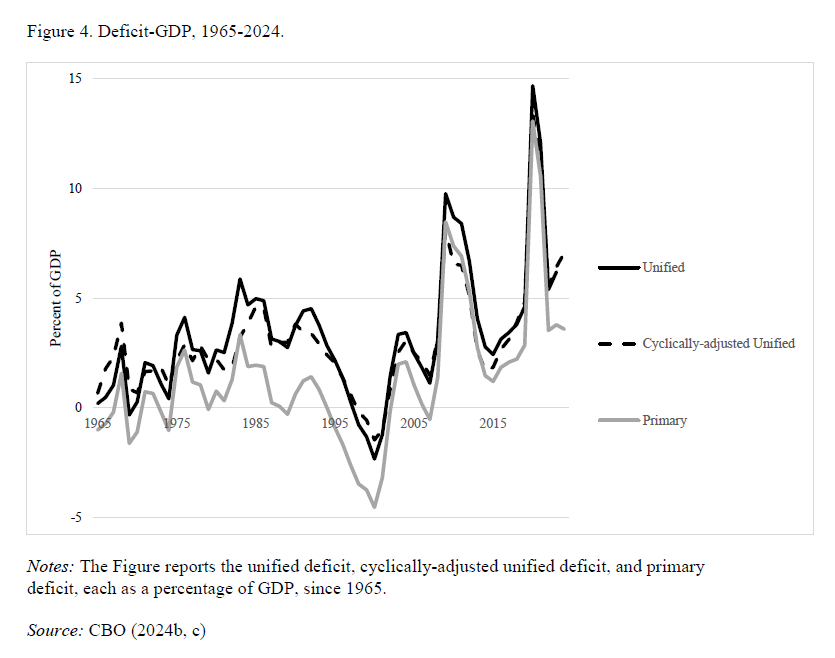
Then and Now: A Look Back and Ahead at the Federal Budget
Authors: Alan J. Auerbach, William Gale
From: University of California, Berkeley, The Brookings Institution
How America’s debt crisis will resolve
With US debt at 99% of GDP and projected to reach 107% by 2027 (surpassing the WWII record), the debt path shows “ever-upward” trajectory i.e. the definition of unsustainability. Invoking Herb Stein’s Law (“If something cannot go on forever, it will stop”), Jeffrey Frankel examines six possible ways the debt crisis could be resolved.
1. Faster economic growth ❌ – Unlikely
- Traditional “rosy scenario” claim that tax cuts will boost growth and revenues has never materialized
- US labor force is now shrinking due to lower birth rates, retiring baby boomers, immigration restrictions, and deportations
- Immigration restrictions worsen debt sustainability (immigrants are net contributors to Social Security and Medicare; ironically, undocumented workers pay payroll taxes but fear claiming benefits)
- AI boom might raise CBO’s 1.6% long-term growth estimate to 2.0%, but tech stock valuations likely contain bubble component
2. Near-zero interest rates ❌ – Not Coming Back
- During the period between 2008 and 2020 interest rates were very low and as a result interest payments were only 2.4% of GDP in 2020
- Interest payments are now at 3.8% of GDP, the second-largest spending category after Social Security, exceeding Medicare, defense, and non-defense discretionary spending
- Zero rates are gone permanently
3. Default ⚠️ – Possible but catastrophic
- US creditworthiness has already been downgraded and Treasury securities are losing safe-haven status
- Trump’s “Liberation Day” market reaction was a warning sign
- Trump’s business history of defaults/debt renegotiations raises concerns
- Some proposals floated: charging foreign central banks “user fees,” taxing foreign investment, forcing foreign central banks into 100-year zero-coupon bonds (essentially a debt restructuring/default)
- Conventional wisdom that countries borrowing in own currency can’t default may not hold because investors could curtail this privilege
4. Inflation⚠️ – Technically feasible but damaging
- Government can “print money” to inflate away real debt value (as Continental Congress did during Revolution)
- Inflation reduced debt/GDP slightly in 2022 but going forward, this would be “as bad a solution as explicit default”
5. Financial repression ⚠️ – Undemocratic but under discussion
- Common in developing countries: heavy-handed regulation forcing domestic banks to buy government bonds at artificially low rates, plus capital controls
- Trump associates have discussed variants (see point 3 above)
- “Pretty drastic step,” essentially equivalent to default
6. Extreme fiscal austerity ⚠️ – Most likely long-term, but requires a crisis
- The Math: Assuming 5% nominal growth (2% real + 3% inflation) and 5% interest rates, US must eliminate its entire primary deficit, currently over 3% of GDP after Trump’s 2017 tax cut extension
- Requires eliminating: Almost all defense spending OR almost all non-defense discretionary spending
- Political gridlock: Democrats won’t cut programs knowing Republicans will use savings for tax cuts; Republicans won’t raise taxes or cut Social Security/Medicare
- Historical precedent: Clinton achieved surpluses (1998-2000) via tax increases + spending restraint + PAYGO rules, but Bush immediately reversed course in 2001
- Frankel concludes: “It will probably take a serious fiscal crisis to jolt the American system into making the necessary reforms.”
How will unsustainable US debt end?
By: Jeffrey Frankel – Harvard University