
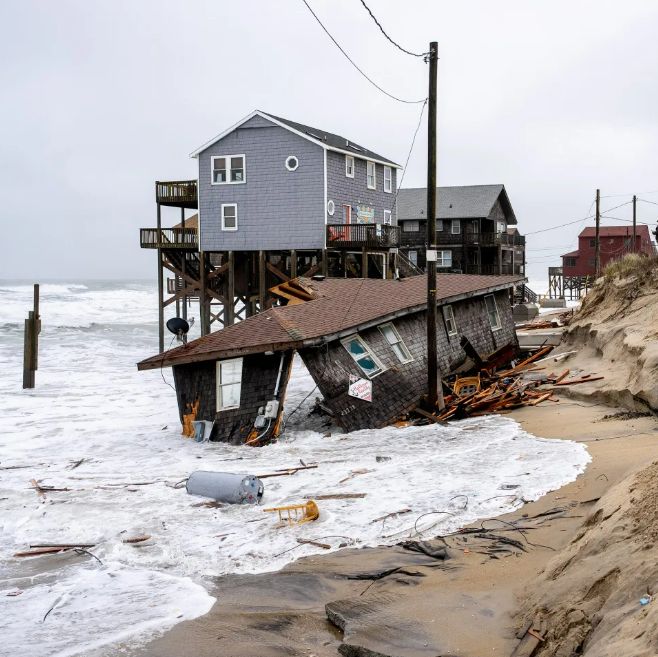


Local vs non local banks and natural disaster recovery
Justin Gallagher and Daniel Hartley investigate the impact of local banking concentration on credit allocation and economic recovery following natural disasters in the U.S. The authors use a county-level panel dataset from 1980 to 2014, which includes data on state-level Presidential Disaster Declarations, federal disaster assistance, and private sector lending. The primary sources include the Home Mortgage Disclosure Act (HMDA) for home loans, and the Federal Deposit Insurance Corporation (FDIC) for bank deposits. Finally, Gallagher and Hartley use a difference-in-differences model to estimate the impact of natural disasters on credit allocation and economic outcomes.
Key findings
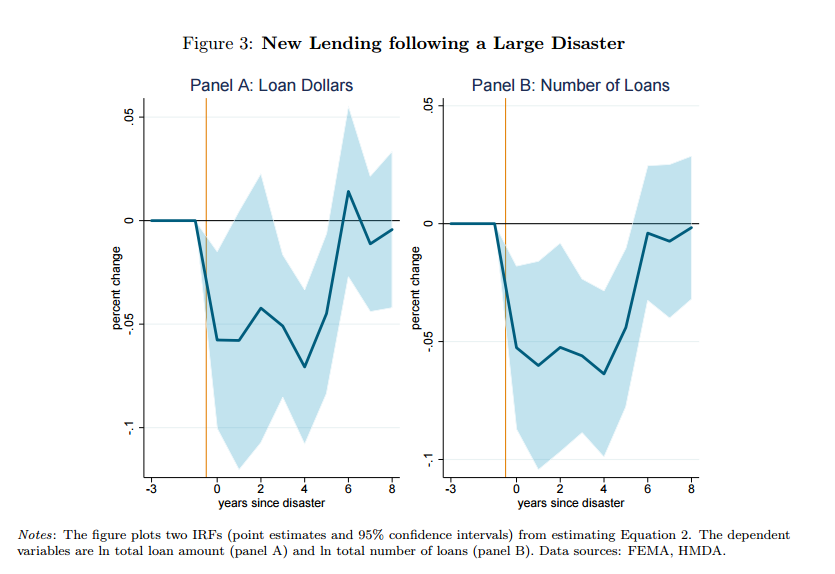
- Impact of Local Banking on Credit Allocation: The paper finds that regions with a higher concentration of local banks allocate less new credit following a natural disaster compared to regions with more non-local banks. This reduction in credit is more pronounced for low-income individuals.
- Economic Recovery: Counties with a higher share of local banking experience weaker economic recovery post-disaster. This is reflected in lower levels of new credit, which can impede long-term economic redevelopment. On the other hand, non-local banks, due to their larger capacity and geographic diversification, are better positioned to provide necessary credit following disasters, contributing to more robust economic recovery.
- Theoretical Framework: The authors discuss three main predictions regarding local banks: they have less capacity to lend due to limited geographic diversification, a greater incentive to lend to support local recovery, and an informational advantage in assessing local credit risk. However, the capacity constraint appears to dominate, leading to less credit provision in regions with more local banking.
Natural Disasters, Local Bank Market Share, and Economic Recovery
Authors: Justin Gallagher , Daniel Hartley
From: Federal Reserve Bank of Chicago
Bank competition and natural disaster recovery
In this paper, Kim et al. explore how competition among banks influences their strategic adaptation to climate risks, particularly in the context of limited regulatory oversight. The authors focus on how banks learn about and respond to climate risks, using the aftermath of Hurricane Harvey as a case study. They used confidential supervisory data on home equity lines of credit, combined with high-resolution flood risk projections, to analyze how banks updated their risk models following Hurricane Harvey. The study employed a difference-in-differences approach to identify changes in banks’ risk assessments and lending behaviors, focusing on areas outside the direct impact of the hurricane to isolate learning effects from local economic shocks.
Key Findings
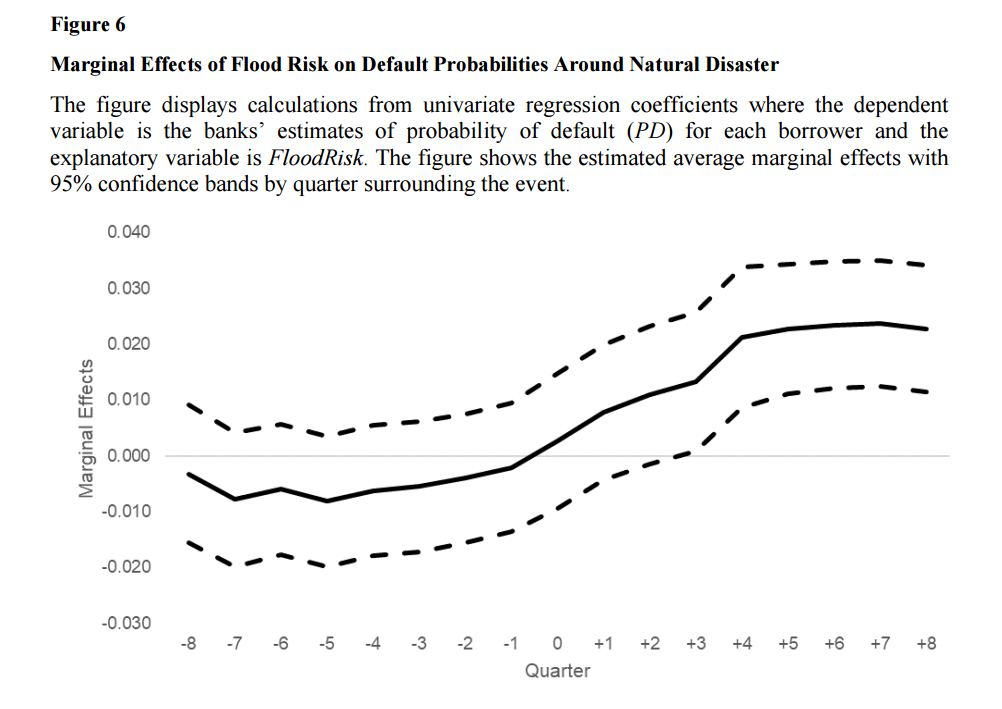
- Heterogeneous Learning and Adaptation: Banks exhibit different levels of learning about climate risks, which affects their adaptation strategies. Banks with greater exposure to Hurricane Harvey were more likely to update their internal risk models to account for future flood risks, even in areas not directly affected by the hurricane. This suggests that banks with more exposure had informational advantages that informed their risk assessments.
- Impact of Competition: The study finds that competition influences banks’ adaptation behaviors. In less competitive markets, banks with higher exposure to Hurricane Harvey reduced lending in areas with higher flood risks. However, in more competitive markets, these banks were less likely to adapt, suggesting that competitive pressures may encourage risk-taking over risk mitigation.
- Strategic Complementarity: The adaptation behavior of banks is influenced by the actions of their competitors. Banks are more likely to adapt when their competitors also adapt, indicating a strategic complementarity. This suggests that banks may be less concerned about losing market share if they expect their competitors to also reduce risky lending.
- Policy implications: Kim et al. suggest that policy measures should consider both microprudential and macroprudential aspects, as the adaptation strategies of individual banks can have broader systemic implications.
Bank Competition and Strategic Adaptation to Climate Change
Authors: Dasol Kim, Luke M. Olson, Toan Phan
From: Office of Financial Research, Federal Reserve Bank of Richmond
