Energy prices and their impact on inflation expectations – Germany
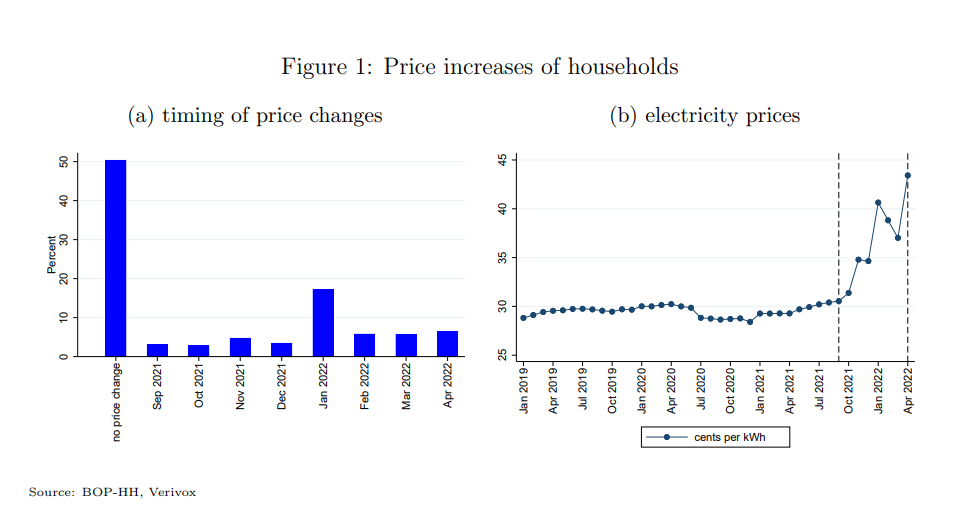
In this paper, Nils Wehrhöfer investigates the impact of energy price increases on the inflation expectations of both households and firms in Germany. The author uses two monthly panel survey data sets, the Bundesbank Online Panel Households (BOP-HH) and the Bundesbank Online Panel Firms (BOP-F), and employs a difference-in-difference approach to compare households and firms that experience a price change with households and firms that have not experienced a price change yet. The key findings of the paper are as follows:
- Households’ Inflation Expectations: Households generally increase their inflation expectations when they experience a rise in their personal electricity prices. This behavior is not consistent with full-information rational expectations, suggesting that households are extrapolating their personal experiences to the broader economy. The effect is particularly pronounced among low-income households, those who are less informed about past inflation, and those with lower trust in the European Central Bank (ECB). As a result of extrapolating from personal experience, households’ inflation forecasts become less accurate and diverge more from professional forecasts.
- Firms’ Inflation Expectations: In contrast to households, firms do not adjust their inflation expectations when they experience increases in energy prices. Firms’ decision-makers form their expectations in a manner similar to high-income households, which suggests that they do not extrapolate firm-specific energy price shocks to the aggregate economy. Firms do expect to pass on some of the energy price increases to their own prices, indicating a response to the cost shock but not an adjustment in their inflation expectations.


Energy prices and inflation expectations: Evidence from households and firms
Author: Nils Wehrhöfer
From: Deutsche Bundesbank
Energy prices and their impact on inflation expectations – Euro Area
Similarly to the Nils Wehrhöfer’s paper above, Paula Patzelt and Ricardo Reis in this paper are exploring the relationship between energy prices, specifically electricity prices, and households’ inflation expectations. Using Euro Area data on expected inflation by households across different regions, genders, education levels, and income brackets, as well as data on energy costs across regions and sources they are able to quantify the impact of an increase in electricity prices on expected inflation. More specifically, they are using the recently-available Consumer Expectations Survey (CES) for the EA, which has between 9,000 and 22,000 monthly respondents across 11 countries between 2020:4 and 2023:12. Patzelt and Reis find:
- Impact of Electricity Prices on Expected Inflation: The authors find that a 1% increase in electricity prices leads to a rise in households’ average expected inflation by 0.96 to 1.30 basis points (bps). This effect is observed to grow until 10 to 12 months after the shock, indicating a lasting impact of energy price changes on inflation expectations.
- Role of Unanchored Expectations: Patzelt and Reis highlight the significance of unanchored inflation expectations in amplifying the effect of energy price shocks. When inflation expectations are less well anchored, as observed between 2021 and 2023, a 1% rise in electricity prices increases expected inflation by an additional 0.22 to 1.61 bps. This finding underscores the importance of central banks’ efforts to keep inflation expectations well anchored.
- Contribution to the Rise in Expected Inflation in 2021-23: Despite the observed effects, the authors conclude that exogenous shocks to energy prices only account for a small share of the rise in expected inflation during the period of 2021-23. This suggests that other factors played a more significant role in driving inflation expectations during this time.
Estimating the rise in expected inflation from higher energy prices
Authors: Paula Patzelt, Ricardo Reis
From: LSE


