A survey of global capital allocation
In this paper, Florez-Orrego et al. analyze trends in international capital flows and their implications. Some of their findings include:
- International capital flows have risen substantially since the 1990s, driven by trade integration, financial development, and policies encouraging free capital mobility.
- Portfolio debt and equity flows now dominate foreign direct investment (FDI) flows. Equity and bond holdings are increasingly diversified across countries.
- There is still evidence of home bias. Investors underweight foreign assets relative to portfolio theory predictions. Home bias is more severe for equities than bonds.
- The trends have distributional consequences. Capital flows from emerging to advanced economies lower borrowing costs in advanced economies while increasing growth in emerging markets.
- The US dollar remains the dominant international funding currency, but the euro has gained share since its introduction. The Japanese yen, British pound, and Swiss franc also retain roles in funding.
- On the borrowing side, the US dollar makes up a large share of emerging market borrowing, while advanced economies rely more on their own currencies.
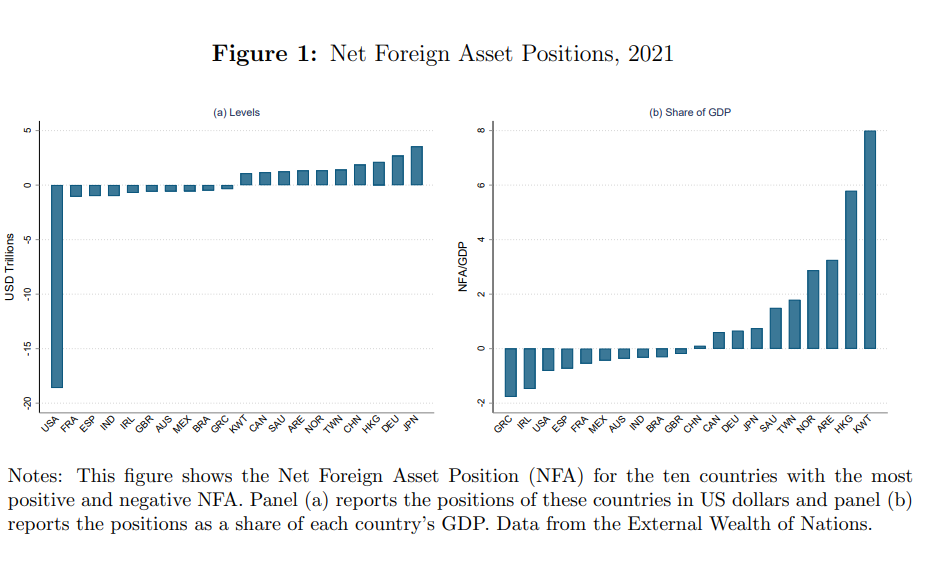
- The euro area and Japan are net lenders, while the US and UK alternate between borrowing and lending. Emerging markets have transitioned from borrowing to lending.
- Major destinations of investment flows are tax havens like Luxembourg, Ireland, Cayman Islands. Looking through tax havens to ultimate parents reveals more investment in emerging markets like China.
Global Capital Allocation
Authors: Sergio Florez-Orrego, Matteo Maggiori, Jesse Schreger, Ziwen Sun, Serdil Tinda
From: New York University Stern School of Business, Stanford University Graduate School of Business, Columbia Business School
Portfolio returns across countries
In this paper, Bertaut et al. examine how capital and returns are allocated globally. They use a highly disaggregated and confidential dataset obtained from the official reporting by investors (starting in 1995) that forms the backbone of the Treasury International Capital (TIC) data collection system. They match the securities information, which includes holdings, prices, dividends, and coupons, with a battery of firm-level measures, including TFPQ (Total Factor Productivity based on quantities, a measure of productivity growth), MRPK (Marginal Revenue Product of Capital, used to calculate markups), intangibles and financial wedges, which they estimate structurally using data from several accounting and financial datasets worldwide (Refinitiv, Global Compustat and Worldscope). They find:
- U.S. assets earn a positive excess portfolio return of 1.8 percent on average (from 1995-2000), which is mostly due to the composition of claims weighted toward equities. Portfolio equity returns are similar between claims and liabilities, while bond returns are lower for liabilities. This outperformance is explained by asset composition, with claims weighted toward higher-returning equities, while equity returns are similar across countries.
- A combination of TFPQ and MRPK and intangibles holds the largest out-of-sample predictive power for capital flows.
At the level of portfolio returns, we find that the excess return between U.S. claims and liabilities is positive and stable on average and is due the composition of claims which are tilted toward equities. The average portfolio equity returns are very similar across countries, while the bond returns are still lower for U.S. liabilities, albeit mostly vis-a-vis countries with high sovereign default risk. Exploiting the geographical dimension of our data we find that equity portfolio shares have increasingly shifted toward Asian firms, particularly so for those channeled through Caribbean centers.
The Global (Mis)Allocation of Capital
Authors: Carol Bertaut, Stephanie Curcuru, Ester Faia, Pierre Olivier Gourinchas
From: Federal Reserve Board, Goethe University Frankfurt, IMF


