• Twitter
  • Search
e-axes

360° Econ View

The issues, the debates, and the research

  • Home
  • Useful Data
  • About
  • Contact
  • Home
  • Useful Data
  • About
  • Contact

India

India post-COVID

Posted by e-axes on February 15, 2022

Read Next →

India

Not all is well in India

India

What happened to India?

India

A Central Bank under attack

Economic progress during the last ten years

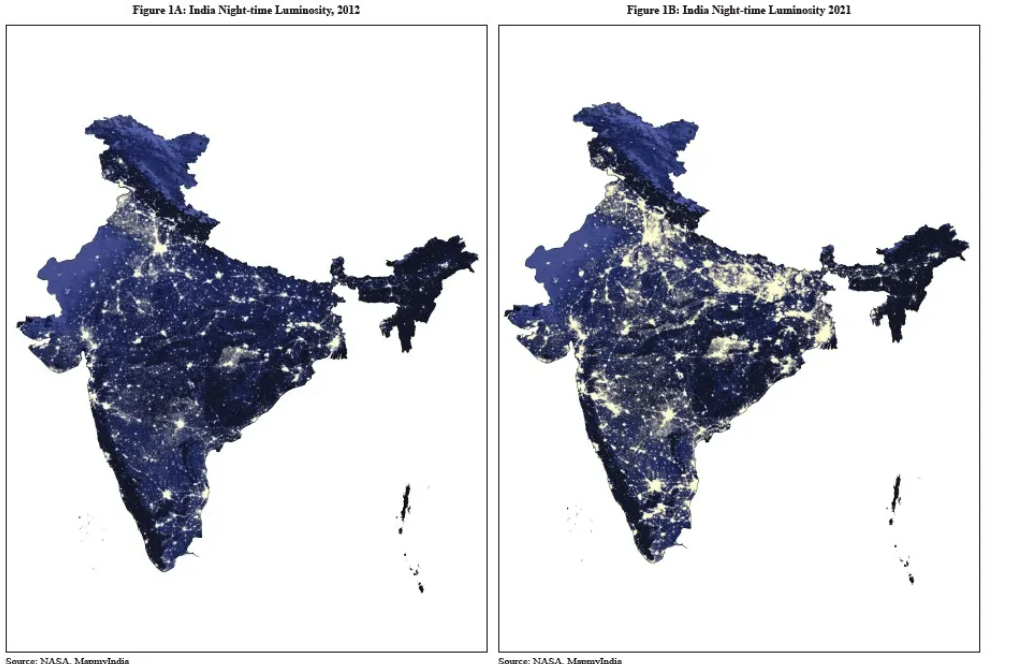
There are many concerns about Post-COVID India, but it is worth noting how much progress the Indian economy has made during the last ten years. Using satellite imagery to collect luminosity data in order to estimate economic development, is a method that allows economists not to solely rely upon government statistics.
The left-hand photo shows India in 2012; the right-hand photo is India nine years later in 2021. The spread of electric lighting  is clear.
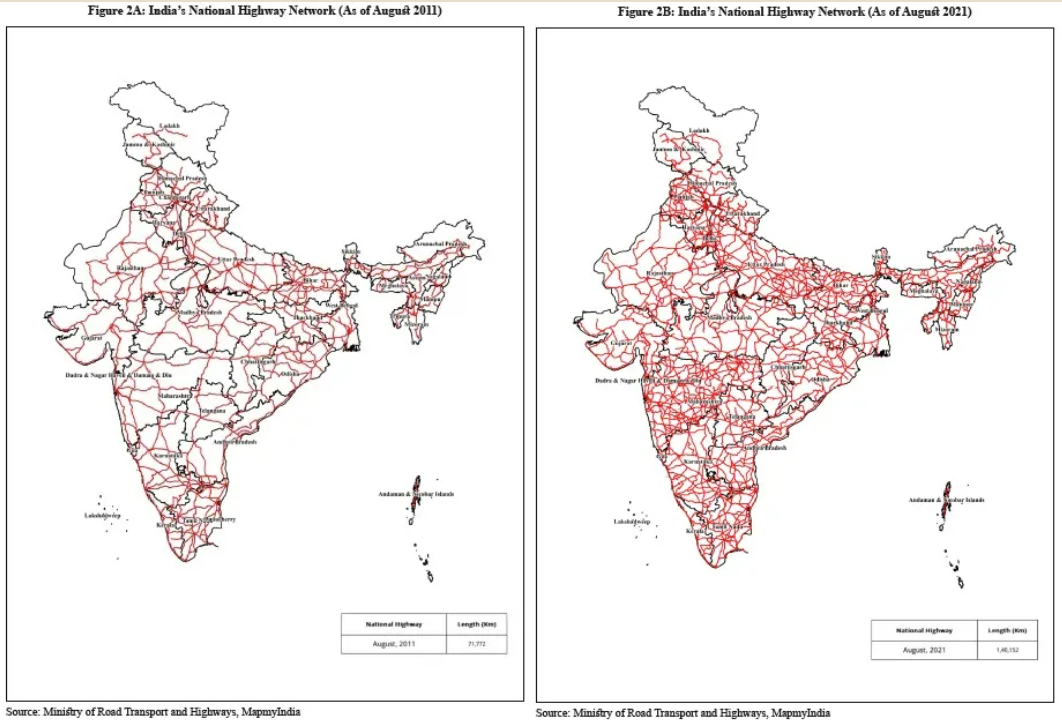
For India, even old maps provide another indication of how significant economic growth has been in India: below is a comparison of the extent of India’s national highway system, as the network doubled its road-miles from 10 years ago up to the present.

India’s Economy: The Satellite Photo Tour
By: Timothy Taylor – Journal of Economic Perspectives

India post-COVID

The current economic backdrop:

  • The National Statistics Office released the advance GDP estimates on January 7, 2022:  in the financial year 2021–22 , India’s GDP growth rate will be 9.2 percent. In 2020-2021 it was 7.3 percent. However, this growth estimate is lower than the 9.5 percent rate growth published by the Reserve Bank of India (RBI) in December 2021. The growth in nominal GDP is estimated to be 17.6 percent.
  • The RBI has kept policy rates at 4 percent. The reverse repo rate was kept unchanged at 3.35 percent to nudge commercial banks toward facilitating loan issuance. The RBI has not yet formally announced any “normalization” procedure.
  • Inflationary pressures are also mounting. In India, the wholesale price index (WPI) inflation rose to a record high of 14.32 percent in November 2021. The consumer price index (CPI) inflation is 4.91 percent, though that is still within RBI’s comfort zone of the inflation targeting framework of 4 percent (with a band of +/- 2).

Going forward:

Any attempt at fiscal consolidation at this juncture employing capital expenditure compression rather than tax buoyancy can adversely affect economic growth. Public investment—infrastructure investment in particular—is a major growth driver through “crowding-in” of private corporate investment.

If the growth rate does not stabilize around 9% or more, argues Shashi Tharoor, India risks creating a mass of young, poorly educated, unemployed, and angry people – the classic formula for social and political unrest. If the government’s economic incompetence continues, hopes of a demographic dividend may turn into a nightmare.
An accommodative fiscal stance is crucial for India
By: Lekha Chakraborty – National Institute of Public Finance and Policy, India
The Price of Modi’s Economic Incompetence
By: Shashi Tharoor – former UN under-secretary-general

Print Friendly, PDF & Email

e-axes

Read Next →

India

Not all is well in India

India

What happened to India?

India

A Central Bank under attack

Comments are Closed

Account

  • Login

Subscriptions

You are not logged in.
Login
Subscribe

Subscriptions

Subscribe

Most Read

  • Bank Heterogeneity and the Transmission of Monetary Tightening
  • Central Bank Losses and Public Debt: Constraints on Inflation Control
  • AI Valuations, Capital Investment, and Growth
  • How Firms’ Cost Expectations Shape Prices
  • Communicating Uncertainty: Fan Charts, Confidence, and Credibility
  • The AI Infrastructure Boom: Productive Investment or Financial Fragility?
  • Macroeconomic Risk: From Scenario Synthesis to Distributional Transmission
  • Measuring Expectations in Real Time: The Value and Limits of Kalshi Markets
  • Measuring Global Tensions Using AI
  • When Markets Drift from the Real Economy

Sections

  • AI
  • Banking
  • Books
  • Brexit
  • CBDC
  • China
  • Climate
  • COVID-19
  • Crypto
  • Demographics
  • Economic Growth
  • Economic Science
  • Economics of Information
  • Emerging Markets
  • Eurozone
  • Financial Markets
  • Geoeconomics
  • Geopolitics
  • India
  • Inequality
  • Inflation
  • International Economics
  • Macro
  • Markets
  • Monetary Policy
  • Oil
  • Politics & Economics
  • Taxation
  • Tech
  • Trade
  • U.S.
  • Ukraine-Russia War
  • Uncategorized
  • Useful Data

© 2026 e-axes

  • Privacy Policy & Terms of Service

Theme by Anders Norén

This website uses cookies to improve your experience. We'll assume you're ok with this, but you can opt-out if you wish.
Cookie settingsAccept
Privacy & Cookies Policy

Privacy Overview

This website uses cookies to improve your experience while you navigate through the website. Out of these cookies, the cookies that are categorized as necessary are stored on your browser as they are as essential for the working of basic functionalities of the website. We also use third-party cookies that help us analyze and understand how you use this website. These cookies will be stored in your browser only with your consent. You also have the option to opt-out of these cookies. But opting out of some of these cookies may have an effect on your browsing experience.
Necessary
Always Enabled
Necessary cookies are absolutely essential for the website to function properly. This category only includes cookies that ensures basic functionalities and security features of the website. These cookies do not store any personal information.
SAVE & ACCEPT