• Twitter
  • Search
e-axes

360° Econ View

The issues, the debates, and the research

  • Home
  • Useful Data
  • About
  • Contact
  • Home
  • Useful Data
  • About
  • Contact

Eurozone

Will the NGEU funds be effective?

Posted by e-axes on November 10, 2021

Read Next →

Eurozone

Why Firms Choose the U.S. And What Europe Could Do About It

Eurozone

Europe After the American Umbrella: A New Policy Agenda

Eurozone

From Open Markets to Strategic Scale: Rethinking Europe’s Growth Model

What can history teach us?

The Next Generation EU (NGEU) funds, agreed upon in July 2021, is a package of funds which, through a combination of grants and loans, aims to support the recovery from the COVID-19 pandemic and foster investments leading to a greener, digital economy. Will this effort be successful?
In this paper, Canova and Pappa, use an equilibrium model of a monetary union featuring endogenous growth and externalities in order to highlight the main transmission channels EU funds have to a typical European region. They look at the impact of older funds such as the European Regional Development Fund (ERDF) launched to foster innovation and research, to favor the digital agenda, and to support small and medium-sized enterprises; and the European Social Fund (ESF), whose aim was to support investments in education and health, and to fight poverty.  It should be noted that the NGEU funds combine features of  both ERDF and ESF. They find that:

  • The macroeconomic effects of the ERDF are less persistent than those of ESF;
  • Regional dynamic responses are heterogeneous and country specific features, location, tenure in the EU, and level of development are, in part, responsible for these differences;
  • In response to the programs, lower income, peripheral, and newly tenured regions of the EU do not take full advantage of the funds and underperform in terms of recovery and transformation.

What do these findings imply for the success of the NGEU funds?

[The] NGEU funds will not have uniform effects, nor help, in particular, those who currently lag most behind. In these regions the recovery and the transformation process may not happen, even if a larger amount of funds is channeled to them, perhaps because of government inefficiencies, lack of medium term planning, shortage of entrepreneurship, or low average level of education and of skills. Thus, the threat that income polarization and regional inequalities will increase, and the ”recovery and transformation” process will be a multi-gear one is not trivial, unless important social transformations will take place correcting for these distortions.


What are the likely macroeconomic effects of the EU Recovery plan?
Authors: Fabio Canova, Evi Pappa
From: Norwegian Business School, Universidad Carlos III

How to boost the effectiveness of the NGEU funds?

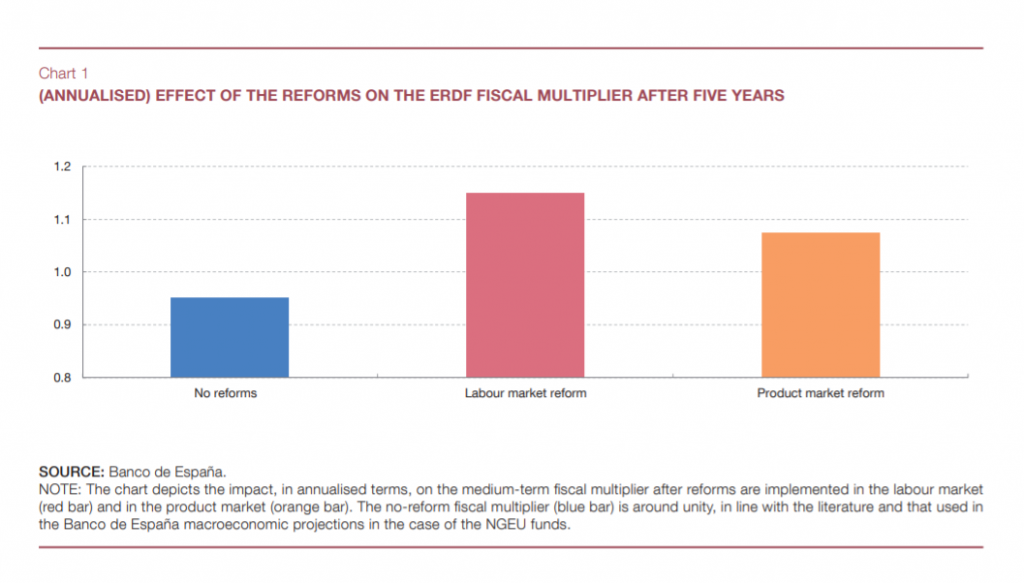
Albrizio and Geli examine the extent to which differences in the level of labor and product market rigidity impact the fiscal multipliers of different countries in the EU. They too look at how the European Regional Development Fund (ERDF) impacted growth in European countries. They find that:

  • The regulatory framework at least partly determines the size of the European funds’ fiscal multiplier;
  • More flexible labor and product market regulation could continuously increase the size of the multiplier.

An Empirical Analysis of the Determinants that can Boost Next Generation EU’s Effectiveness
Authors: Silvia Albrizio and José Federico Geli
From: Banco de España

Print Friendly, PDF & Email

e-axes

Read Next →

Eurozone

Why Firms Choose the U.S. And What Europe Could Do About It

Eurozone

Europe After the American Umbrella: A New Policy Agenda

Eurozone

From Open Markets to Strategic Scale: Rethinking Europe’s Growth Model

Comments are Closed

Account

  • Login

Subscriptions

You are not logged in.
Login
Subscribe

Subscriptions

Subscribe

Most Read

  • Public Debt Maturity and Macroeconomic Policy Transmission
  • Bank Heterogeneity and the Transmission of Monetary Tightening
  • AI Valuations, Capital Investment, and Growth
  • New and Noteworthy Books in Economics (September)
  • AI and the Natural Rate: Puzzle or Policy Challenge?
  • Macroeconomic Risk: From Scenario Synthesis to Distributional Transmission
  • Communicating Uncertainty: Fan Charts, Confidence, and Credibility
  • Transfers, Taxes, and the Ricardian Equivalence
  • Can Institutions Limit the Economic Damage of Populism?
  • Asia’s Expanding Non-Dollar Payment Networks

Sections

  • AI
  • Banking
  • Books
  • Brexit
  • CBDC
  • China
  • Climate
  • COVID-19
  • Crypto
  • Demographics
  • Economic Growth
  • Economic Science
  • Economics of Information
  • Emerging Markets
  • Eurozone
  • Financial Markets
  • Geoeconomics
  • Geopolitics
  • India
  • Inequality
  • Inflation
  • International Economics
  • Macro
  • Markets
  • Monetary Policy
  • Oil
  • Politics & Economics
  • Taxation
  • Tech
  • Trade
  • U.S.
  • Ukraine-Russia War
  • Uncategorized
  • Useful Data

© 2026 e-axes

  • Privacy Policy & Terms of Service

Theme by Anders Norén

This website uses cookies to improve your experience. We'll assume you're ok with this, but you can opt-out if you wish.
Cookie settingsAccept
Privacy & Cookies Policy

Privacy Overview

This website uses cookies to improve your experience while you navigate through the website. Out of these cookies, the cookies that are categorized as necessary are stored on your browser as they are as essential for the working of basic functionalities of the website. We also use third-party cookies that help us analyze and understand how you use this website. These cookies will be stored in your browser only with your consent. You also have the option to opt-out of these cookies. But opting out of some of these cookies may have an effect on your browsing experience.
Necessary
Always Enabled
Necessary cookies are absolutely essential for the website to function properly. This category only includes cookies that ensures basic functionalities and security features of the website. These cookies do not store any personal information.
SAVE & ACCEPT