• Twitter
  • Search
e-axes

360° Econ View

The issues, the debates, and the research

  • Home
  • Useful Data
  • About
  • Contact
  • Home
  • Useful Data
  • About
  • Contact

Inequality

Why doesn’t the US have a European-style safety net?

Posted by e-axes on June 10, 2020

Read Next →

Inequality

Rethinking the Fight Against Inequality

Inequality

Are Billionaires Paying Taxes in France and the US?

Inequality

Urban Job Ladders and Market Power: Dual Engines of Inequality


Political Economics
By: IGM Forum – University of Chicago

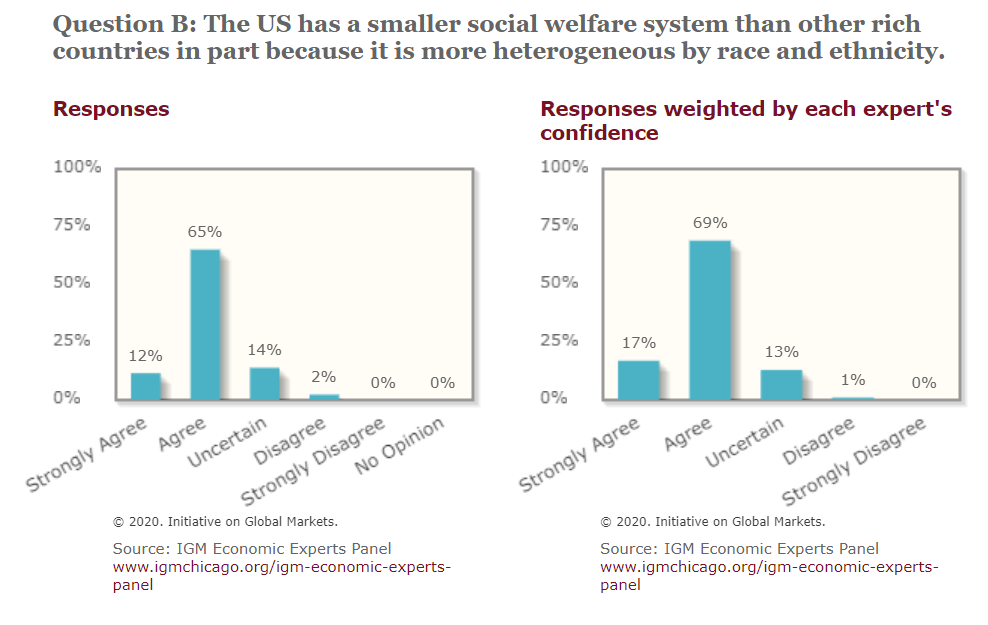
Racism is the main reason why the US has a weak safety net

In this 2001 paper, Alesina and Glaeser are examining why the U.S. doesn’t have the generous welfare benefits of advanced countries in Europe. They conclude that there are two factors explaining the difference:

  • U.S. institutions were designed much earlier than their modern European equivalents, and are thus more oriented toward protecting private property above all else;
  • “Within the US, race is the single most important predictor of support for welfare. America’s troubled race relations are clearly a major reason for the absence of an American welfare state.”

Why doesn’t the US have a European-style welfare state?
Authors: Alberto Alesina, Edward Glaeser, Bruce Sacerdote
From: Harvard University, Dartmouth College

Easy access to credit has replaced the welfare system?

In this 2020 paper, Wiedemann and Wise make an interesting connection between the concept of “personal responsibility” and the growing reliance on credit among American families. This means that in the case of a financial emergency, people are likely to turn to high-interest credit under the belief that doing so is the “responsible option.” The authors use state-level observational data to show that when Americans believe that everyone can pay their own way, using credit if necessary, they are less inclined to support public spending.

They argue that the turn to credit for social welfare occurred in a period where structural changes in labor markets, rising inequality, and welfare reform coincided with a type of politics that portray those who rely on the welfare state as racial minorities lacking in personal responsibility.
The Politics of Personal Responsibility, Credit, and the American Welfare State
Authors: Andreas Wiedemann, Tess Wise
From: Princeton University, Amherst College

Print Friendly, PDF & Email

e-axes

Read Next →

Inequality

Rethinking the Fight Against Inequality

Inequality

Are Billionaires Paying Taxes in France and the US?

Inequality

Urban Job Ladders and Market Power: Dual Engines of Inequality

Comments are Closed

Account

  • Login

Subscriptions

You are not logged in.
Login
Subscribe

Subscriptions

Subscribe

Most Read

  • Bank Heterogeneity and the Transmission of Monetary Tightening
  • Central Bank Losses and Public Debt: Constraints on Inflation Control
  • AI Valuations, Capital Investment, and Growth
  • How Firms’ Cost Expectations Shape Prices
  • Communicating Uncertainty: Fan Charts, Confidence, and Credibility
  • The AI Infrastructure Boom: Productive Investment or Financial Fragility?
  • Macroeconomic Risk: From Scenario Synthesis to Distributional Transmission
  • Measuring Expectations in Real Time: The Value and Limits of Kalshi Markets
  • Measuring Global Tensions Using AI
  • When Markets Drift from the Real Economy

Sections

  • AI
  • Banking
  • Books
  • Brexit
  • CBDC
  • China
  • Climate
  • COVID-19
  • Crypto
  • Demographics
  • Economic Growth
  • Economic Science
  • Economics of Information
  • Emerging Markets
  • Eurozone
  • Financial Markets
  • Geoeconomics
  • Geopolitics
  • India
  • Inequality
  • Inflation
  • International Economics
  • Macro
  • Markets
  • Monetary Policy
  • Oil
  • Politics & Economics
  • Taxation
  • Tech
  • Trade
  • U.S.
  • Ukraine-Russia War
  • Uncategorized
  • Useful Data

© 2026 e-axes

  • Privacy Policy & Terms of Service

Theme by Anders Norén

This website uses cookies to improve your experience. We'll assume you're ok with this, but you can opt-out if you wish.
Cookie settingsAccept
Privacy & Cookies Policy

Privacy Overview

This website uses cookies to improve your experience while you navigate through the website. Out of these cookies, the cookies that are categorized as necessary are stored on your browser as they are as essential for the working of basic functionalities of the website. We also use third-party cookies that help us analyze and understand how you use this website. These cookies will be stored in your browser only with your consent. You also have the option to opt-out of these cookies. But opting out of some of these cookies may have an effect on your browsing experience.
Necessary
Always Enabled
Necessary cookies are absolutely essential for the website to function properly. This category only includes cookies that ensures basic functionalities and security features of the website. These cookies do not store any personal information.
SAVE & ACCEPT