


The reduced form approach
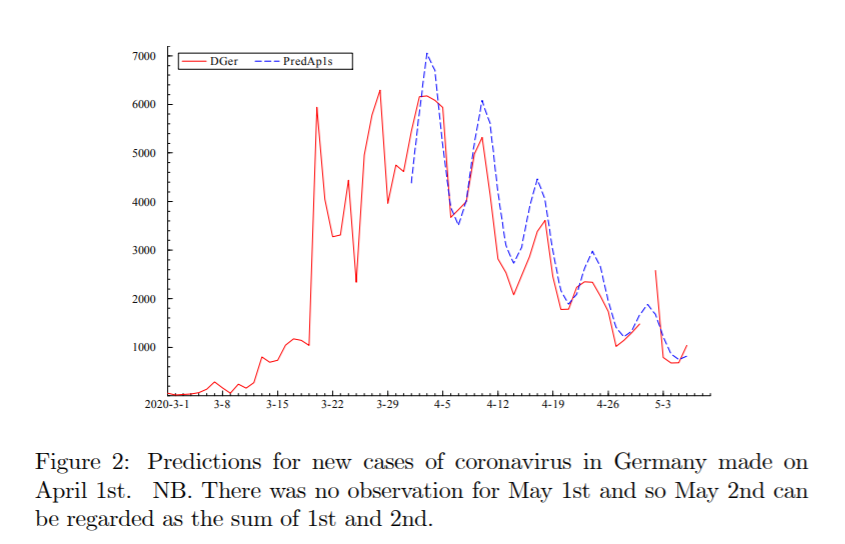
In this paper, Harvey and Kattuman, focus on Generalized Logistic growth curves and in particular the Gompertz model. The model’s application on COVID data showed that:
- The dynamic Gompertz can adapt to changing conditions and can be informative about the effect of interventions;
- The model turned out to be relevant for new cases and deaths in the UK and Germany;
- The dynamic Gompertz model was particularly impressive for German new COVID cases.
[W]e suggest that the possibility of a second wave can be monitored by tracking the filtered estimates of new cases or deaths given by our model. Of course, if these methods are to be useful in practice they require reliable up to date observations on new cases, preferably at a disaggregated level.
Time series models based on growth curves with applications to forecasting coronavirus
Authors: Andrew Harvey, Paul Kattuman
From: Cambridge University
Blending the structural and reduced-form approaches
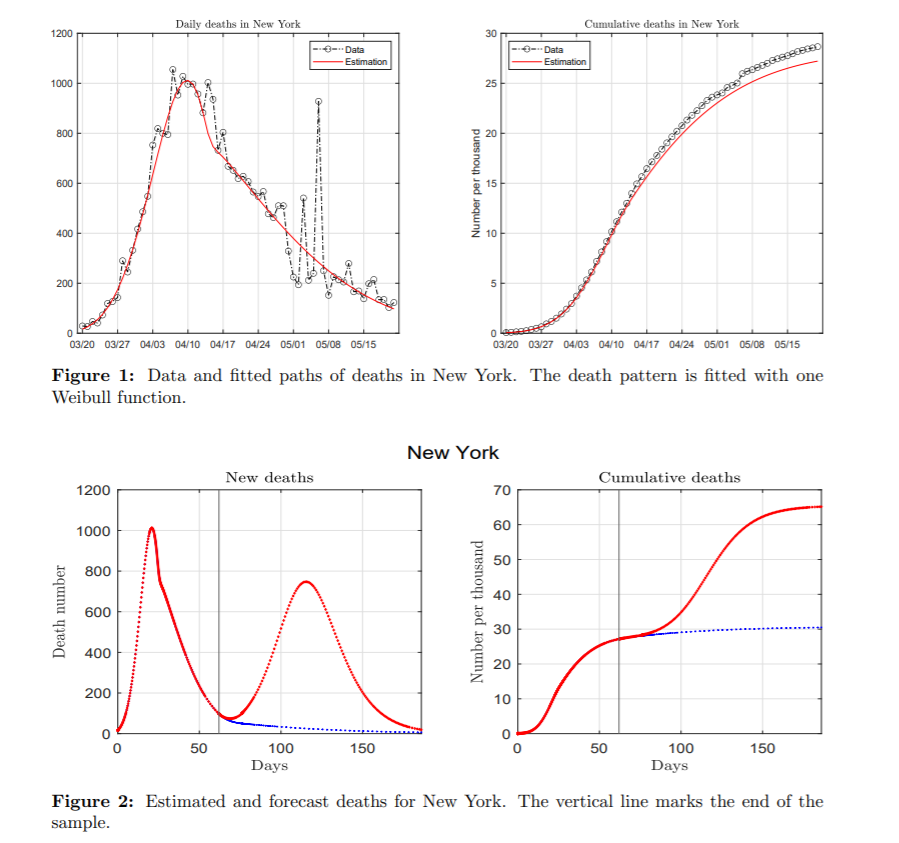
In this paper, Atkeson and al. present a procedure for estimating and forecasting disease scenarios for COVID-19 using a structural SIR model of the pandemic. They present forecast scenarios for a second wave of the pandemic as well as for a long and slow continuation of current levels of infections and daily deaths. In their counterfactual scenarios, they find that there is no clear answer to the question of whether earlier mitigation measures would have reduced the long run cumulative death toll from this disease. In some cases, they find that it would have, but in other cases, we find the opposite — earlier mitigation would have led to a higher long-run death toll.
They have estimated the model and used it to construct forecast and counterfactual scenarios for ten U.S. states and a number of other countries.
Estimating and Forecasting Disease Scenarios for Covid-19 with an Sir Model
Authors: Andrew Atkeson, Karen A. Kopecky, ao A. Zha
From: University of California, Los Angeles (UCLA), Federal Reserve Bank of Atlanta
