• Twitter
  • Search
e-axes

360° Econ View

The issues, the debates, and the research

  • Home
  • Useful Data
  • About
  • Contact
  • Home
  • Useful Data
  • About
  • Contact

Ukraine-Russia War

The ruble’s wild ride

Posted by e-axes on April 13, 2022

Read Next →

Ukraine-Russia War

The costs of war

Ukraine-Russia War

Russia and the global wheat market

Ukraine-Russia War

On the reconstruction of Ukraine

How the ruble’s depreciation was stemmed

As soon as the war started:

  • The Bank of Russia imposed strict capital controls, introduced a 30% commission (later reduced to 12%) on foreign-currency purchases, and hiked its key policy rate from 9.5% to 20%;
  • Russia’s government ordered all Russian exporters to repatriate and exchange 80% of their export revenues for rubles while various categories of buyers were banned from purchasing US dollars, and holders of foreign-currency-denominated bank deposits faced major constraints withdrawing their savings.

In the short term this swift policy response didn’t succeed in stemming the ruble’s depreciation: the official exchange rate moved from 81 rubles per dollar before the war to 139 per dollar on March 9. In addition, inflation accelerated substantially, with the growth rate of the official consumer price index rising to 2% per week. But today the ruble has returned to the 80-per-dollar range!

Today’s exchange rate indicates that Russia’s balance of payments is strongly supported by current oil prices, which implies that fiscal performance is holding up well, too. While the early sanctions froze much of Putin’s stock of cash, high oil prices have ensured substantial daily inflows.

The Incredible Bouncing Ruble
By: Sergei Guriev – SciencesPo

The Bank of Russia and its reserves

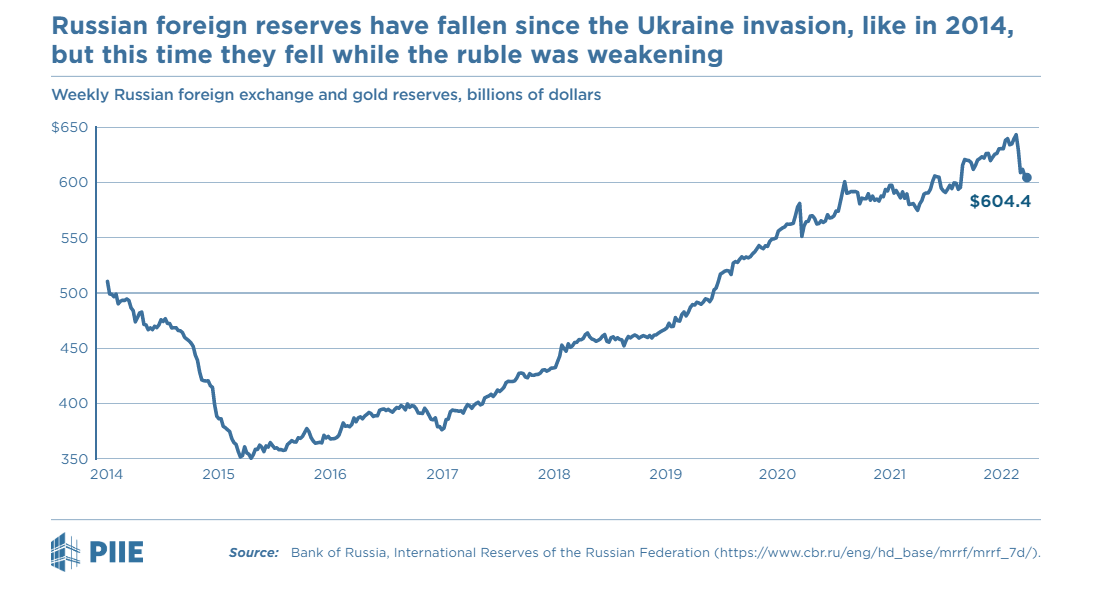
Patrick Honohan argues that the Bank of Russia resorted to incredible measures in order to stem and reverse the fall of the ruble because for Putin there is a symbolic political value of stabilizing the dollar value of the Russian currency. But what happened to the Bank’s reserves is unclear:

As soon as the fighting began, the Bank of Russia stopped publishing its weekly statistics on reserves. It was not immediately clear whether this bounce-back resulted from the bank using unsanctioned reserves in massive market intervention (as it had in similar circumstances during 2014). Last week, though, for unknown reasons the bank reversed course and started publishing reserves data again. Reserves have fallen about $40 billion since the eve of the war, but the weekly pattern of the fall is intriguing. Most of it occurred before March 4, while the ruble was still weakening. During the following three weeks, when the ruble recovered, the net fall in Russia’s reserves was less than $5 billion—less than 1 percent of the total.

Russia’s ruble actions are monetary theater of the absurd
By: Patrick Honohan – Peterson Institute

Sanctions and the demand for dollars

Itskhoki and Mukhin in this note argue that sanctions have also lowered demand for dollars, which are needed to purchase imported goods, thereby driving the ruble’s exchange rate upward. But that is not good news for Russia’s economy, which is bound to slow down.
Sanctions and the Exchange Rate
Authors: Oleg Itskhoki, Dmitry Mukhin
From: UCLA, LSE

Print Friendly, PDF & Email

e-axes

Read Next →

Ukraine-Russia War

The costs of war

Ukraine-Russia War

Russia and the global wheat market

Ukraine-Russia War

On the reconstruction of Ukraine

Comments are Closed

Account

  • Login

Subscriptions

You are not logged in.
Login
Subscribe

Subscriptions

Subscribe

Most Read

  • Public Debt Maturity and Macroeconomic Policy Transmission
  • Bank Heterogeneity and the Transmission of Monetary Tightening
  • AI, Knowledge and the Future of Human Expertise
  • AI Valuations, Capital Investment, and Growth
  • New and Noteworthy Books in Economics (September)
  • AI and the Natural Rate: Puzzle or Policy Challenge?
  • Macroeconomic Risk: From Scenario Synthesis to Distributional Transmission
  • Transfers, Taxes, and the Ricardian Equivalence
  • Can Institutions Limit the Economic Damage of Populism?
  • Asia’s Expanding Non-Dollar Payment Networks

Sections

  • AI
  • Banking
  • Books
  • Brexit
  • CBDC
  • China
  • Climate
  • COVID-19
  • Crypto
  • Demographics
  • Economic Growth
  • Economic Science
  • Economics of Information
  • Emerging Markets
  • Eurozone
  • Financial Markets
  • Geoeconomics
  • Geopolitics
  • India
  • Inequality
  • Inflation
  • International Economics
  • Macro
  • Markets
  • Monetary Policy
  • Oil
  • Politics & Economics
  • Taxation
  • Tech
  • Trade
  • U.S.
  • Ukraine-Russia War
  • Uncategorized
  • Useful Data

© 2026 e-axes

  • Privacy Policy & Terms of Service

Theme by Anders Norén

This website uses cookies to improve your experience. We'll assume you're ok with this, but you can opt-out if you wish.
Cookie settingsAccept
Privacy & Cookies Policy

Privacy Overview

This website uses cookies to improve your experience while you navigate through the website. Out of these cookies, the cookies that are categorized as necessary are stored on your browser as they are as essential for the working of basic functionalities of the website. We also use third-party cookies that help us analyze and understand how you use this website. These cookies will be stored in your browser only with your consent. You also have the option to opt-out of these cookies. But opting out of some of these cookies may have an effect on your browsing experience.
Necessary
Always Enabled
Necessary cookies are absolutely essential for the website to function properly. This category only includes cookies that ensures basic functionalities and security features of the website. These cookies do not store any personal information.
SAVE & ACCEPT